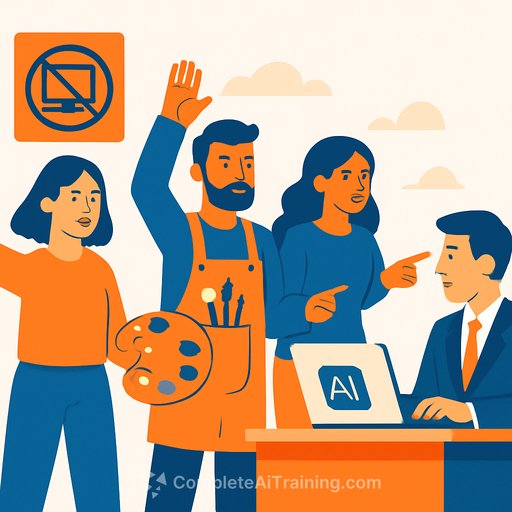
AI-Generated Images Spark Concern Among Newfoundland Artists
Emma Bishop, a St. John's-based artist, has noticed a surge in the use of AI-generated images by individuals and local businesses. As a traditional artist, she feels this trend threatens the livelihood of local creatives by replacing human-made designs with AI creations. To raise awareness, Bishop designed and posted signs around St. John's urging people to reconsider supporting AI art over local talent.
"I just want people to get encouraged to do their own research on why it might not be the best thing to use, and ... think again about maybe supporting a local artist," Bishop said.
Businesses Embrace AI, Sparking Debate
The Orange Store, a local convenience chain, recently faced backlash after using AI-generated images in Father's Day advertisements. Sandy Mercer, spokesperson for North Sun Energy, acknowledged the use of AI art in promotional materials, highlighting the company's interest in exploring innovative marketing ideas.
Bishop argues that AI-generated art takes away work from local artists, who already face limited opportunities in Newfoundland and Labrador. "It may be quicker and it may be more convenient, but I truly believe that using a local artist to make some of your art is just so much more beneficial for both people," she said.
She also points out that AI systems train on artists' work without consent. "Every time I post on Instagram, my art is feeding into an AI algorithm, and I can't stop that unfortunately," Bishop explained.
Environmental Costs of AI Art
Beyond artistic concerns, Bishop highlights environmental impacts tied to AI technology. Estimates suggest that a single AI-generated image consumes roughly as much power as charging a smartphone, while AI models require extensive cooling, often using significant water resources. She questions whether the convenience AI offers outweighs the environmental and community costs.
While AI is being used in climate change efforts, its own emissions remain a problem worth considering.
Is AI Art Crossing Ethical Lines?
Meghan Fitzgerald, director of Iceberg Gallery, which supports emerging artists in Newfoundland and Labrador, raises ethical questions about AI's use in art. She referenced a social media trend where users generated images of themselves in the style of the Studio Ghibli animation, spotlighting potential intellectual property issues.
"That is a very specific art style. It is very specific to that studio," Fitzgerald said. "That sparks the question of, is this a violation of intellectual property?"
Hayao Miyazaki, Studio Ghibli’s founder, has openly criticized AI, calling it "an insult to life itself" and refusing to integrate AI technology into his work.
Fitzgerald believes AI should be regulated, with artists compensated when their work influences AI-generated images used commercially. "This technology isn't going away. It's only going to get more sophisticated and more prevalent in our society," she said. "So we have to find a way to play nice with it instead of erasing it entirely."
Finding Balance Between AI and Artists
Bishop hopes for a future where artists can give consent before AI uses their work. "I think one day it can be used and I think one day it will be a great tool for artists to use. I just don't think we're there yet. And I think we need to talk about that," she added.
For creatives wanting to understand AI's impact and tools, exploring practical courses can offer insight into how AI works and how artists might engage with it responsibly. Resources like Complete AI Training offer courses that can help artists stay informed about AI developments.
Key Takeaways for Creatives
- AI-generated art is increasingly used by businesses but raises concerns about fairness and ethics.
- Local artists face lost opportunities as AI replaces human-made designs.
- AI training data often includes artists’ work without permission, raising intellectual property issues.
- Environmental costs of AI image generation should be considered alongside its benefits.
- Regulation and consent mechanisms are needed to protect artists in the AI era.
- Artists can benefit from learning about AI tools to engage with technology thoughtfully and protect their work.
Your membership also unlocks: