Mary Claire King on AI in Genetics: High Potential, High Stakes
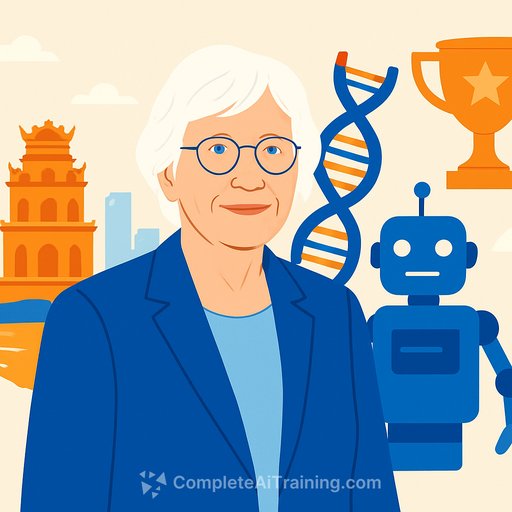
Professor Mary Claire King, who discovered the BRCA1 gene and opened the door to life-saving genetic testing for millions of women, has received the VinFuture 2025 Grand Prize for Female Scientists. During her visit to Hanoi, she shared a clear stance on artificial intelligence in genetics: exciting for discovery, not yet trustworthy for clinical decisions.
Her message is simple and useful for researchers: move fast in basic science with AI, but keep clinical care on solid ground-evidence, transparency, and reproducibility.
AI in Genetics: Useful in the Lab, Risky at the Bedside
King has tested AI models against patient cases validated over decades by the global community. The results still miss the mark too often. Two failure modes worry her most: falsely calling a gene pathogenic, and dismissing a variant that is in fact linked to disease.
Those errors aren't academic. In the clinic, they can trigger wrong diagnoses, unnecessary interventions, or missed treatments. "In my field, AI is not yet reliable enough for diagnostics or clinical use," she says.
She draws a line between two tracks. First, AI for discovery-protein design, new targets, better hypotheses-where speed matters and errors are part of the process. Second, AI for patient care-where accuracy and explanatory reasoning have to be non-negotiable.
As an example of the first track, she points to work from Prof. David Baker in protein design, where AI systems have created new protein structures. The point: let AI expand what's possible in basic science while we build the validation frameworks required for medicine.
Practical Guidance for Scientists and Clinicians
- Use AI as a hypothesis engine, not a decision engine. Treat outputs as candidates that must survive independent validation.
- Set explicit error budgets for clinical pipelines. False positives and false negatives carry different risks; manage both.
- Keep provenance and versioning on models, training data, and annotations. You need to know what changed and why a call was made.
- Favor interpretable features for diagnostic contexts. If a model can't show its work, don't let it steer care.
- Test against gold-standard, longitudinal cases. Benchmark on real-world variability, not just clean datasets.
Vietnam's Leap in Genomics
King first visited Vietnam in 2017. Back then, a Vietnamese child's DNA sample had to be shipped to the United States for analysis. Today, the full workflow happens in Hanoi. "Vietnam now fully owns a technology that used to be in the hands of only a few countries," she notes.
The bottleneck isn't sequencing anymore-it's interpretation. That work demands experience, constant learning, and cross-disciplinary collaboration. She believes Vietnam's clinicians and scientists are well-positioned to push forward, especially in screening for breast and ovarian cancers.
BRCA Testing and the Treatment Window It Opens
King stresses a clear priority for Vietnam: broaden access to genetic testing for women. BRCA1 and BRCA2 carriers face higher risks, but they also gain options. PARP inhibitors have changed outcomes for many patients when used appropriately.
For context on BRCA-related risk and testing standards, see the National Cancer Institute's overview: BRCA Mutations: Cancer Risk and Genetic Testing. For therapy basics, NCI also provides guidance on PARP inhibitors.
"I've Never Seen Such Dedication to Pediatric Patients"
King still remembers walking into the National Children's Hospital in Hanoi in the evening-parents arriving with critically ill children and young doctors gathered around screens, examining every data point. "What struck me most was their deep, unwavering commitment to the patients," she says. "I've never been to any place in the world where people cared so deeply for sick children."
She suggests that Vietnam's history may have shaped this resolve-where each young life is treated as irreplaceable.
A Personal Chapter Comes Full Circle
At the VinFuture ceremony, King reflected on her past. "Fifty-three years ago, I led a protest against the US war in Vietnam. The next year, I led another. And another the year after that. On the 50th year, you won." Standing on stage in Hanoi felt like history closing a loop-and opening a new one focused on scientific collaboration.
The award carries special meaning for her as a signal to the next generation: "Come into science. Ask the big questions. Women belong here. We can lead discoveries for humanity."
Where This Leaves Us
AI will have a seat at the table in medicine, but it needs proof-clean validation, clear reasoning, and clinical-grade reliability. Until then, keep it in the lab and close to peer review.
King's visit affirms something bigger than a prize. Science can connect people who once stood on opposite sides, and build shared progress from hard-won knowledge. That's the work ahead-rigor first, care always.
Your membership also unlocks: