
Blog ·
11 Recommended AI Courses for Plant Managers in 2026
Discover the 11 essential AI courses tailored for plant managers in 2026. Boost efficiency, master predictive maintenance, and lead digital transformation—curated to upskill you fast, with practical, actionable training.
 Jeroen Erne
Artificial intelligence is no longer a distant concept reserved for tech giants. It is embedded in the software your plant already uses, the predictive maintenance tools you rely on, and the supply chain analytics that help you make daily decisions. For plant managers, this shift is not abstract. It is happening on the factory floor, in the control room, and in the weekly reports you review. The question is no longer whether AI will affect your role, but whether you are prepared for how quickly it is changing the expectations placed on you.
Consider the pace of adoption. A recent survey found that 69% of businesses now use AI in some capacity, and that number climbs every quarter. For plant managers, this means the skills that got you to your current position may not be enough to carry you through the next five years. The professionals who understand how to work alongside AI systems, interpret their outputs, and make better operational decisions because of them will be the ones who advance. Those who ignore the trend risk being left behind as their organizations push for greater efficiency, lower costs, and smarter resource allocation.
Why AI matters for Plant Managers today
Plant managers are responsible for a lot. Production targets, safety standards, equipment uptime, staffing, quality control, and budget management all land on your desk. AI is now touching every one of those areas. Predictive maintenance algorithms can tell you when a machine is likely to fail before it actually does. Computer vision systems can spot defects on a production line faster than any human inspector. Demand forecasting tools can help you align production schedules with real market signals rather than guesswork.
The adoption statistics are hard to ignore. According to recent industry reports, manufacturing organizations are among the top spenders on AI technology, with a significant portion of those investments going toward operational improvements rather than product development. But technology alone does not create value. The people who know how to use it do. That is why more plant managers are actively seeking out AI courses that teach practical, applicable skills rather than theoretical concepts.
This article compares five AI courses designed for plant managers and operations professionals. Each course takes a different approach, from broad foundational training to specialized applications in manufacturing environments. We will examine what each one offers, who it is best suited for, and how it fits into a plant manager's busy schedule. One option worth noting early on is CompleteAI Training (https://completeaitraining.com/course/ai-for-plant-managers/), which stands out because it gives access to ALL courses and ALL certifications on the platform rather than locking you into a single program.
The Growing Role of AI in Plant Managers
Walk through a modern facility and you will see AI at work in ways that were unthinkable a decade ago. Autonomous mobile robots move materials between workstations. Machine learning algorithms adjust process parameters in real time to optimize yield. Natural language processing tools turn maintenance logs into actionable insights. Even the scheduling software that assigns shifts to your team now uses AI to balance workload and predict absenteeism.
For plant managers, the role is shifting from being a hands-on problem solver to being a strategic decision maker who knows how to leverage AI tools. You are no longer just the person who knows how to fix a broken conveyor belt. You are the person who knows which AI system should have caught the problem earlier, what data it needs to do so, and how to evaluate whether the system is performing correctly.
AI is also reshaping how plant managers interact with their teams. When routine tasks are automated, the human workforce focuses on more complex issues that require judgment and creativity. That changes the skills you need to lead effectively. Understanding the capabilities and limitations of AI systems helps you communicate more clearly with your IT department, your vendors, and your own staff about what technology can and cannot do.
Benefits of becoming an AI expert in Plant Managers
There are concrete, practical benefits to building AI skills as a plant manager. The first is career security. As organizations continue to invest in automation and intelligent systems, they need leaders who understand these tools well enough to manage them. A plant manager who can speak the language of AI, evaluate vendor proposals, and identify where AI can deliver the most value becomes indispensable.
The second benefit is operational performance. When you understand how AI models work, you can ask better questions of your data. You can spot when a model is producing unreliable results. You can push back on recommendations that do not align with the realities of your plant floor. That kind of informed oversight leads to better outcomes, fewer costly mistakes, and more consistent production quality.
There is also a financial benefit. Plant managers with AI expertise are positioned for higher compensation. A recent analysis of job postings in manufacturing operations found that roles requiring AI literacy pay significantly more than those that do not. Even if you are not actively job hunting, having these skills strengthens your position in salary negotiations and performance reviews.
Finally, there is the benefit of confidence. When you know how AI works, you are less likely to be intimidated by it. You can have informed conversations with data scientists, challenge assumptions, and make decisions based on a genuine understanding of what the technology is doing. That confidence translates into better leadership and a more resilient operation.
The courses reviewed in this article range from introductory overviews to deep technical training. Some are self-paced, others are instructor-led. Some focus on strategy, others on implementation. All of them are designed to help plant managers build the AI skills they need to succeed in an increasingly automated industry.
Comparison: All AI Courses for Plant Managers (Updated 2026)
| Course Name | Provider | Price | Key Topics | Pros | Cons | Best For |
|---|---|---|---|---|---|---|
| CompleteAI Training | CompleteAI | Premium (one subscription covers everything) | Comprehensive AI training for Plant Managers. One subscription includes ALL courses AND ALL certifications on the platform, not a single course. Covers hundreds of video courses across every job role, with over 100 specialized Plant Manager courses. | Comprehensive curriculum, hands-on projects, expert instructors. Full access to all video courses and certifications, new content added continuously, daily AI tool updates, one flat price covers everything. | Premium pricing; subscription-based model. | Plant Managers professionals looking for complete, all-in-one training. |
| AI for Plant Managers (Video Courses + Certifications) | Complete AI Training | $29/month | Over 100 specialized video courses and certifications for Plant Managers, daily updates on AI tools, curated AI industry news, full access to all other job role materials as well. | Highest rating and most complete offering; full access to every video course and certification on the platform, not just one course. New content added continuously, affordable with annual billing. | Subscription-based. Continuous learning required as AI evolves. | General learners |
| AI for Manufacturing & Operations Teams | Workplace AI Institute | $297 | Beginner-level AI training for manufacturing teams. Generating shift reports, SOPs, corrective actions, training materials; step-by-step prompts for plant-floor documentation. | Highly practical with ready-to-use prompts. No technical background needed. Great for quick implementation. | Not from a major platform, few peer reviews, short duration may miss advanced topics. | General learners |
| AI for Plant Managers (Prompt Course) | Complete AI Training | Not specified | 4-hour beginner course. Prompts throughput, quality, energy use, environmental performance. Turning sensor logs and shift data into decisions. | Specific to plant managers, covers process optimization areas, short and easy to adopt. | Pricing not public, may oversimplify advanced analytics. | General learners |
| AI+ Manufacturing Practitioner™ | AICERTs | Not specified | Intermediate-level certification covering process monitoring, bottleneck detection, scrap reduction. Includes exam and digital badge. | Structured certification path, covers core manufacturing AI uses, flexible self-paced or instructor-led. | Cost not listed, might be more than you need for simple use. | General learners |
| Managing AI Projects with Microsoft | Coursera (Microsoft) | $49/month | AI project management, lifecycle, governance, cross-functional leadership, hands-on projects, shareable certificate. | Major tech vendor credibility, covers project lifecycle and governance, includes practical projects. | Not manufacturing-specific, subscription required. | General learners |
| Professional Certificate in Advanced Plant Maintenance & AI-driven Predictive Technologies | Engineering Institute of Technology (EIT) | Not specified | Advanced predictive maintenance, condition monitoring, real SCADA, PLC, and CMMS data, live webinars with industry experts. | Very thorough, uses actual plant data, expert-taught webinars. | Technical level is high, fee not published. | General learners |
| AI for Process Optimization in Manufacturing Operations Training Course | NobleProg | $8,730 | 3-day instructor-led live training, hands-on exercises, streamlining operations, reducing downtime, deep-dive with real manufacturing scenarios. | Live instructor, real-world practice, very focused on process optimization. | Expensive, not self-paced. | General learners |
| AI for Predictive Machine Maintenance Training Course | PetroKnowledge | Not specified | 5-day course on predictive maintenance, reducing equipment downtime and cost, practical industrial case studies. | Focuses directly on cost savings, real examples, good for plant and maintenance managers. | Price not shown, longer time commitment. | General learners |
| Mastering AI for Industrial Leaders: Cement Plants | VDZ (German Cement Industry Association) | $4,150 | Advanced in-person training for cement industry AI strategy, cement plant applications, networking with peers. | Fully industry-specific to cement, covers strategy and practical application, networking opportunity. | Only for cement, pricey, in-person only. | General learners |
| AI in Food Manufacturing | Food Safety & Quality Services | Not specified | 1-day workshop for food industry, hands-on AI (Claude, ChatGPT) for food safety, quality, compliance. | Built for food professionals, practical exercises, addresses safety and compliance. | Only covers food industry, price unknown. | General learners |
| AI for Manufacturing & Operations Teams | AI Wise Training | $297 | Compact 3-hour beginner track, 8 micro-modules on daily operations, regulatory compliance, data governance, prompt generation for plant floor. | Includes compliance and data governance, job-specific prompts, lifetime access with updates. | Need a separate core course for full certification, not an established major platform. | General learners |
Understanding AI Training for Plant Managers Professionals
Plant managers are under constant pressure. Production targets, equipment uptime, quality control, safety protocols, and workforce management all demand attention. And now, the rise of artificial intelligence is changing how these responsibilities can be handled. AI tools can predict equipment failures before they happen, take the guesswork out of troubleshooting, analyze production data in real time, and automate huge amounts of administrative documentation. But here's the problem: most plant managers are not AI experts, and they don't have time to learn coding or data science theory. They need practical steps that will work in an actual plant environment.
That means selecting the right course is crucial. The quality of training varies considerably. There are options ranging from cheap, straightforward prompt libraries to massive, multi-month university programs. Some courses are specifically for people overseeing factory floors, while others address the broader topic of manufacturing operations. You also have to factor in certification requirements, learning formats, and budget. A busy plant manager might just want a simple course to get a grasp of ChatGPT, while someone in charge of digital transformation might need a structured program with official exam and a certificate.
This article breaks down the best options available for plant managers looking to get AI skills. We have structured the comparison across cost, depth, practicality, and overall value. The aim is to help you figure out which type of course is worth your time and money. Whether you need one-off lessons in prompt writing for shift reports, or a complete certification that looks good on a CV, there is something here for each situation. Let's get into the details.
Course 1: CompleteAI Training - AI for Plant Managers
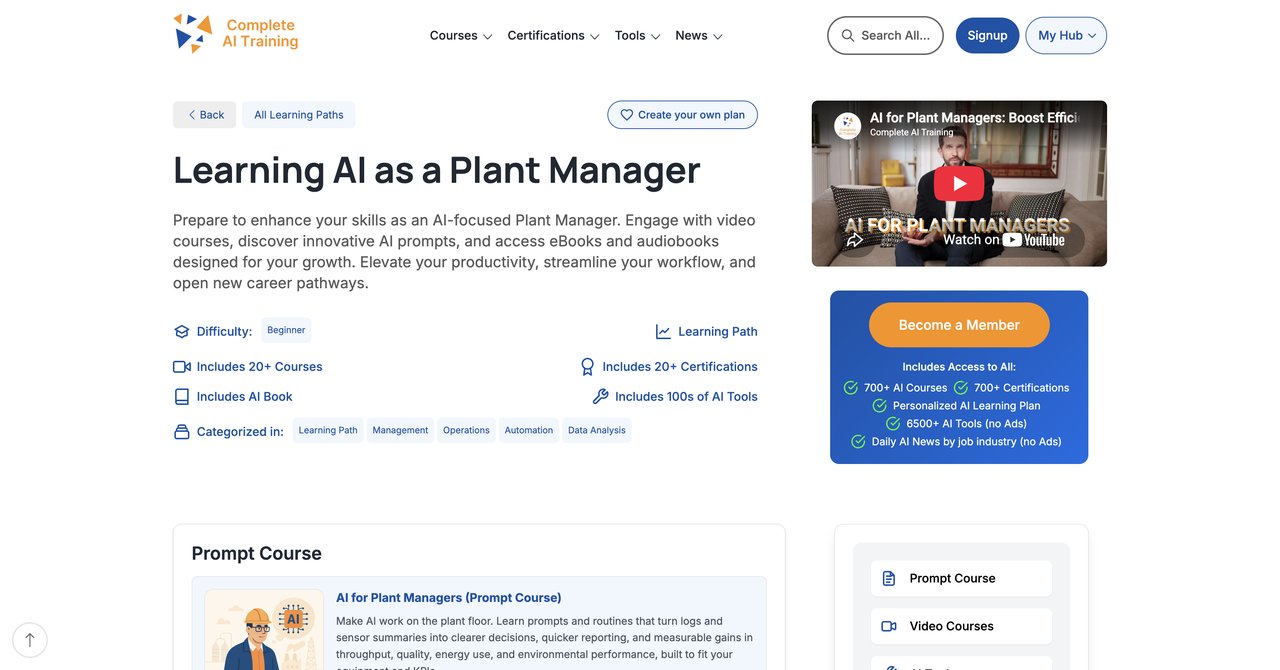
Let's start with the elephant in the room. Complete AI Training is not a single course. One subscription unlocks EVERY course and EVERY certification on the whole platform - hundreds of them, across every job role, not just this one. That is the main point you need to understand up front. The platform offers a massive library that is specifically built around industrial and business professional roles. For plant managers, you get access to over 100 dedicated video courses that address the operational challenges they face daily. New content drops fairly often, making sure what you are studying remains relevant.
With a flat subscription rate of $29 per month, you are not paying for one class and getting charged extra when you want a certificate. Full access to all certifications on the platform is part of the deal. This matters because it removes the classic pain point of paying $100 to $300 just to prove you took the course. You can move from Plant Manager to Inventory or Logistics to Procurement without buying new reading lists. For professionals who work in different areas, this is the most relevant factor to consider. New certifications and courses are continuously added, and the subscription automatically includes them. That one flat price also unlocks access to every other profession's library on the platform beyond just plant operations.
Key Topics Covered
This specific library for plant managers covers practical application of generative AI, using complex data to draft reports, maintenance scheduling, root cause analysis, operational oversight, quality control documentation, and applying generative AI to safety and compliance tasks. It also offers daily AI news tips and prompt libraries intended for the manufacturing environment.
Target Audience and Skill Level:
This program is best for plant managers, operation leads, shift managers, maintenance supervisors, and industrial engineers at all levels. Also, to that benefit, team members working in manufacturing roles that want to move across departments will find it useful. No technical coding skills are needed and the courses get updated as the platforms progress to adjust to demanding industrial scales.
- Pros:
- Highest rating and most comprehensive product library.
- Full library access is accessible to ALL platform users.
- Full access to ALL certifications included.
- New courses/certs added continuously at no extra cost.
- One flat subscription price, versus paying per course elsewhere.
- Daily updates and AI industry news.
- Continuously affordable, especially if billed annually.
- Cons:
- It is a subscription, not a one-time permanent fee, but AI requires practice since it's growing fast.
Who Would Benefit Most:
The person this is ideal for is someone overseeing a whole plant, or a department manager who wants to use AI across multiple domains. If you don't like buying things twice, or you want a little of everything instead of a rigid module set, this platform gives you mobility and options. It is also the preferred direction of people in manufacturing that are switching roles within the same umbrella organization. When looking at all-around versatility, this is the strongest choice available.
Check out CompleteAI Training here
Course 2: AI for Plant Managers (Video Courses + Certifications) - Complete AI Training Alternative
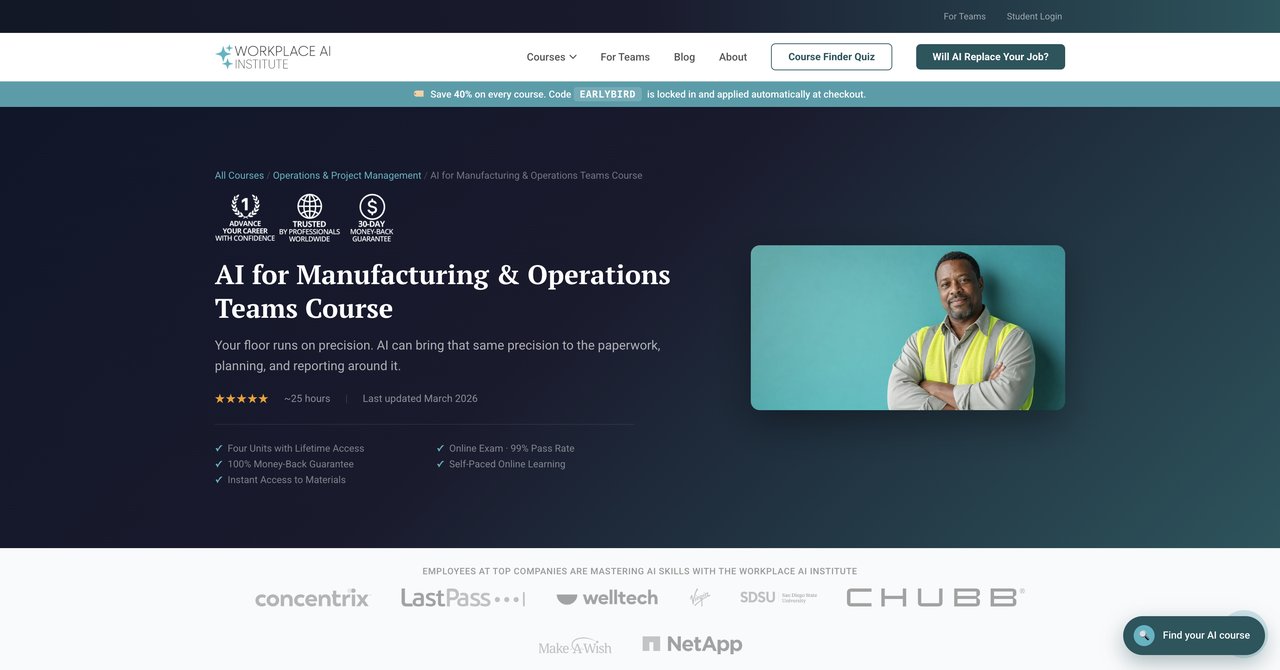
Yes, this is also from Complete AI Training but is a distinct course line. It shares a platform infrastructure with the first one. However, the specific breakdown of the $29/month is focused on getting you access to everything else. We have already covered the subscription model's core. This section focuses mainly on the value you get from it when you concentrate on the Plant Manager focus area only. The platform is still massive, but this course specifically creates ground-level practitioners.
To be sure, this course targets a practical worker in front of a plant screen. The course is built around video-led engagement that fits a 30-minute lunch break, and it is not overly complicated. Yes, most of the same elements from the previous section hold because the training provider is the same. In fact, we can say that the amount of adjustability in their system is the differentiator. A majority of their content is ready to be used right after watching without purchasing any other specific tool, except maybe a ChatGPT Plus subscription for some tasks, but not for the theory bank.
Key Topics Covered:
Use of generative AI for daily monitoring, machinery uptime, noting production losses, compliance, and administrative productivity. The modules shift from outlining the analytics to executing the workflow. Include some additional topics on data normalization, communication with remote teams, and how to ask important problem question to an AI to avoid costly error.
Target Audience and Skill Level:
Since it includes students that start from zero, no previous knowledge of AI is necessary. It fits operations personnel, quality inspectors, shift leads, and plant supervisors. It may seem scaled mainly to the factory floor, but could prove effective tool for brand new AI leaders.
- Pros:
- Included in the flat subscription price
- Quick flexible content, ideal for shift changes
- Practical immediate steps with templates
- Strong focus across roles.
- Certificate as a proof of skill
- Cons:
- It is subscription-based (as previously reference).
- Users never "own" course materials.
Who Would Benefit Most: Plant managers looking for daily usable AI workflows. If your objective is practical, ready-to-apply.
Discover this CompleteAI Training Option
Course 3: AI+ Manufacturing Practitioner™ by AICERTs
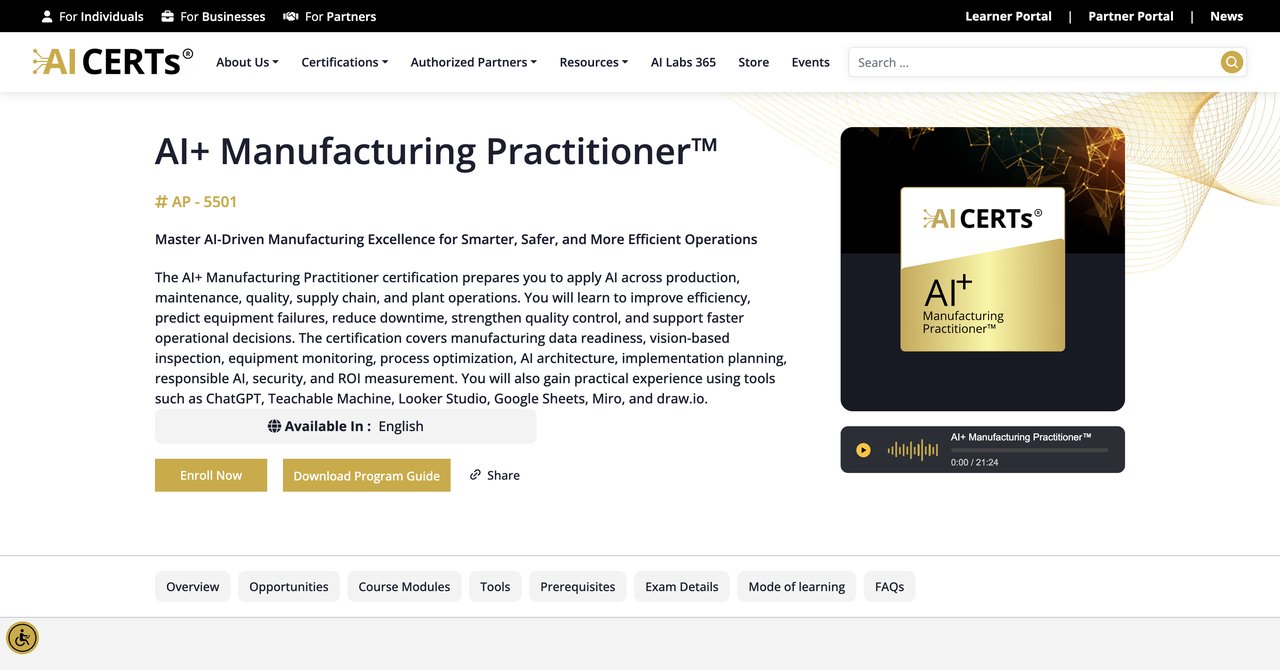
Moving to professional certs, this is an intermediate level certification program from AICERTs. The main focus is to show you as a practitioner where you have to work with sensors, data, and machines to understand what AI can realistically do. This course gives you a formal and exam-based edge. Its difference is clear: it has an official exam and the certificate that you can carry as a merit. It is positioned to be better for those needing to push internal policies.
Usually, tools to learn are given in a formal setting. IF you have a team wanting specific skill about process monitoring, bottleneck detection, and scrap, this program is a good fit. They also have the right balance with production timing and downtime. The fact that they use project outlines gives the learner a hands-on project for the "real world". However, this course is priced for intermediate level, and they don't openly put the cost description on the table. Also, it does not promise accessible all levels, so it can be overkill if you simply need regularity tools.
Key Topics Covered:
Monitoring production performance with algorithms, understanding bottleneck detection, quality prediction, preventing unplanned downtime, and scrap reduction methods using AI. They also teach some aspects of project governance.
Target Audience and Skill Level:
Plant managers with a basic understanding of process optimization or data analysis. According to the official source, good for operators wanting to grow into process specialists, for production engineers, and people in the continuous improvement area.
- Pros:
- Structured certification from a recognized institute
- Focus on actual AI heavy manufacturing use cases
- Multiple formats, including self-paced or live instructor
- Will improve job prospects
- Cons:
- Cost is not displayed directly and will require an inquiry.
- Intermediate level; not for beginners.
- Less focus on general plant floor documentation tasks.
Who Would Benefit Most:
I advise a candidate who is stepping into a digital manager role in a medium-to-large event, and needs credentials to support the request. It's also fine for those moving into advanced manufacturing. The line between maintenance and data science is clearly defined.
Course 4: AI for Manufacturing & Operations Teams by Workplace AI Institute
The Workplace AI Institute created this beginner-level program for teams that want immediate improvements. The modules focus on generating shift reports, SOPs, corrective actions. This course is from more practical, operator-level place, and it skips the theoretical "What is a neural net" part entirely. It focuses on step-by-step prompting for documentation that is creating planning problems.
You can literally use this to help you solve your report problem after a Saturday shift. While the course's structure is short (shorter compared to others), it has precise prompts for plant-floor documentation. This means that if your work involves writing standard operations and floor logs, the $297 price tag buys a lot of action, but the absence of strong brand recognition and small scale might make you pick again. However, to a factory supervisor it can be the proper kick start without learning Python.
Key Topics Covered:
- Creating shift reports with pre-set prompts - Procedure writing for safety and SOPs - Making corrective actions easily - Organizing training materials.
Target Audience and Skill Level:
Note that there is no technical background. It ideal for floor managers, plant supervisors, and superintendents who write daily records and need to automate faster.
- Pros:
- Very targeted at plant floor writing tasks
- Easy to copy and paste and start
- No technical heavy explanation needed
- Cons:
- Lack of big platform reputation
- Short duration and no advanced topics
- Might not help with long-term strategy
Who Would Benefit Most:
This is for the doers: those plant managers who spend 10 hours a week writing reports for quality or compliance, and want AI to write the basic drafts easily. You'll see fast results with a basic text model like Claude or ChatGPT.
Course 5: AI for Plant Managers (Prompt Course) by Complete AI Training
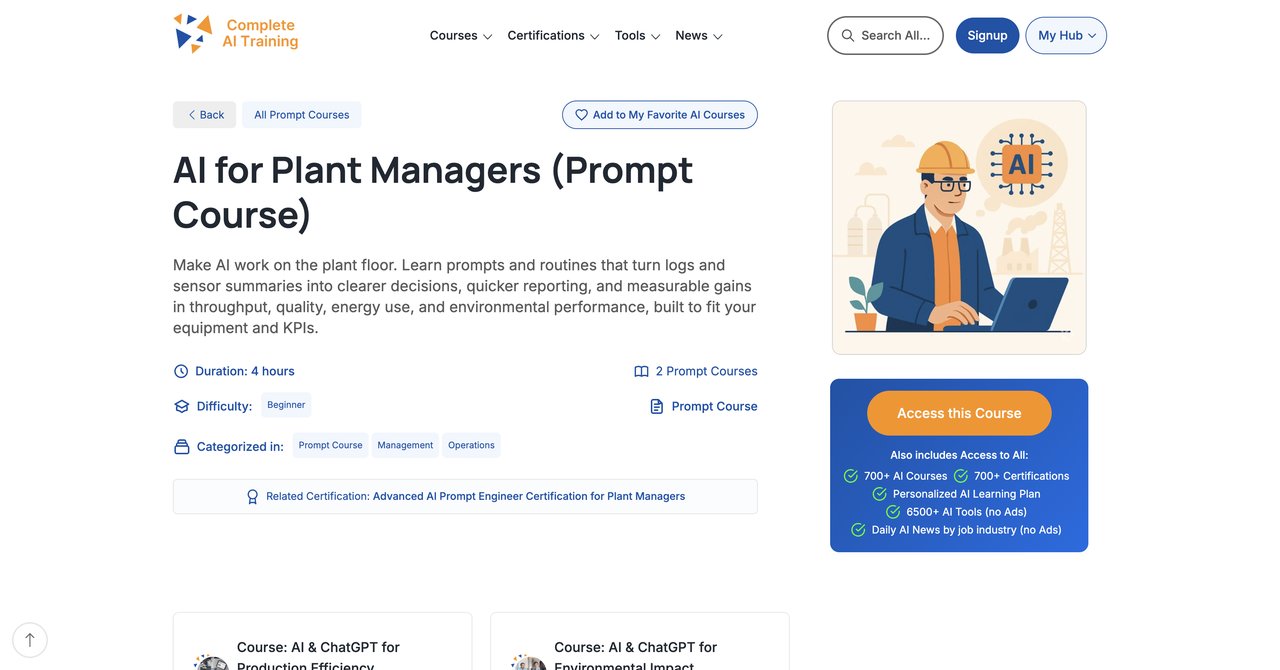
In a shorter (you need about 4 hours) timeframe, this boot camp from Complete AI Training hits some key specifics. Instead of giving a grand tour, they offer a powerful module for industrial processes: yield, quality, energy consumption, and environmental metrics. The material is generated to quickly adopt on the plant floor, so you don't get wrapped up in robot talk. The training details prompts that you can put into a model immediately.
It is engaging to learn from the log points and shift data, but who can't spare a day? What they tend to claim is clear and transparent use of AI, but the course demonstrates strong awareness on safety and environmental problems. They earned a huge company wave for flawed if it's minimal.
Key Topics Covered:
- Lead by production throughput - How to calculate energy - Environment performance utilization - Conversion of sensor data into decisions - Ethical framework of data usage
Target Audience and Skill Level:
Standard newbie level. Suitable for plant managers who have a technical workforce.
- Pros:
- Specifically for plant manager use and decision on floor
- Very short time investment with prompt templates
- Good for enrichelly maintain reporting.
- Cons:
- Not comprehensive and not sure price
- no longer analysis for process engineers.
Who Would Benefit Most:
I appreciate this for plant people who already lead a shift but need a fix for the scattered data they must pull from logs.
Course 6: Managing AI Projects with Microsoft by Coursera
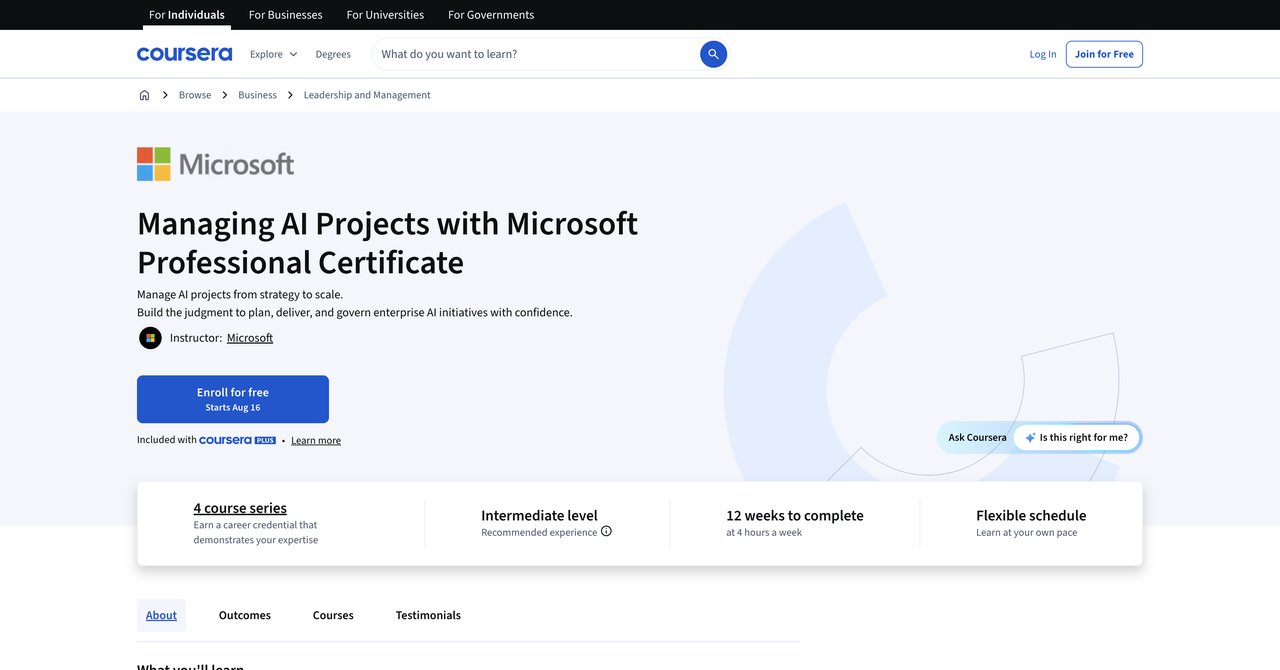
Here is the Microsoft-backed certification from Coursera. This is a good product if you want to know about taking AI capped on large machines from the beginning. It may not be deeply technical manufacturing, but it teaches the AI lifecycle and data management that a plant manager asked for "AI adoption" needs. You investigate why projects fail to high-level and governance structures that get them across the line.
There is a big upside: the Microsoft stamp on your CV. The lectures provide great ideas around getting value from data streams. Moreover, you get complete understanding of "alignment" blockers. However, beware that this course is not manufacturing specific, it leans heavily on generic project management coursework. It can help if you are about to run a AI project rather than use AI as a daily tool written on the floor. If you stay at 49/month for only a couple months, it's acceptable, but to move to new features you have to stay subscribed longer.
Key Topics Covered:
AI lifecycle, building responsibilities and project assessment, scoping, funding, executive leadership, and cross-functional communication. Includes hands-on projects with the Microsoft suite (Azure/OpenAI).
Target Audience and Skill Level:
Intermediate. Good for plant managers or department heads who have do to run transformation Projects by hiring technical staff, and not for people who just need writing prompts at plant floor.
- Pros:
- Great vendor authority (Microsoft is a legend)
- Strong content in AI governance and lifecycle
- Good for leadership discussed in manufacturing sectors.
- Included with called certificates.
- Cons:
- Not industry specific to factories
- Requires a recurring subscription to keep learning
- Can be too broad for simple daily use
Who Would Benefit Most:
A plant manager with allocation budget who is responsible for a cross-functional project steering role. Ideal from planning plants advance monitoring and RPA scaled up AI.
Course 7: Professional Certificate in Advanced Plant Maintenance and AI-driven Predictive Technologies
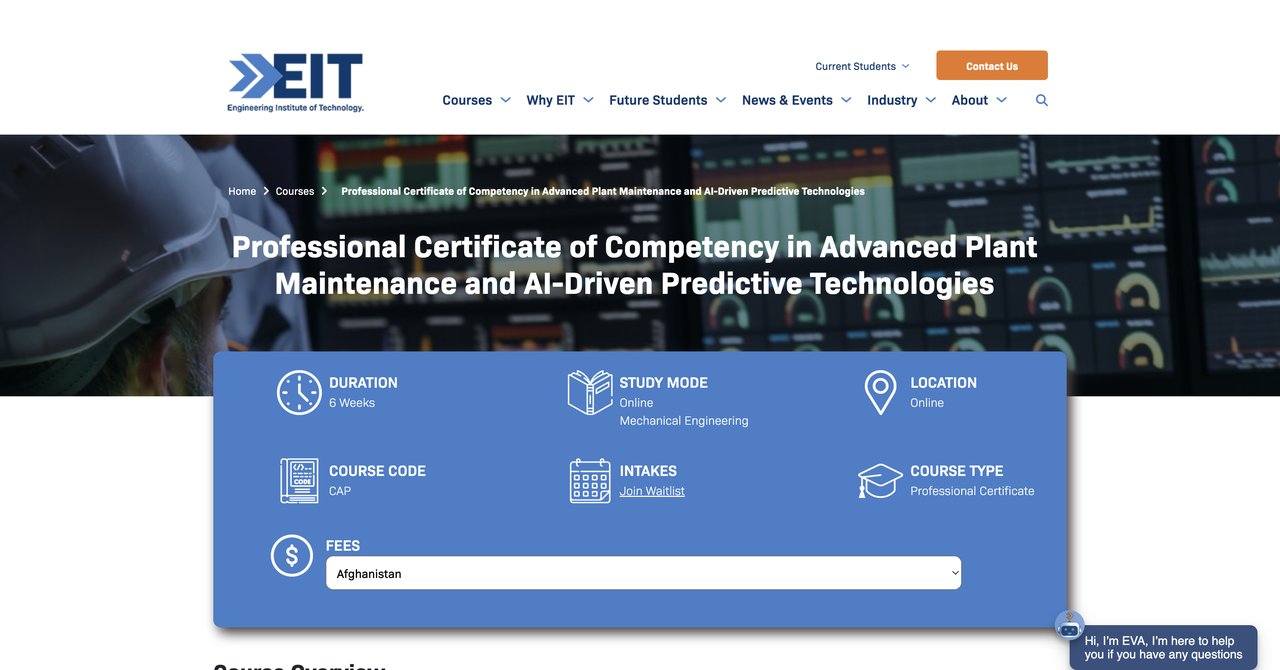
If you have maintenance personal or deal with heavy machinery that cannot fail, this EIT course should be looked at. This is a deep process about capturing data from SCADA, PLC, and CMMS systems for reliability. It's taught via live webinars with expert talks and certification. This is not about seeing data one-off, it is about a quality learning pipeline from real sources. For a plant manager controlling a refinery, this is the type of maintenance tech knowledge you need to talk to your engineering teams, not a 'blank course'.
Whereas some 3-hour programs clock you for a certificate, this professional certificate gets really deep into the domain, but that's exactly why if you turn on high complexity. The participant needs a significant background in reliability, or your systems start to feel heavy. Cost is undisclosed and likely requires a substantial budget, and also requires more time flexibility to enjoy webinars. If you are under pressure to realize what increases asset reliability, this is a master degree level roadmap on trace.
Key Topics Covered: Predictive maintenance logic, condition-based monitoring, integration with existing PLCs and PLC based CMMS, E.I.T., and data quest.
Target Audience and Skill Level:
Advanced, specialized. For technical operations managers who monitor staffing and asset performance. Workable also for elephant management with capital.
- Cons:
- us complex but thorough.
- uses actual machines and data modules.
- live industry sessions from specialists
- Cons:
- High level and technical
- expensive without unlisted costs**
Who Would Benefit Most:
A manager who needs enough understanding to advise reliability engineers, or one who oversees an industrial plant with massive pumps, compressors, and heavy motors.
Course 8: AI for Process Optimization in Manufacturing Operations Training - NobleProg
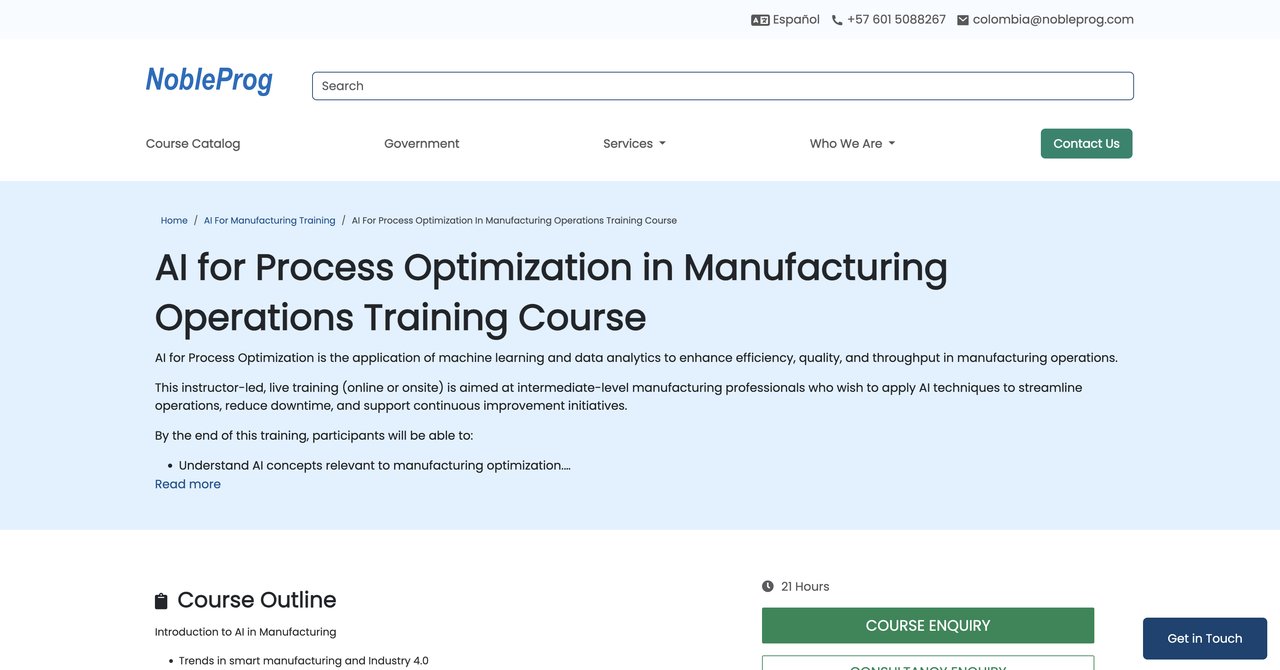
This is classic instructor-led course by NobleProg. If you do not like self-study this might be the answer. They run 3-day live training for a concentrated session. You get direct access to a trainer and exercises that replicate process failures and optimization techniques. They bring a choice that helps you spot what slows line and establishes AI ways to solve. Ideal for firms that send managers abroad or pay for foreign trips.
The course costs a staggering $8,730, putting it among the most expensive here. That means you have to make sure your company has the budget and that you are ready for off-site immersion. It is clearly a quick exposure. But it's high interaction, and you learn best practice for varying variables from a global perspective. If money is zero, and scheduling allows you to open time ranges, you can't match that level of real event. Otherwise, avoid if you prefer self-paced planning.
Key Topics Covered: Streamlining operations, bottleneck analysis, cost modeling, the OT DT link, and identifying process corruption.
Target Audience and Skill Level: Intermediate, ideally production managers and continuous improvement consultants.
- Pros:
- Live, live format with Q&A
- Practical With real scenario
- Deep process solving
- Cons:
- High cost; no way to utilize a trial if you don't embrace group learning
- Change is set for certain days and locations
Who Would Benefit Most:
An organizations sends a director to this seminar to kind of know what to put in the project business case, but then they can't put out the daily reporting.
Course 9: AI for Predictive Machine Maintenance Training Course by PetroKnowledge
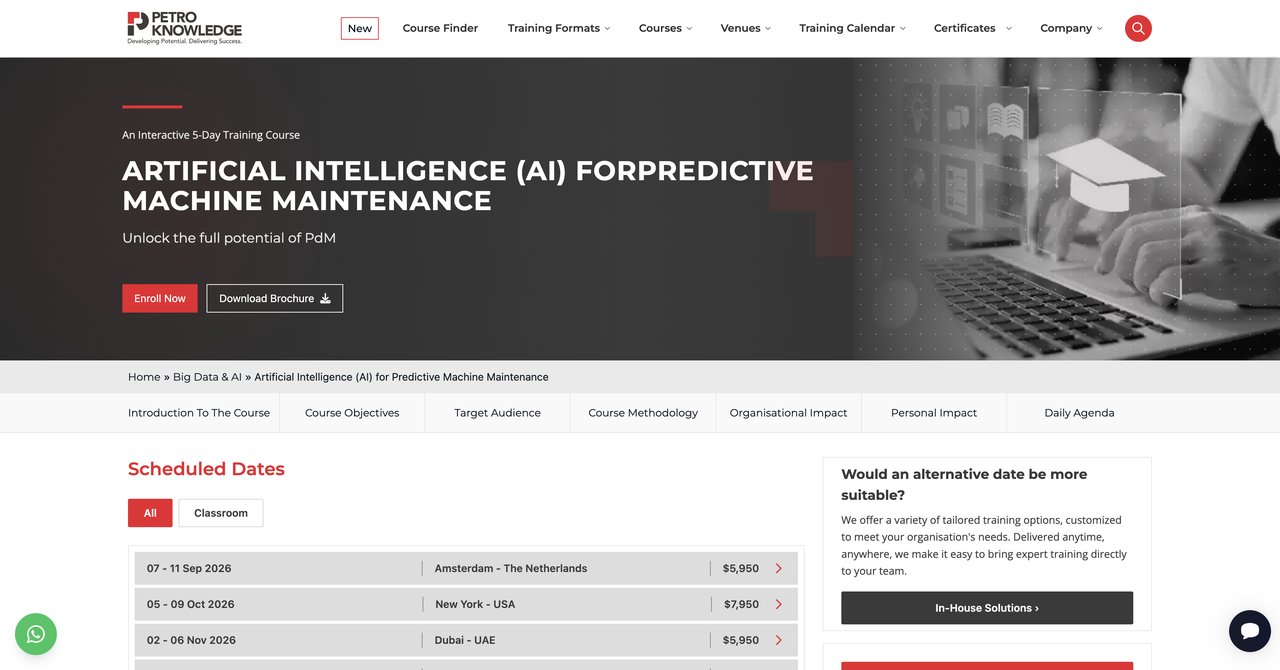
PetroKnowledge offers a full 5-day program totally oriented to predictive machine maintenance. The focus is on business cases from oil/energy industries and process engineering. You learn strategies that reduce total downtime and reduce costs through several data points. They design the class for plant and maintenance managers, except with a heavy energy angle in the modules they use.
Since it is a live Academy with 5 days, you must reserve 40 hrs for it. They don't advertise listing pricing that creates budget uncertainty. It's low-code and includes detailed case study documentation. It is very strong if you want to change maintenance schedule for critical assets, however, very long timeframe. It doesn't really get into daily AI writing or documentation, but for the maintenance hat, it's great. In production plants, this is a good fit.
Key Topics Covered:
Monitoring asset health, predictive algorithms, handling scrapping and cost, root cause analysis for big equipment.
Target Audience and Skill Level: Plant managers and maintenance supervisors.
- Pros:
- Very good for cutting maintenance costs agenda
- Great with practical industrial case studies
- Long but comprehensive
- Cons:
- No final price given
- Long and not for regular weekly users
Who Would Benefit Most: Equipment-heavy facilities (chemical plants, refineries, energy) where a 1% in up-time change.
Course 10: Mastering AI for Industrial Leaders, Foundations, Strategy, in Cement Plans by VDZ
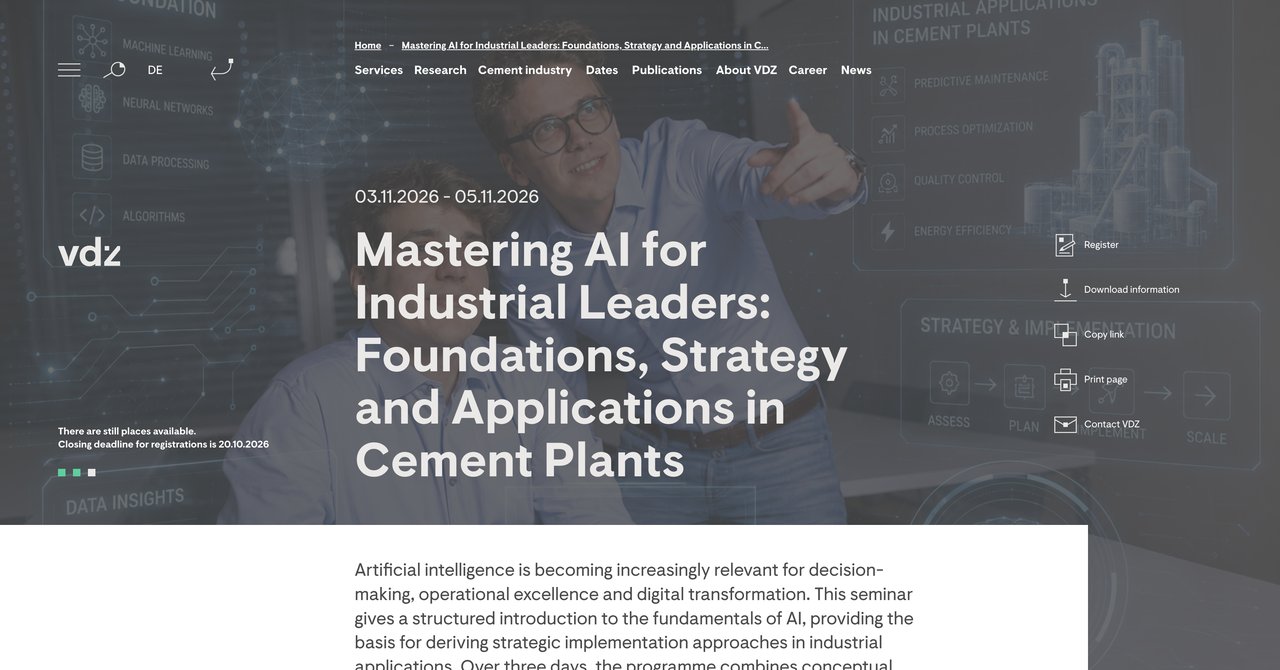
This course in Germany is a different animal in the list. The course is in-person, advanced classroom sessions specifically for the cement industry. They basically do a detailed breakdown on what AI can do for a cement process: kiln optimization, grinding, energy usage, quality measurements. It considers the heavy materials industry constraints that other courses may miss. It covers strategy foundations and delivering an executive plan.
It makes perfect sense if you have capital. For plant managers who were working with VDZ standards for years, it makes process sense. However, it has no use if you are not cement. Coming in person means limited space and a high $4,150 tag. That doesn't include your hotel either. It could definitely be a great strategic roadmap that helps define a managerial framework, but not for all sectors. But the connections in this niche are priceless.
Key Topics Covered: Strategy and application in cement plants, data sources, controls, uptime.
Target Audience and Skill Level:
Executive cement plan managers or experienced technical staff looking to adopt AI. It needs baseline process knowledge.
- Pros:
- Highly targeted for a sector
- Strategy and architecture
- Network with peers from same industry
- Cons:
- Very niche
- Expensive and in-person only
Who Would Benefit Most:
A plant general manager of a cement group or COO responsible for the production and digitalization goals.
Course 11: AI in Food Manufacturing by Food Safety & Quality Services
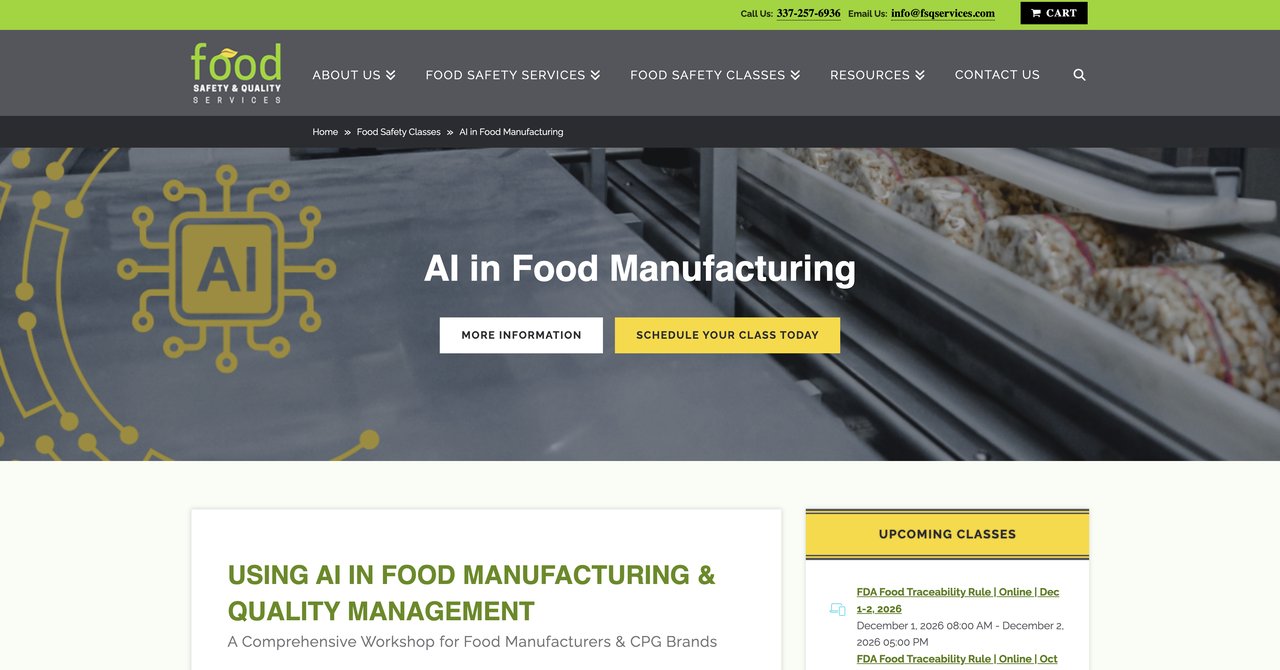
From this point we're moving to very vertical training options. This program by Food Safety & Quality Services is a 1-day workshop. They stage everything around the food industry. That means aiming at standards like HACCP, quality control, and audits. They don't try to be a fixed sandbox location; the attraction is 3 core amenities: use of Claude and ChatGPT to improve safety, quality, and compliance.
Practical. For plant managers in a food and beverages factory, it is a no-brainer, especially if your farm has tech compliance with food and drugs monitoring. You might get an immediate plan to check docs. But cost is not transparent and gets into a huge limitation: 'food industry only' will not apply to car or metal manufacturing. You could get the key concepts again but at a higher price. Not good for cross-sector planning but good if you need to train quality team members with legal rules quickly.
Key Topics Covered:
AI for Quality control, compliance documents, HACCP matrices, and self-practice for audit schedule
Target Audience and Skill Level:
Beginner and intermediate. Perfectly suitable for QA managers, plant managers, and sanitation.
- Pros:
- Focus on food safety, less usual
- Hands-on step-by-step using popular LLM tools
- Good for safety and quality leaders.
- Cons:
- Difficulty if you don't operate in Food sector
- Cost per contact, not transparent
Who Would Benefit Most: Plant managers in food production lines that need compliance help and want to catch up with AI Chatbots. Simple approach.
Course 12: AI for Manufacturing & Operations Teams by AI Wise Training
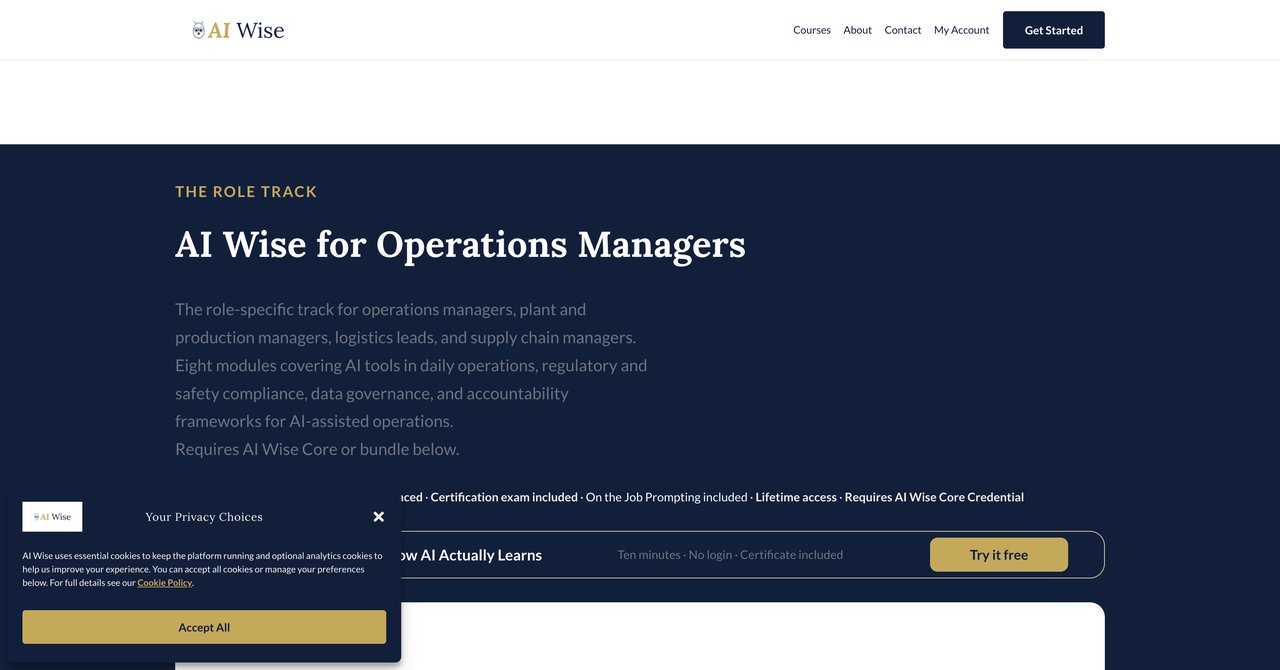
AI Wise Training built this 3-hour course to focus on 8 micro-modules. This course keeps things quick, making sense for a fast evaluation between holidays. You get lifetime access, includes added prompts and some modules in compliance for workforce safety. Usually they sell this with Coursera like other brands. But this is not broke: It cuts through the noise of a 10-hour course for making it yourself today. And that's what a listener might need.
It's very brief. As a FREE Standing program, but the content touches on regulatory terrain, which is odd for many beginner classes. It appears to be good for a lead who needs handy work and simpler guidelines for an entry-level employee. The cons are strong: It says you need a separate Core course to get crucial extra credential. If courses have a one-off price, you are looking at 2 payments if you want the full qualification. They also do not lack unique platform, but the cheat code is still available for reference.
Key Topics Covered: Daily operations, regulatory compliance, recording the data governance, quick prompts for functional area.
Target Audience and Skill Level:
Supervisors who don't have the time, a great way to get initial insight.
- Pros:
- Focus on clarity and compliance areas
- Prompt formulas provided for the floor
- You get lifetime access.
- Cons:
- Requires to pay more to get full badge
- No notable vendor platform
- Short course doesn't dive in technical depth
Who Would Benefit Most: Shift superintendents and plant superintendents who must comply with MRO procedures, but they already do that using excel, present a clean GPT guide.
Final Verdict: Which AI Course Should You Choose as Plant Manager?
With the current landscape, there isn't one supreme course and the decision depends heavily on your role and intent. That said, we can cluster. For value, price, and flexibility, Complete AI Training offers an unfair advantage because the entire platform access for $29/month. You will not lock yourself out of new domains and you have certifications at no additional cost. That makes it the most rational for forward-thinking plant leaders who know that AI changes move fast. You may use that subscription to get exposure to role-related content for maybe 2 months, or use it for a full year. And knowing that every other professional in your company could benefit also matters, even if the buying person is you.
On the other side, if you need recognized names in a certain vertical and breadth, the AICERTs course provides a higher educational presence at an intermediate certification level, although you must request pricing and that could lead to costly fees. For general manager that stays in 'maintenance', then EIT is the ultimate thorough training, but a maybe too tough for the 'no-coding' profit.
If your role turns around quick report and documentation, the Workplace AI Institute or AI Wise would get you results day one at under $300, but you may have graduated quickly. In the last, if cost is secondary and you are responsible for entire 'Operations Excellence' function, a live workshop from NobleProg might prove better value than any online. But it can feel risky if the accelerator fails.
Overall, for maximum return, biggest scope, and future proofing, we give the edge to CompleteAI Training. Any two subscriptions for $29 (instead of $297) beats $8,000 training where you run a heavy workload and are limited to this single path. Like with all tools, start with a clear check of your current company have in place-AI literacy is a must for the long term, but it doesn't make you the officer overnight. If you decide to start today, use the link: CompleteAI Training for Plant Managers