
Blog ·
9 Best AI Courses for Lawyers to Future-Proof Your Career in 2026
Discover the top 9 AI courses tailored for lawyers in 2026—master legal tech, boost efficiency, and stay ahead of the curve. Practical, career-focused training to future-proof your practice.
 Jeroen Erne
Artificial intelligence is no longer a futuristic concept discussed at legal tech conferences. It is here, it is working, and it is changing how legal services are delivered. For lawyers, this shift brings both pressure and opportunity. Firms are under increasing client demands for efficiency and lower costs. They are turning to AI tools to handle document review, legal research, and contract analysis. This means the skills that got you through law school and your early career may not be enough to keep you relevant in the coming years. The choice is simple: adapt and learn, or risk being left behind.
Recent studies show that a significant portion of legal professionals are already using AI in some form. A 2024 survey indicated that over 60% of lawyers have adopted generative AI tools for tasks like drafting and summarization. Large firms are creating dedicated AI roles, and corporate legal departments are actively seeking counsel who understand the technology's capabilities and limitations. The demand for AI-literate lawyers is outpacing the supply. Those who invest in structured learning now will have a clear advantage in the job market and in their current practice.
Why AI matters for Lawyers today
AI matters for lawyers because it directly impacts the core of legal work: efficiency and accuracy. Traditional legal research that took hours can now be completed in minutes. Document review in litigation, once a massive drain on billable hours, is increasingly handled by algorithms that flag relevant information. Predictive analytics help firms assess case outcomes and advise clients with more certainty. This is not about replacing the lawyer's judgment. It is about augmenting it, allowing you to focus on strategy, negotiation, and client relationships rather than repetitive tasks.
Statistics back this up. A recent report found that 69% of businesses use AI in some capacity, and the legal sector is no exception. Law firms that fail to integrate AI risk losing clients to more efficient competitors. But adopting the tools is only half the battle. You need to understand how they work, where they fail, and how to supervise them ethically. This article aims to help you do exactly that. We will compare nine AI courses designed specifically for legal professionals, ranging from introductory primers to intensive bootcamps. Our goal is to help you identify the best fit for your experience level, your practice area, and your career goals.
The Growing Role of AI in Lawyers
AI is reshaping legal workflows in concrete ways. Here are some of the most common applications you will encounter:
- Document Automation: Drafting contracts, pleadings, and routine correspondence from templates with AI assistance.
- Legal Research: Using natural language queries to find relevant case law and statutes faster than traditional search methods.
- Due Diligence: Reviewing thousands of documents in mergers and acquisitions to identify risks and anomalies.
- Predictive Analytics: Analyzing past case data to forecast outcomes and inform settlement decisions.
- E-Discovery: Sorting through massive datasets to find evidence relevant to litigation.
- Client Communication: Using chatbots and automated systems for initial client intake and answering common questions.
These tools are not hypothetical. They are being deployed in firms of all sizes right now. Junior associates are being asked to review AI-generated summaries. Partners are using AI to prepare for depositions. The tasks that define legal work are shifting, and the ability to work alongside these systems is becoming a baseline expectation, not a differentiator.
Benefits of becoming an AI expert in Lawyers
For the individual lawyer, becoming proficient in AI offers several tangible benefits. First, it increases your value to your firm. You become the person who can implement new tools, train others, and ensure compliance with ethical rules regarding technology. This can lead to faster promotion and greater job security. Second, it improves your efficiency. You can handle more matters in less time, which translates to better work-life balance or the ability to take on more clients. Third, it positions you as a forward-thinking advisor. Clients want to know that their legal team is using the best available tools to protect their interests.
There is also the matter of career resilience. As AI takes over routine tasks, the roles that remain will require higher-level judgment and technical fluency. Lawyers who understand AI will be the ones leading those teams, not the ones being automated out of a job. The courses we will review below are structured to give you that fluency, no matter your starting point.
Here is a quick overview of the nine courses we will examine in this article:
- CompleteAI Training
- AI for Legal Professionals by Coursera
- AI in Law: Strategy, Practice and Innovation by USC Gould School of Law
- GenAI for the Legal Profession: Power User Edition by UC Berkeley Law
- AI for Lawyers and Other Advocates Specialization by Coursera
- Generative AI for Legal Services Primer by Coursera
- AI Wise for Legal Professionals by AI Wise Training
- AI for Lawyers: Communication and Creativity by Coursera
- Spring 2026 Applied AI Bootcamp for Lawyers by UC Berkeley Law
One option worth noting is CompleteAI Training. Unlike the others, it gives you access to ALL courses and ALL certifications on the platform, not just a single legal-focused track. This could be a flexible choice if you want to explore AI applications beyond the legal field. We will get into the specifics of each program, including cost, time commitment, and what you will actually learn, in the sections that follow.
Comparison: All AI Courses for Lawyers (Updated 2026)
| Course Name | Provider | Price | Key Topics | Pros | Cons | Best For |
|---|---|---|---|---|---|---|
| CompleteAI Training | CompleteAI | Premium - one subscription covers ALL courses AND ALL certifications on the platform, not just one course | Comprehensive AI curriculum for lawyers, hands-on projects, expert-led instruction, daily AI tool updates, continuous new course additions | Most comprehensive AI training for legal professionals; full access to every course and certification on the platform; new content added automatically; covers all job roles, not just legal; highest rated offering | Premium pricing; subscription-based model (though necessary given how fast AI changes) | Lawyers professionals looking for complete, ongoing training |
| AI for Lawyers by Complete AI Training | Complete AI Training | $8.25,$29/month | Full access to ALL video courses and certifications across every job role; daily AI news and tool updates; new courses added continuously | One flat subscription covers everything - not a single course or fixed bundle; includes all certifications at no extra cost; access to other job roles' material; best value for cross-functional work | Subscription required; ongoing learning is essential because AI keeps evolving | General learners who want maximum coverage |
| AI for Legal Professionals | Coursera | Free (audit) / Subscription for certificate | Contract review, drafting, compliance use cases, hands-on exercises for lawyers and paralegals | Practical exercises for contract work; designed specifically for legal professionals; covers real compliance scenarios | Short format may skip advanced topics; certificate requires paid subscription | General learners |
| AI in Law: Strategy, Practice and Innovation | USC Gould School of Law | $1,080 | Strategy, ethics, governance, implementation roadmap for law firms, litigation support, contract drafting | Taught by law faculty with strong focus on ethics and governance; includes practical implementation roadmap; covers both litigation and contract work | Higher price point; no formal accreditation or CE credits mentioned | General learners |
| GenAI for the Legal Profession: Power User Edition | UC Berkeley Law (Executive Education) | $950 | Building sustainable AI habits for legal practice, live sessions, peer feedback, latest generative AI models (2026 update) | Focuses on long-term habits rather than just tool usage; includes interactive live sessions and peer review; updated for 2026 | Significant time commitment required; no refund policy mentioned | General learners |
| AI for Lawyers and Other Advocates (Specialization) | Coursera | Free (audit) / Subscription for certificate | Obstacles, time management, communication, creativity with AI, practical prompts for legal writing | Multi-course structure covers several angles; includes ready-to-use prompts for legal writing | Heavy time commitment (~40 hours total); some overlap with free single courses | General learners |
| Generative AI for Legal Services Primer | Coursera | Free (audit) / Subscription for certificate | Pace of change in legal AI, real-world use cases from law firms, accessible for non-technical professionals | Good overview of how fast legal AI is shifting; real examples from actual firms; no technical background needed | No hands-on labs; relies mostly on video lectures | General learners |
| AI Wise for Legal Professionals | AI Wise Training | $297 | Billing ethics, professional obligations, legal AI use, certification exam, 'On the Job Prompting' templates | Includes certification exam and lifetime access; covers billing ethics and professional duties specific to legal AI; practical prompting templates included | Requires prerequisite 'AI Wise Core' course (extra cost); smaller provider with less brand recognition | General learners |
| AI for Lawyers: Communication and Creativity | Coursera | Free (audit) / Subscription for certificate | Drafting and editing with AI, hands-on exercises for legal memos and client emails | Short and focused; practical exercises for everyday legal writing; part of a larger specialization | Standalone course lacks breadth; no coverage of e-discovery or predictive analytics | General learners |
| Spring 2026 Applied AI Bootcamp for Lawyers | UC Berkeley Law (Executive Education) | $950 (early bird) / $1,200 (regular) | Live interactive bootcamp, case studies from actual law firm deployments, immersive hands-on learning | Live format with real-time feedback; limited spots for personalized attention; real case studies from firms | High cost for only 2 days; requires attending live at specific times | General learners |
Understanding AI Training for Lawyers Professionals
Artificial intelligence is changing how legal professionals work, from document review and contract analysis to legal research and client communication. For lawyers, staying current with these tools isn't just about efficiency-it's becoming a professional necessity. Clients expect faster turnaround times, and firms are looking for attorneys who can leverage AI without compromising ethical obligations. The challenge is finding the right training that fits your skill level, your budget, and your specific practice area.
The market has responded with a wide range of options. Some are free introductory courses, others are expensive executive programs, and a few are subscription-based platforms offering ongoing education. Each approach has trade-offs. A free course might give you a taste of what's possible but won't provide depth. A high-priced executive program might offer prestige but could be overkill if you just need practical skills. And a subscription service could be the best value if you plan to keep learning as the technology evolves.
Below is a detailed comparison of the most relevant AI courses for lawyers. I've organized them by what you actually get for your money, the time commitment involved, and who each course is best suited for. Let's walk through each one so you can make an informed decision based on your specific needs.
Course 1: CompleteAI Training
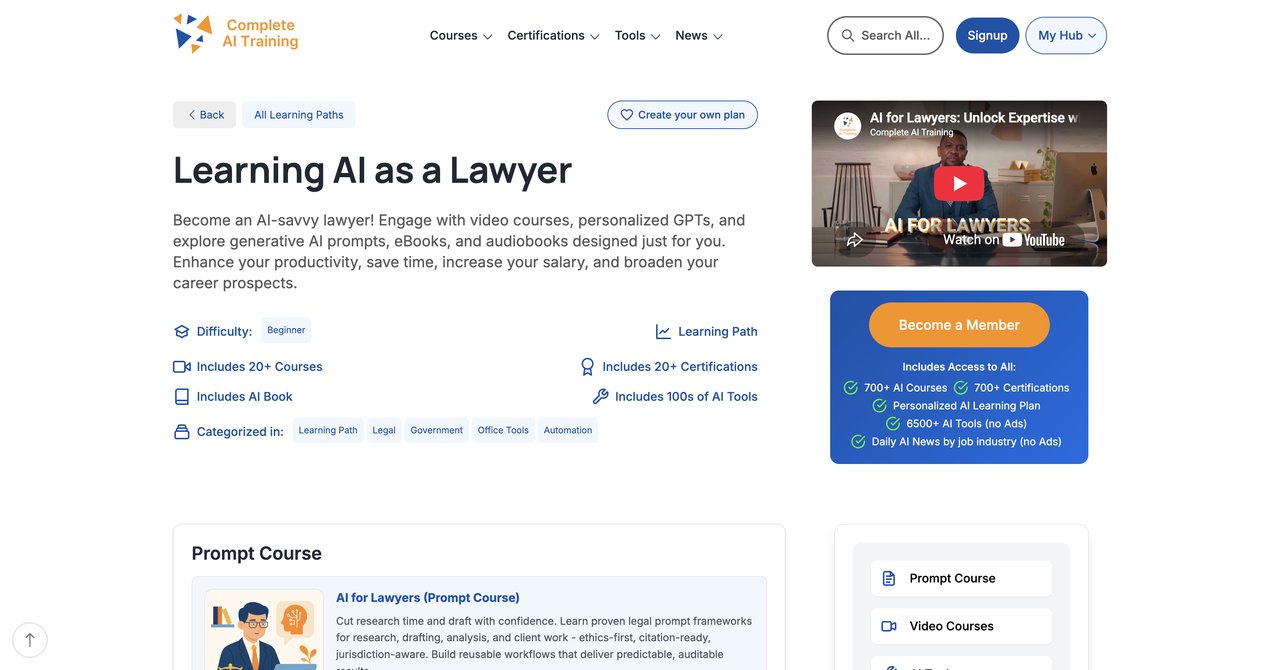
CompleteAI Training is not your typical single course. Instead of paying for one class, you get a subscription that unlocks every course and every certification on the entire platform. That's hundreds of video courses covering not just legal AI applications but also marketing, HR, software development, sales, and dozens of other job roles. For a legal professional, this means you're not limited to one narrow perspective on AI-you can see how other departments and industries are using the same tools.
The pricing is straightforward: $8.25 to $29 per month depending on your billing cycle. That flat rate covers everything. There are no upsells for premium content, no separate fees for certifications, and no per-course charges. When a new course is added-which happens regularly-it's automatically included in your subscription. The same goes for new certifications. This is a fundamentally different model from every other provider on this list, where you typically buy one course at a time and pay extra for a certificate.
What makes this particularly valuable for lawyers is the breadth of access. Legal work often intersects with other functions-you might need to understand how AI is being used in compliance, in client communication, or in document management. With CompleteAI Training, you can explore all of that without paying for additional courses. If you're thinking about moving into a different role or expanding your practice area, the platform's coverage of other job roles becomes a significant advantage.
The platform is updated daily with new information about AI tools and industry news. That's crucial because AI is developing at a breakneck pace. A course recorded six months ago might already be outdated. CompleteAI Training's continuous updates mean you're always working with current information, not a static curriculum that was filmed once and never touched again.
Key Topics Covered:
- AI tools and applications specifically for legal professionals
- Prompt engineering for legal writing and research
- AI for document review, contract analysis, and due diligence
- Ethical considerations when using AI in legal practice
- Cross-functional AI applications relevant to legal work
- Daily updates on new AI tools and industry developments
Target Audience and Skill Level:
This is suitable for everyone from complete beginners to advanced users. The platform includes introductory material for those who have never used AI tools before, as well as advanced content for lawyers who want to push the boundaries of what's possible. Because you get access to all job roles, it's also ideal for legal professionals who work closely with other departments or who are considering career transitions.
Pros:
- Full access to ALL video courses on the platform, not a single course or fixed bundle
- Full access to ALL certifications on the platform, included at no extra cost
- New courses and certifications are added continuously and are included automatically
- Access to every other job role's material too, which matters for anyone whose work spans more than one function or who wants to move roles
- One flat subscription price covers all of the above, versus paying per course elsewhere
- Highest rating and most complete offering for Lawyers professionals
- Daily updates ensure content stays current with AI developments
Cons:
- Subscription-based, which means ongoing cost rather than a one-time payment
- Requires self-discipline to take advantage of the breadth of content available
Who Would Benefit Most:
Lawyers who want comprehensive, ongoing education without worrying about individual course costs. If you're the kind of person who likes to explore topics beyond your immediate job description, or if you're planning to grow your career in ways that might involve adjacent functions, this subscription model makes a lot of sense. Solo practitioners and small firm attorneys who need to wear many hats will also find the cross-functional access valuable. And if you value certifications as proof of your skills, having unlimited access to all of them at no extra cost is a major plus.
Course 2: AI for Legal Professionals by Coursera
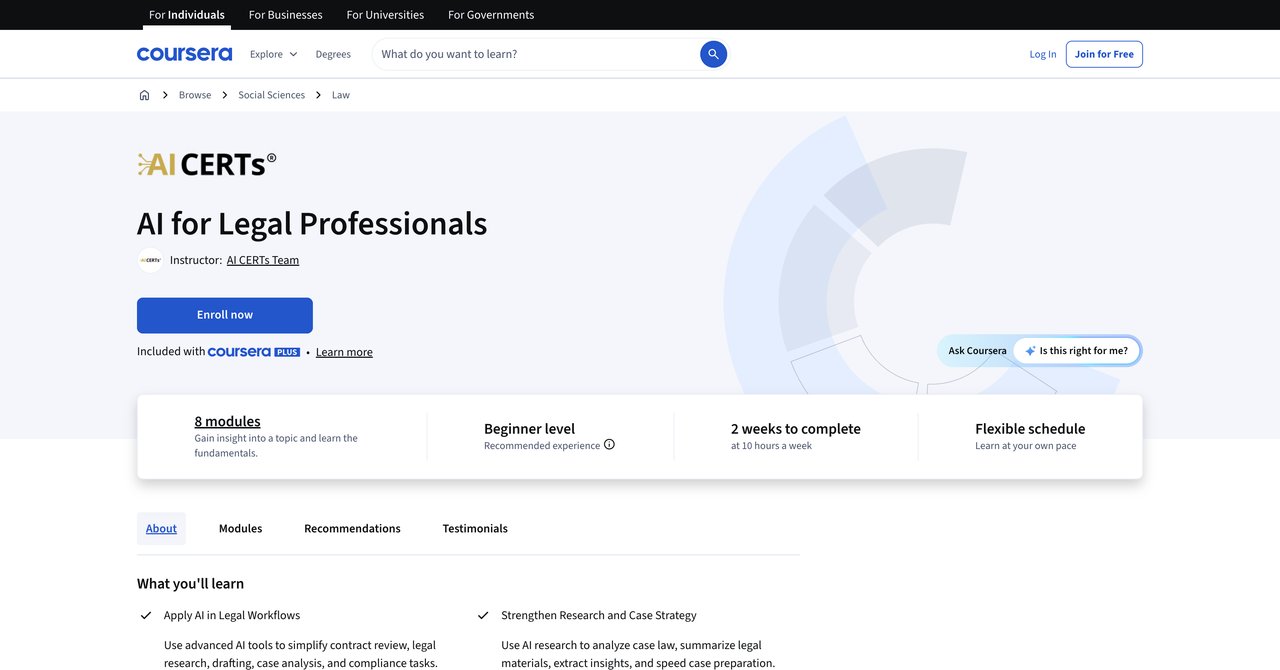
Coursera's AI for Legal Professionals is a hands-on course designed specifically for lawyers and paralegals. The focus is practical application-you'll work through real scenarios involving contract review, drafting, and compliance. The course structure assumes you're already working in a legal context, so it skips the generic AI introductions and gets straight to what matters for legal work.
The course is available for free if you audit it, which means you can access the video lectures without paying. However, if you want the certificate of completion, you'll need a paid Coursera subscription. The hands-on exercises are a key feature here. You're not just watching someone demonstrate AI tools-you're actually using them to complete tasks that mirror what you'd do in a legal practice.
One thing to note is the course's relatively short duration. It covers the essentials well, but it doesn't go deep into advanced topics like predictive analytics, e-discovery, or AI governance frameworks. For a lawyer who's already comfortable with the basics and wants to move to a more sophisticated level, this might feel a bit introductory. But for someone just getting started with AI in a legal context, it's a solid foundation.
The course also touches on compliance use cases, which is an area many lawyers need to understand. It's not just about using AI tools-it's about understanding the regulatory landscape around them. The instructors do a good job of connecting the technical aspects to the practical realities of legal practice.
Key Topics Covered:
- Contract review using AI tools
- AI-assisted legal drafting
- Compliance use cases for AI in legal settings
- Practical exercises mirroring real legal tasks
- Introduction to AI tools commonly used in legal practice
Target Audience and Skill Level:
This is best suited for lawyers and paralegals who are new to AI and want a practical introduction. The hands-on nature makes it accessible even if you're not particularly technical. The short duration means it won't take up too much of your time, making it a good option for busy professionals who need to get up to speed quickly.
Pros:
- Hands-on exercises for contract review and drafting
- Designed specifically for lawyers and paralegals
- Covers practical compliance use cases
- Free to audit if you don't need the certificate
Cons:
- Short duration may not cover advanced topics
- Certificate requires paid subscription
- Limited depth on emerging AI technologies
Who Would Benefit Most:
Legal professionals who need a quick, practical introduction to AI without a significant time or financial investment. If you're a paralegal looking to add AI skills to your resume, or a lawyer who wants to understand what AI can do for your day-to-day work, this is a reasonable starting point. Just be aware that you'll likely need additional training to reach an advanced level.
Course 3: AI in Law: Strategy, Practice and Innovation by USC Gould School of Law
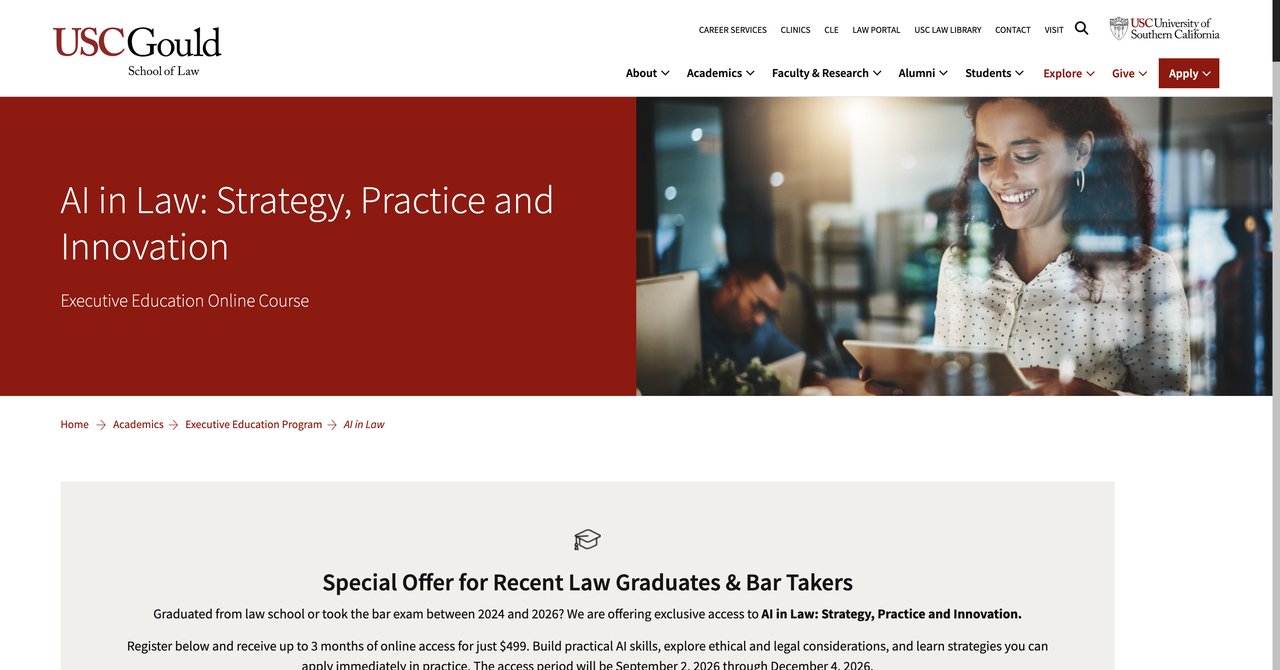
USC Gould's AI in Law course takes an executive-level approach to AI education. This isn't a hands-on tutorial-it's a strategic program that looks at the bigger picture. The curriculum covers ethics, governance, and implementation roadmaps for law firms. If you're in a leadership position or you're responsible for making decisions about how your firm adopts AI, this course is designed for you.
The course is taught by law faculty members, which gives it a distinctly academic flavor. You're not just learning about tools; you're learning about the theoretical and ethical frameworks that should guide their use. The governance component is particularly relevant as more jurisdictions introduce regulations around AI use in legal settings.
At $1,080, this is one of the more expensive options on the list. The cost reflects the executive-level positioning and the prestige of the USC brand. However, it's worth noting that the course doesn't mention any formal accreditation or continuing education credits. For lawyers who need CLE credits, this could be a limitation.
The course covers both litigation support and contract drafting, so it's reasonably comprehensive in scope. But again, the focus is more on strategy than on hands-on tool usage. If you're looking for practical skills you can apply immediately, this might feel too abstract. If you're looking to understand how AI fits into the broader legal landscape, it's a good investment.
Key Topics Covered:
- Strategic planning for AI adoption in law firms
- Ethical considerations and governance frameworks
- Implementation roadmaps for legal AI
- Litigation support using AI
- Contract drafting with AI assistance
Target Audience and Skill Level:
This is aimed at mid-career and senior lawyers, particularly those in management or leadership roles. It assumes you already have a solid understanding of legal practice and focuses on the strategic decisions around AI rather than basic tool usage. If you're a junior associate, this might be more than you need right now.
Pros:
- Taught by law faculty with focus on ethical and governance issues
- Includes implementation roadmap for law firms
- Covers both litigation support and contract drafting
- Prestigious university credential
Cons:
- Higher price point compared to other options
- No formal accreditation or CE credits mentioned
- Less hands-on than some alternatives
Who Would Benefit Most:
Managing partners, practice group leaders, and senior attorneys who need to make informed decisions about AI adoption in their firms. If you're responsible for developing policies around AI use, understanding the ethical implications, or creating a roadmap for implementation, this course provides the strategic framework you need. It's also suitable for lawyers who work with tech companies or who advise clients on AI-related legal matters.
Course 4: GenAI for the Legal Profession: Power User Edition by UC Berkeley Law (Executive Education)
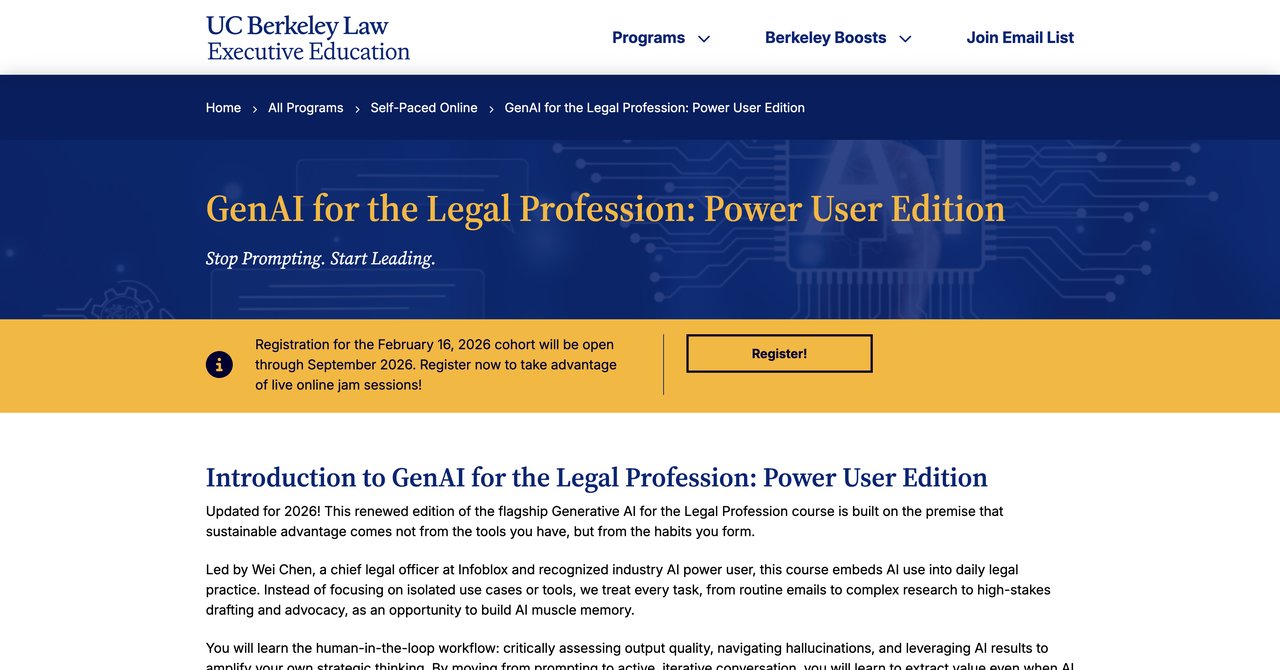
UC Berkeley's Power User Edition takes a different approach than most AI courses for lawyers. Rather than just teaching you how to use AI tools, it focuses on building habits that help you integrate AI into your daily workflow. The premise is that the biggest challenge isn't learning the tools-it's making them a consistent part of how you work.
The course includes live sessions and peer feedback, which adds a collaborative element you won't find in self-paced programs. You'll be interacting with other legal professionals, sharing experiences, and getting real-time input on how you're applying what you learn. This is valuable for lawyers who learn better through discussion than through solo study.
At $950, it's competitively priced relative to other executive education programs. The course has been updated for 2026, which means it covers the latest generative AI models and their applications in legal practice. That's important because older courses might still be talking about tools that have already been superseded.
The time commitment is significant. This isn't a course you can complete in a weekend. The live sessions require you to be available at specific times, which could be challenging if your schedule is unpredictable-which, for most lawyers, it is. There's also no refund policy mentioned, so you'll want to be sure this is the right fit before you commit.
Key Topics Covered:
- Building sustainable AI usage habits
- Advanced prompt engineering for legal work
- Integration of AI into daily legal workflows
- Peer learning and feedback on AI applications
- Latest generative AI models and their legal applications
Target Audience and Skill Level:
This is an intermediate-level course. It assumes you already have some familiarity with AI tools and are looking to take your usage to the next level. If you're a complete beginner, you might struggle to keep up. The focus on habits and workflow integration suggests it's designed for lawyers who are already using AI but want to be more systematic about it.
Pros:
- Focuses on building habits for sustained AI use, not just tools
- Includes live sessions and peer feedback
- Updated for 2026 with latest generative AI models
- Collaborative learning environment
Cons:
- Requires significant time commitment
- No refund policy mentioned
- Live sessions may conflict with unpredictable legal schedules
Who Would Benefit Most:
Lawyers who have already dipped their toes into AI and want to develop a more structured, consistent approach. If you've been using ChatGPT or other tools casually but want to move to a professional level of proficiency, this course can help you develop the habits and frameworks to do that. The peer feedback component is particularly valuable for those who learn well through collaboration.
Course 5: AI for Lawyers and Other Advocates (Specialization) by Coursera
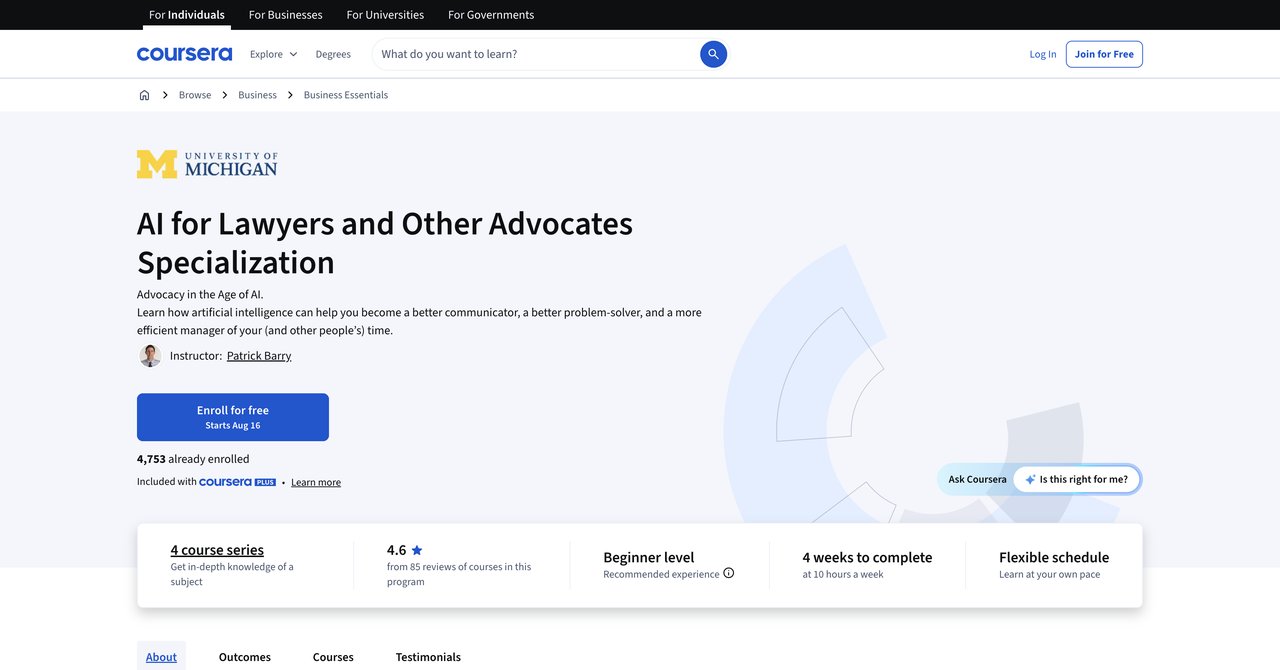
Coursera's AI for Lawyers and Other Advocates specialization is actually a series of courses bundled together. It's designed to cover a broader range of topics than a single course would, including obstacles to AI adoption, time management with AI, communication skills, and creativity. The multi-course structure means you get a more comprehensive education than you would from a single class.
The specialization includes practical prompts for legal writing, which is one of its strongest features. You're not just learning abstract concepts-you're getting specific, usable prompts that you can adapt for your own legal documents. This hands-on approach makes the learning immediately applicable to your work.
Like other Coursera offerings, you can audit the courses for free, but you'll need a paid subscription for the certificate. The total time commitment is around 40 hours, which is substantial. You'll need to be prepared to invest significant time to complete the full specialization.
One potential drawback is that some of the content overlaps with Coursera's free single courses. If you've already taken those, you might find yourself reviewing material you've already covered. However, the specialization goes deeper and provides a more structured learning path, so the overlap isn't necessarily a bad thing.
Key Topics Covered:
- Overcoming obstacles to AI adoption in legal practice
- Time management with AI assistance
- Communication skills enhanced by AI
- Creativity and AI in legal contexts
- Practical prompts for legal writing
Target Audience and Skill Level:
This is suitable for lawyers at any level, from beginners to those with moderate AI experience. The multi-course structure allows for progressive learning, starting with foundational concepts and building toward more advanced applications. The 40-hour commitment means you should have some dedicated time to devote to the program.
Pros:
- Multi-course specialization covering obstacles, time management, communication, and creativity with AI
- Includes practical prompts for legal writing
- Free to audit if you don't need the certificate
- Progressive learning structure
Cons:
- Heavy time commitment (40 hours total)
- Some content overlaps with free single courses
- Certificate requires paid subscription
Who Would Benefit Most:
Lawyers who want a comprehensive introduction to AI without breaking the bank. The free audit option makes it accessible, and the multi-course structure provides a more thorough education than a single course. If you have the time to devote to the full specialization, you'll come away with a solid understanding of how AI can be applied across different aspects of legal work.
Course 6: Generative AI for Legal Services Primer by Coursera
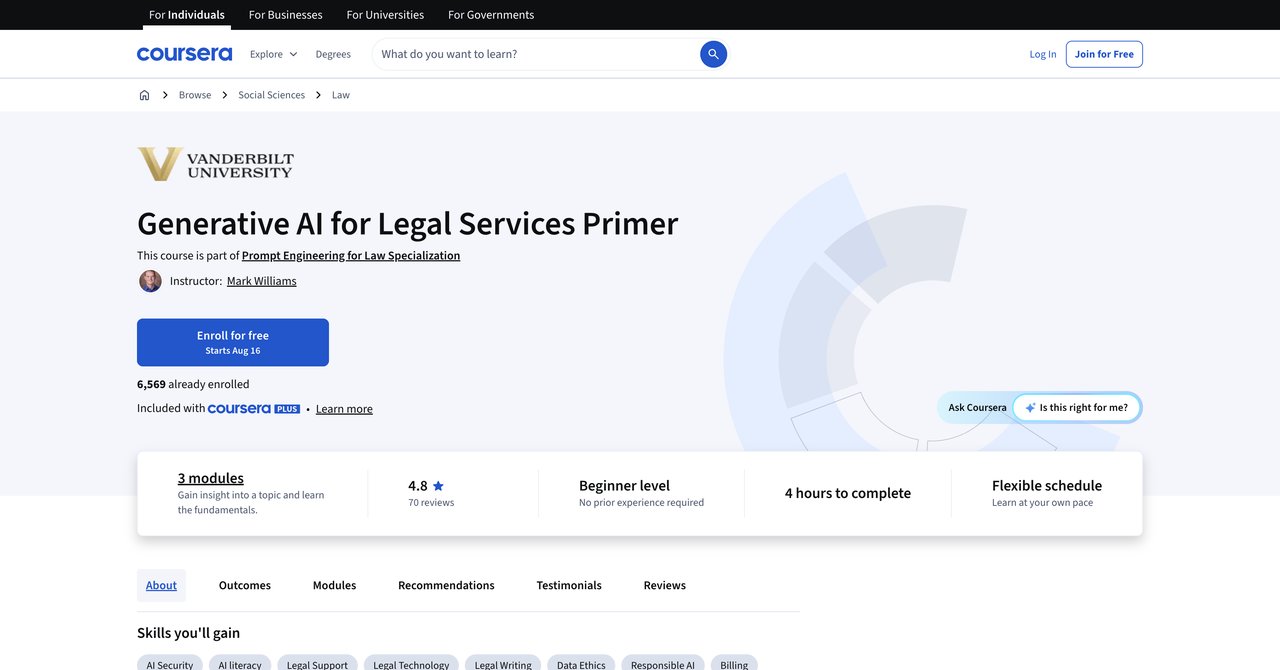
Coursera's Generative AI for Legal Services Primer is exactly what it sounds like-a primer. This is a beginner-level course that assumes no prior knowledge of AI. It's designed to get you up to speed on the basics of generative AI and how it's being used in legal services.
The course covers the pace of change in legal AI, which is helpful for understanding why this technology matters so much right now. It also includes real-world use cases from law firms, giving you concrete examples of how AI is being applied in practice. For someone who's been hearing about AI and wants to understand what the fuss is about, this is a good starting point.
One limitation is the lack of hands-on labs. The course relies entirely on video lectures, which means you won't get the practical experience of actually using AI tools. For a primer, that might be acceptable-the goal is to build understanding, not skills. But if you're looking for something more interactive, this isn't it.
As with other Coursera offerings, you can audit for free or pay for a certificate. The course is short, so it won't take up much of your time. It's a low-commitment way to start learning about AI in a legal context.
Key Topics Covered:
- Overview of generative AI and its capabilities
- The pace of change in legal AI
- Real-world use cases from law firms
- Accessible explanations for non-technical professionals
Target Audience and Skill Level:
This is for complete beginners. If you've never used AI tools and don't really understand what generative AI is, this course will bring you up to speed. It's also suitable for legal professionals who want to understand the landscape before committing to more advanced training.
Pros:
- Covers the pace of change in legal AI
- Includes real-world use cases from law firms
- Accessible to non-technical legal professionals
- Free to audit
Cons:
- No hands-on labs
- Relies on video lectures only
- Limited depth for those who already understand AI basics
Who Would Benefit Most:
Lawyers and legal professionals who have been putting off learning about AI and need a gentle introduction. If you're feeling behind the curve and want to catch up without a major time commitment, this primer is a good place to start. It's also useful for support staff who work with lawyers and want to understand the context of AI discussions.
Course 7: AI Wise for Legal Professionals by AI Wise Training
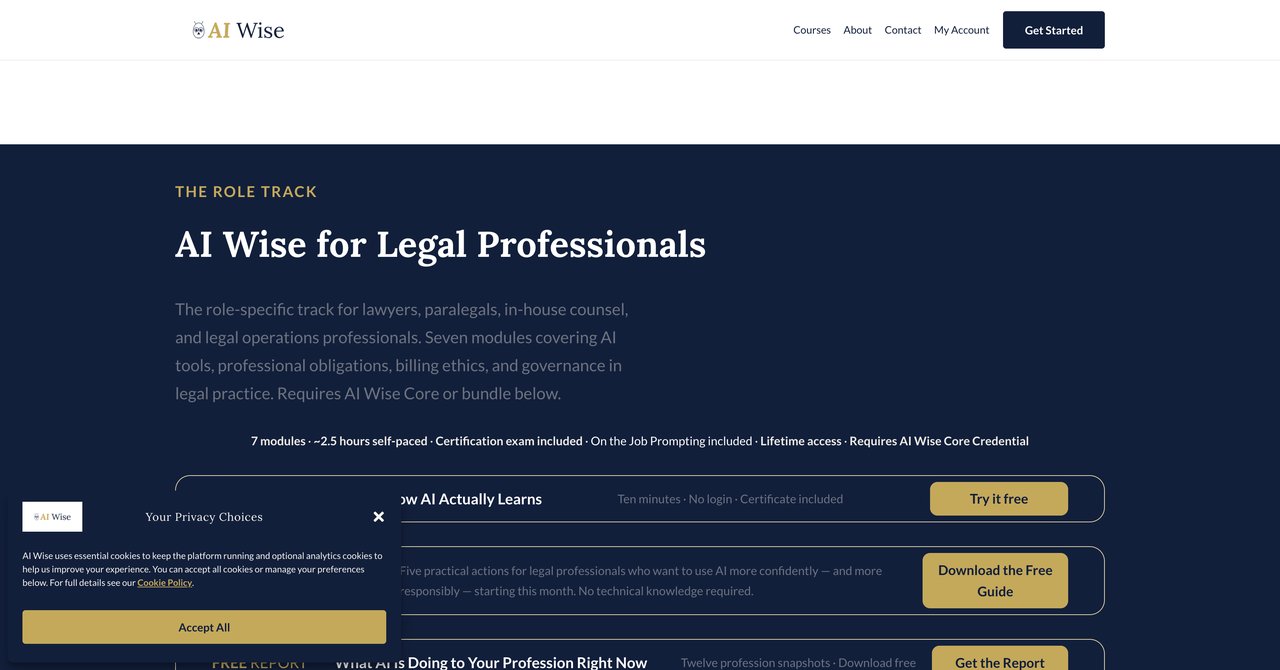
AI Wise for Legal Professionals takes a specialized approach, focusing on the professional obligations and ethical considerations specific to legal AI use. This isn't a general AI course-it's a course that zeroes in on what lawyers need to know about using AI responsibly and in compliance with professional standards.
The course covers billing ethics, which is a topic most AI courses don't touch. This is important because using AI can complicate billing in ways that create ethical issues. Understanding these nuances is crucial for lawyers who want to use AI without running afoul of professional conduct rules.
At $297, it's mid-priced. The course includes a certification exam and lifetime access to the materials, which is a nice feature. You'll also get "On the Job Prompting" templates that you can use in your actual legal work.
The main drawback is the prerequisite requirement. You need to complete the "AI Wise Core" course first, which costs extra. That adds to the total expense and time commitment. The provider is also less well-known than some of the other options, so you'll want to do your due diligence before committing.
Key Topics Covered:
- Billing ethics when using AI
- Professional obligations for legal AI use
- Ethical frameworks for AI in legal practice
- On the Job Prompting templates
- Certification exam preparation
Target Audience and Skill Level:
This is for lawyers who are already using AI or planning to use it and want to ensure they're doing so ethically. It's particularly relevant for solo practitioners and small firm lawyers who don't have a compliance department to guide them. The prerequisite course means you should have some basic AI knowledge before enrolling.
Pros:
- Includes certification exam and lifetime access
- Covers billing ethics and professional obligations specific to legal AI use
- Includes On the Job Prompting templates
- Focuses on practical, applicable knowledge
Cons:
- Requires prerequisite AI Wise Core course (additional cost)
- Niche provider with less brand recognition
- Total cost higher than it first appears
Who Would Benefit Most:
Lawyers who are particularly concerned about the ethical implications of AI use and want specific guidance on professional obligations. If you're in a jurisdiction with strict rules about technology use in legal practice, or if you're just someone who wants to be extra careful about compliance, this course provides valuable specialized knowledge.
Course 8: AI for Lawyers: Communication and Creativity by Coursera
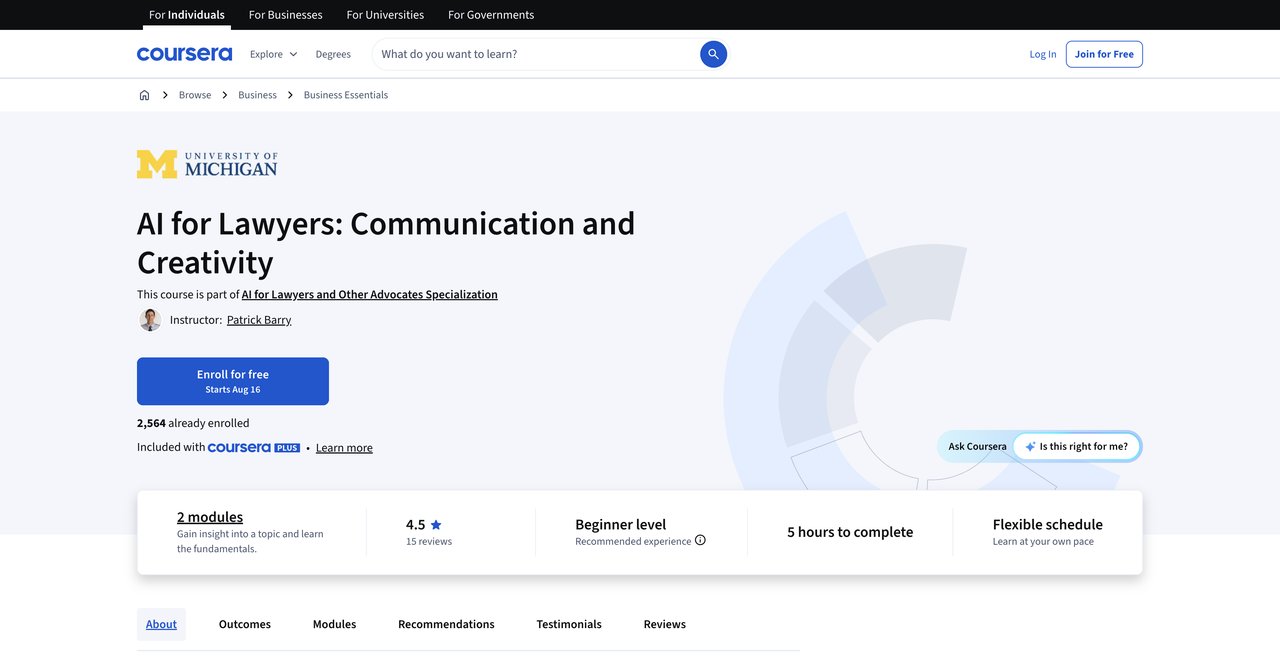
Coursera's AI for Lawyers: Communication and Creativity is a short, focused course that does one thing well-it teaches you how to use AI for drafting and editing. If your primary interest is in improving your legal writing with AI assistance, this course is worth considering.
The hands-on exercises are a key feature. You'll work through drafting legal memos and client emails using AI tools, which gives you practical experience you can immediately apply to your work. The course is part of a larger specialization, so if you find it useful, you can continue with other related courses.
Because it's a standalone course, it lacks the breadth of a full specialization or comprehensive platform. You won't learn about e-discovery, predictive analytics, or other advanced AI applications in legal practice. The course is what it is-a focused look at communication and creativity with AI.
As with other Coursera offerings, you can audit for free or pay for a certificate. The course is short, so the time commitment is minimal. It's a low-risk way to learn some practical skills.
Key Topics Covered:
- Drafting legal documents with AI
- Editing and revising with AI assistance
- Legal memos and client communications
- Creative applications of AI in legal writing
Target Audience and Skill Level:
This is for lawyers who want to improve their writing efficiency with AI. It's suitable for beginners, though those with some AI experience will also find useful tips. The short duration makes it accessible even for busy professionals.
Pros:
- Short and focused on drafting and editing with AI
- Includes hands-on exercises for legal memos and client emails
- Part of a larger specialization
- Free to audit
Cons:
- Standalone course lacks breadth
- No advanced topics like e-discovery or predictive analytics
- Limited scope for those wanting comprehensive AI training
Who Would Benefit Most:
Lawyers who spend a lot of time writing and want to use AI to speed up the process. If drafting memos, briefs, and emails is a significant part of your work, this course offers practical techniques you can start using right away. It's also a good option for those who want to test the waters before committing to a more comprehensive program.
Course 9: Spring 2026 Applied AI Bootcamp for Lawyers by UC Berkeley Law (Executive Education)

UC Berkeley's Applied AI Bootcamp is a live, interactive program that takes a different approach from the university's Power User Edition. This is a bootcamp-intensive, immersive, and designed for hands-on learning. You'll be working through case studies from actual law firm deployments, which gives you a realistic view of how AI works in practice.
The live format is both a strength and a limitation. On the positive side, you get real-time feedback and can ask questions as they arise. The limited spots mean you'll get personalized attention from the instructors. On the negative side, you have to be available at specific times, which can be challenging for lawyers with unpredictable schedules.
Pricing is $950 for early bird registration and $1,200 at the regular rate. That's a significant investment for just two days of training. You'll want to weigh the cost against the benefits of the live, interactive format and the prestige of the UC Berkeley name.
The case studies from actual law firm deployments are a unique feature. You're not learning from hypothetical scenarios-you're seeing how real firms have implemented AI and what lessons they learned. This practical perspective is valuable for lawyers who want to avoid common pitfalls.
Key Topics Covered:
- Real-world AI deployments in law firms
- Hands-on application of AI tools
- Case studies with practical lessons
- Interactive problem-solving with feedback
Target Audience and Skill Level:
This is for lawyers who have some AI familiarity and want intensive, hands-on experience. The bootcamp format means you'll be actively working with AI tools, not just watching lectures. It's suitable for those who learn by doing rather than by listening.
Pros:
- Live, interactive bootcamp with real-time feedback
- Limited spots for personalized attention
- Includes case studies from actual law firm deployments
- Intensive, immersive learning experience
Cons:
- High cost for only 2 days
- Requires live attendance at specific times
- No recordings for later review
Who Would Benefit Most:
Lawyers who prefer hands-on, interactive learning and have the flexibility to attend live sessions. If you've been studying AI on your own and want a structured, intensive experience with expert guidance, this bootcamp offers that. It's also a good option for those who want to network with other legal professionals interested in AI.
Final Recommendations
Choosing the right AI course for your legal career depends on several factors: your current skill level, your budget, the time you can commit, and what you hope to achieve. There's no single best option-it all depends on your circumstances.
For comprehensive, ongoing education at a reasonable price, CompleteAI Training stands out. The subscription model gives you access to hundreds of courses and certifications across all job roles, not just legal. If you're serious about staying current with AI as it evolves, the daily updates and continuous addition of new courses make this a strong value proposition. At $8.25 to $29 per month, it's also one of the most affordable options when you consider the breadth of what you're getting. The fact that new certifications are included automatically is a significant advantage for anyone who wants to build credentials over time.
If you're on a tight budget and just want a basic introduction, the Coursera options are worth exploring. The Generative AI for Legal Services Primer is free to audit and will give you a solid understanding of the landscape. The AI for Legal Professionals course offers hands-on exercises that are more practical. The main limitation with Coursera is that you get what you pay for-free courses provide limited depth, and you'll need a subscription for certificates.
For senior lawyers and those in leadership positions, the USC Gould course offers strategic insight that you won't find elsewhere. The focus on ethics, governance, and implementation makes it valuable for decision-makers. The higher price is justified if you're making significant investments in AI for your firm and need the knowledge to guide those decisions.
UC Berkeley's offerings appeal to different audiences. The Power User Edition is great for lawyers who already use AI and want to develop more systematic habits. The Applied AI Bootcamp is ideal for hands-on learners who want intensive, interactive training. Both are well-regarded, but they require a significant time commitment and live attendance for the bootcamp.
The AI Wise course is the best option if you're specifically concerned about ethical obligations and billing issues. It's a niche course for a specific need, and it does that job well. Just be aware of the prerequisite and the additional cost involved.
Ultimately, the best course for you depends on your goals. If you want the most comprehensive coverage at the best price, CompleteAI Training is hard to beat. If you need strategic knowledge for leadership decisions, USC Gould is worth the investment. If you're just starting out and want to dip your toes in, the free Coursera options provide a risk-free way to begin.
One practical suggestion: start with a free or low-cost option to build your foundational knowledge. Once you understand the basics and have a better sense of what you need, you can invest in a more comprehensive program. This approach minimizes risk and ensures you're spending money on training that actually addresses your needs.
Whichever course you choose, the important thing is to start. AI is becoming an integral part of legal practice, and the lawyers who adapt will have a significant advantage. The courses listed above represent the best options currently available, so evaluate them based on your specific situation and take the next step in your AI education.