
Blog ·
9 Top AI Courses for Quality Control Inspectors in 2026
Master AI-powered visual inspection and defect detection with 2026’s top 9 courses. Boost accuracy, speed up workflows, and future-proof your career in quality control.
 Jeroen Erne

Quality control inspectors are feeling the pressure. Production lines move faster than ever, defect patterns change overnight, and customers expect nothing less than flawless output. Meanwhile, artificial intelligence has quietly moved from experimental tech to everyday tool, and industries across the board are adopting it at a startling rate. For quality control professionals, this represents both a threat and an opportunity. Those who understand how to work with AI systems will find themselves in higher demand, commanding better salaries and more stable positions. Those who don't may find their roles slowly phased out or dramatically changed.
The numbers tell a compelling story. Research shows that the majority of businesses now use AI in some form, and the manufacturing sector specifically has seen explosive growth in AI-based inspection and quality assurance systems. Across the globe, companies are implementation AI to improve accuracy, speed up processes, and reduce the human error factor in quality assessments. With projections showing that AI could impact hundreds of millions of job functions worldwide, upskilling isn't a nice-to-have-it's becoming a survival strategy.
If that sounds urgent, it's because it is. The key question for quality control inspectors is not whether to learn AI, but which courses actually deliver the skills that matter. This article compares nine AI training programs specifically designed for quality control professionals, with options ranging from flexible online subscriptions to structured certification programs. Among these, CompleteAI Training - AI for Quality Control Inspectors stands out as a subscription model that gives access to ALL courses and ALL certifications on the platform rather than just a single course. You'll find that option alongside Oxford Management Centre's manufacturing analytics program, NobleProg's three regional offerings, The Knowledge Academy's certification for quality managers, Stanmore UK's food-specific courses, and Petra Cursos EAD's Portuguese-language program.
Why AI matters for Quality Control Inspectors today
The quality control profession has traditionally relied on human judgment-visually inspecting products, sampling batches, analyzing defect patterns, and working with statistical process control. But companies are increasingly turning to AI to handle the repetitive, tedious work that humans are either too slow or too error-prone to perform. Visual inspection systems powered by machine learning can now spot micro-defects that would slip past the human eye. Predictive models can forecast machinery failures before they cause quality issues. Natural language processing can scan thousands of supplier documents to flag potential compliance problems.
Around 69% of businesses report using some form of AI in their operations, and that number climbs higher each year. The industries that employ quality control inspectors-manufacturing, food production, electronics-are among the most active adopters. This doesn't mean inspectors are becoming obsolete. It means their role is shifting. Instead of manually checking each product, they're increasingly responsible for choosing what to check, evaluating AI outputs, and making final decisions. They're running the new systems rather than performing the tedious repetitive tasks of the past.
This article examines nine courses that range from practical, hands-on training to accredited certification. Some programs focus entirely on applying AI tools to everyday quality work, others dig into the broader impacts of AI on manufacturing analytics, and a few take a targeted approach for specific industries like food safety or pharmaceuticals. By the end, quality control inspectors will have a clear picture of which course best fits their experience level, learning style, and career goals.
The Growing Role of AI in Quality Control Inspectors
When you look at how AI actually works in the quality control space, there's a broad range of applications. Each shift has a different impact on the daily job of a quality control inspector:
- Automated visual inspection: Unlike traditional systems, modern AI cameras can scan thousands of product iterations per hour while maintaining conversion rates. One system learning to be trained at those common significant finding patterns while flagging subtle anomalies that draw you into situations.
- Predictive maintenance: Algorithms monitor equipment and machinery noise patterns, vibration, and temperature to anticipate when certain feasible maintenance will be needed-long before a breakdown occurs.
- Data-driven root cause analysis: When defects do happen, AI speeds up your ability using unstructured data. This can inform root-cause analysis rather than drills with manual SQL queries, allowing practicality evaluation of entire production lines or supply chains at once.
- Documentation and compliance: In heavily regulated industries-pharma, medical equipment, food-AI-based tools naturally help track documentation across complicated audit logs to spot missing or suspect showing (IR) issues.
- Decision support in inspections: Rather than relying solely on senior judgement, newer systems provide risk-derived scoring functions flagging which shipments or lots deserve deeper inspection.
- Supplier quality management: AI helps quality inspectors assess supplier performance by drawing together supplier CAPA reports, defect rates, and audit histories into one score, simplifying who to route corrective action requests to first.
These changes move quality inspectors away from repetitive hands-on checks and toward high-level oversight, interpretation, and system tuning. The inspector becomes the one who supervises the AI systems, trains them on new defects, interprets uncertain edge cases, and takes the final call on borderline items. Knowledge of AI fundamentals directly supports the workflow quality control inspectors work in their positions toward to perform.
Benefits of becoming an AI expert in Quality Control Inspectors
Professionals who specifically train in AI and quality control position themselves at a major advantage. First, there's immediate job security: by showing preparedness in working with-not against-AI, the inspector becomes harder to replace. Again, the argument is not that an artificial algorithm will replace them, but that they can perform at a much higher value with them.
There's also the salary benefit. Early movers in AI-critical roles often see improved compensation, especially when they work in large-scale manufacturing production lines or with regulated industries. This is not a niche skill anymore, it's one that companies actively seek when hiring quality professionals. Roles that require AI familiarity within quality have a much higher experience bracket than traditional inspection jobs-minor bonuses that demonstrate mobility.
Another plus: getting involved with the intersection of AI and quality makes inspectors more proactive in their daily work. Instead of reacting to the defect that arrives, the inspector builds a system that predicts and prevents those defects entirely. This positivity translates to less firefighting, fewer contested rejections, and more control over how the day goes. Many who take the hybrid role comment they spend more time actually making decisions and problem solving rather than chasing numbers on repeat.
Finally, in making a deliberate choice about an AI course, they join a group early in the field in establishing professional credibility before everyone else has credential recognition for the overlap. The career growth picture is clear-for someone who can help their employer introduce smarter quality systems, doors opened that were previously locked.
Comparison: All AI Courses for Quality Control Inspectors (Updated 2026)
| Course Name | Provider | Price | Key Topics | Pros | Cons | Best For |
|---|---|---|---|---|---|---|
| CompleteAI Training | CompleteAI | Premium (one subscription covers ALL courses and ALL certifications on the platform, not a single course) | The most comprehensive AI training for Quality Control Inspectors professionals. Includes full access to every video course and every certification on the platform, covering all job roles beyond just Quality Control. New courses and certifications are added automatically. | Comprehensive curriculum; Hands-on projects; Expert instructors; Full access to ALL courses and certifications at no extra cost; New content added continuously; Covers material for other roles too, useful if your work spans multiple functions; One flat price covers everything | Premium pricing | Quality Control Inspectors professionals looking for complete training |
| Complete AI Training for Quality Control Inspectors (Subscription) | Complete AI Training | $29/month (monthly) or $8.25/month billed annually | An extensive library of over 100 specialized video courses and certifications tailored specifically for Quality Control Inspectors. One subscription unlocks ALL video courses and ALL certifications on the entire platform, not just a single course or a fixed bundle. Full access includes certifications at no extra cost, plus new courses and certifications added continuously. Access covers all job roles, not just Quality Control. | Full access to ALL video courses on the platform; Full access to ALL certifications at no extra cost; New courses and certifications added automatically; Access to every other job role's material too; One flat subscription price covers all, very affordable especially with annual billing | Subscription based, crucial for continuous learning as AI is developing continuously | General learners |
| Artificial Intelligence (AI) for Quality Control & Manufacturing Analytics | Oxford Management Centre | $5,950 | AI foundations tailored to manufacturing quality; predictive quality; real-time monitoring; scaling AI in production environments | Covers AI foundations tailored to manufacturing quality; includes predictive quality and real-time monitoring; focuses on scaling AI in production environments | High price point; classroom-style format may not suit hands-on learners | General learners |
| AI for Quality Control and Assurance in Production Lines (Online) | NobleProg | $5,375 (approx. ₩7,500,000) | Instructor-led live training (online or onsite) teaching QC inspectors to apply AI tools for automated inspections and product quality improvement | Instructor-led live training (online or onsite); hands-on implementation in live-lab environment; tailored for automating inspections in manufacturing | Expensive; limited to beginner/intermediate scope | General learners |
| AI for Quality Control and Assurance in Production Lines (Singapore) | NobleProg | Approx. $4,500 (6,045 SGD) | Interactive lectures and exercises to equip QC inspectors with AI skills for automated inspections and enhanced product quality in production line environments. Available onsite or online. | Interactive lectures with exercises; hands-on implementation; available onsite or online in Singapore | Premium pricing; regional focus may not suit all time zones | General learners |
| AI for Quality Control and Assurance in Production Lines (Switzerland) | NobleProg | Price not listed, contact provider | Instructor-led live training for applying AI tools to automate inspections and improve product quality in manufacturing, available onsite or online in Switzerland | Instructor-led live training; available onsite or online in Switzerland; practical exercises for manufacturing QC | Price not listed publicly; limited to beginner/intermediate level | General learners |
| Certified Artificial Intelligence (AI) for Quality Managers Training | The Knowledge Academy | From £1,495 approx. $1,900 | AI for quality managers, QA specialists, and QC inspectors; risk management; supplier quality | Certification recognized in the UK; covers AI for quality managers, QA specialists, and QC inspectors; includes risk management and supplier quality | Price not fully transparent; duration not specified | General learners |
| Graduate Certificate in AI Enabled Food Quality Inspection | Stanmore UK | £140 fast-track approx. $178; £90 standard approx. $115 | AI in food quality inspection; AI-driven inspection techniques | Affordable; online and flexible; focused specifically on AI in food quality inspection | Niche to food industry; beginner level only | General learners |
| AI Food Quality Inspection: Professional Certification Course | Stanmore UK | Unknown | AI-driven inspection techniques; machine learning applications; automated quality assessment; tailored for food industry | Focuses on AI-driven inspection techniques; covers machine learning applications and automated quality assessment; tailored for food industry | Price and duration not listed; limited to food sector | General learners |
| IA aplicada à Qualidade | Petra Cursos EAD | BRL 89.90 approx. $18 (promotional) / BRL 149.90 approx. $30 (regular) | Practical Portuguese-language course for quality professionals covering audits, inspection reports, non-conformity analysis, and ISO preparation using AI tools like ChatGPT, Excel, Power BI, and Copilot | 100% practical with case studies; ready-to-use AI prompts for QC tasks; covers ChatGPT, Excel, Power BI, and Copilot integration; Portuguese language | Portuguese only; beginner level | General learners |
Understanding AI Training for Quality Control Inspectors Professionals
Quality control inspectors are seeing their roles change fast. Manufacturing floors, food processing plants, and production facilities are all starting to use AI for visual inspection, defect detection, and quality analytics. The inspector who knows how these tools work - and how to apply them directly to inspections, audits, and reporting - becomes more valuable in the workplace. The problem is that there's a lot of training options out there, with widely varying prices, formats, and levels of depth, and it's easy to overspend and underserve your actual needs.
This article compares ten specific training options for quality control professionals. Some are single courses, some are certifications, and one is a full subscription platform that gives you more content than you might use in a year. Prices range from about $18 all the way up to nearly $6,000. To make the right choice, you need to be clear on how you learn best, what your budget is, and the actual domain you work in.
Course 1: CompleteAI Training - AI for Quality Control Inspectors (Subscription)
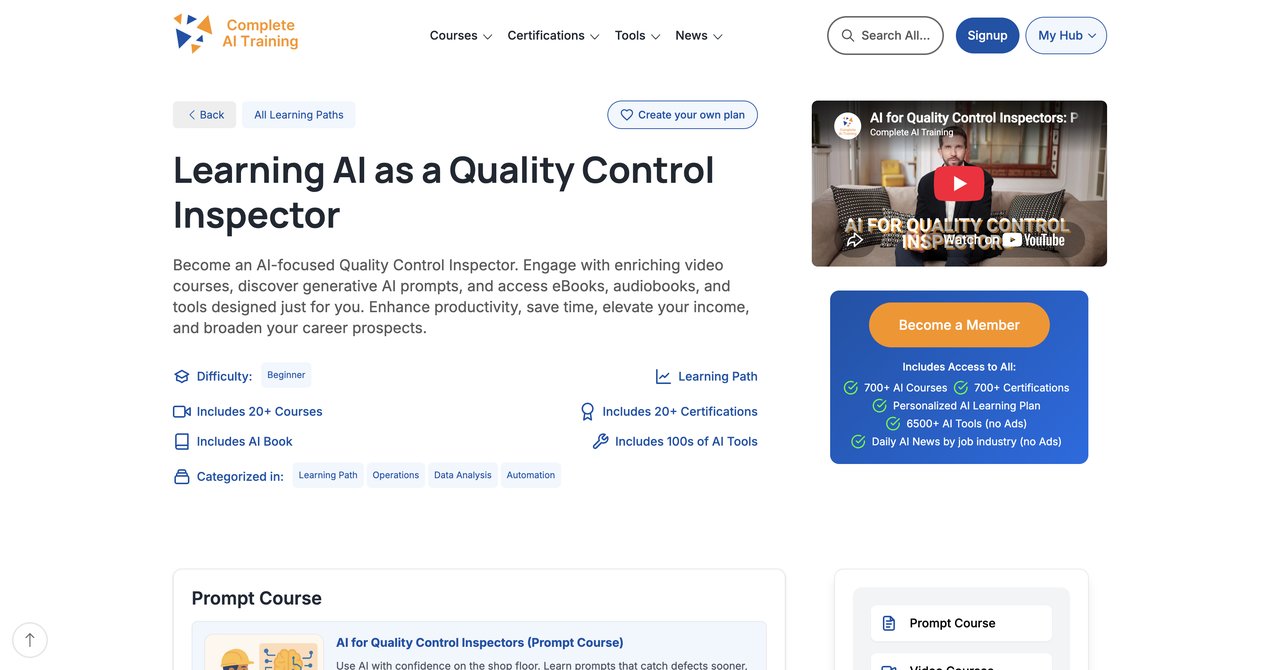
This is not a single course. One subscription unlocks everything on the platform, and that's the point. For a flat monthly or annual fee, you get access to every video course, here and every other job role, plus every certification. That includes full access to all video courses on the platform, not a single course or a fixed bundle. Anyone who has ever bought two or three separate courses and paid separately for each certificate knows how fast that adds up. Here, both are included with subscription.
Subscribers get access to new courses and certifications as they are released, automatically, at no extra cost. AI is changing quickly; quality control is not missing on new usage patterns like real-time visual inspection and predictive maintenance. More importantly, being able to learn what's coming in adjacent functions (procurement, production, operations) is significant when you are looking for a path to grow. The job titles of these roles span multiple functions - often a QC lead also does audits, holds ISO certifications, and supports supplier quality.
Training covers a range from basic AI concepts for manufacturing to specifics approaches for defect detection, quality inspection, using LLMs for documentation at work at regular. There's formal video instruction enough for people who need structured learning, and the certifications attached to it help you demonstrate your new skills. The subscription price is set very reasonably for what you get printed on it, especially with the annual billing. It's a training you can have running while you work, and a course on "AI in your quality inspection functions" won't take half a year to complete.
The cons of this structure: getting the most value from the subscription is built on continuous learning. If you take one course and stop, the deal is only that; if you recognize that AI is developing continuously, a subscription ensures you're not learning last year's content. You have to decide whether continuous, ongoing access is your style. But given what the market charges for one course (some here are £5,000 plus), the subscription pays for itself quickly.
Key topics covered include: AI applications in various Quality functions, defect detection, using LLMs for quality documentation and audit trails, predictive quality, data analysis, and complete access to all career tracking courses, including irregularity and supplier quality management.
Target audience: Quality Control inspectors, QA specialists, quality engineers, and professionals whose work spans production, operations, or supplier quality. Skill level: from novice through advanced. No pre-requisites, and there are dedicated materials for beginners as well as advanced machine learning integrations in the catalog.
Pros:
- Full access to ALL video courses on the platform, not a single course or a fixed bundle
- Full access to ALL certifications on the platform, included at no extra cost
- New courses and certifications are added continuously and are included automatically
- Access to every other job role's material too, which matters for anyone whose work spans more than one function or who wants to move roles
- One flat subscription price covers all of the above, versus paying per course elsewhere
- Very affordable pricing, especially with annual billing
Cons:
- Subscription based, crucial for continuous learning as AI is developing continuously
Who would benefit most: this is the strongest option for professionals who plan to stay in field longer-term and who need flexible, cost-effective ongoing learning that can track AI changes. It also serves individuals cross-functionally in the workplace and those who prefer not to pay extreme costs for single certifications.
Link: Access this course
Course 2: Artificial Intelligence (AI) for Quality Control & Manufacturing Analytics by Oxford Management Centre
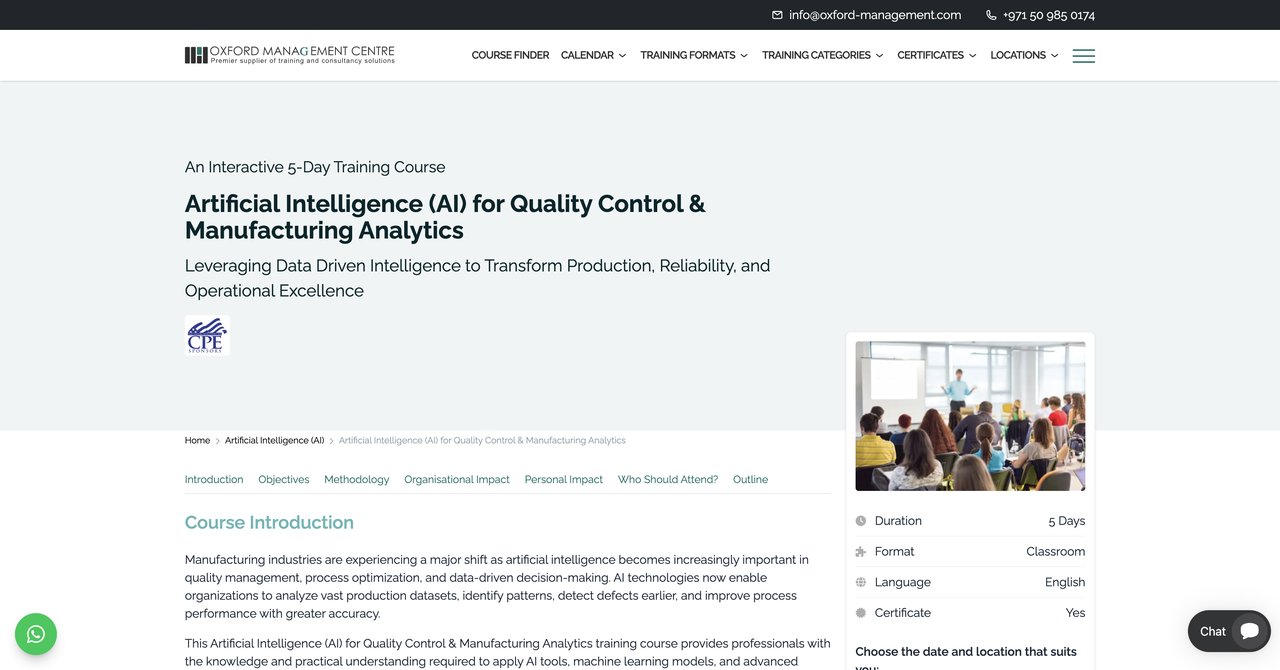
Oxford Management Centre offers an instructor-led program with a focus on manufacturing quality. The course explains AI and how you can use it in industrial contexts, with an eye towards predictive quality and scaling from pilot projects to full production environments. It's aimed at technical management and senior inspectors that will lead AI implementation or want to speak with data science teams in their own language.
The content is modern and industry relevant - real-time monitoring, predictive quality models, root cause analysis from large datasets. It skips the "what is AI?" part pretty quickly into implementation. Classroom-style teaching works well for people who want structured, intensive experience with an instructor.
Key topics covered include: AI foundations for operations and production, manufacturing-specific analytics, predictive quality, real-time monitoring, scaling AI in production facilities, and managing teams to implement these changes.
Target audience and skill level: mid-to-senior level professionals and people tasked with implementing AI in their organization's quality. Learner needs some comfort with how data and measurement works in a production environment.
Pros:
- Covers AI foundations tailored to manufacturing quality
- Includes predictive quality and real-time monitoring
- Focuses on scaling AI in production environments
Cons:
- High price point
- Classroom-style format may not suit hands-on learners
Who would benefit most: a quality manager or lead inspector who needs to present ideas around data-driven quality initiatives and can think strategically about AI deployment.
Link: View Course
Course 3: AI for Quality Control and Assurance in Production Lines (Online) by NobleProg
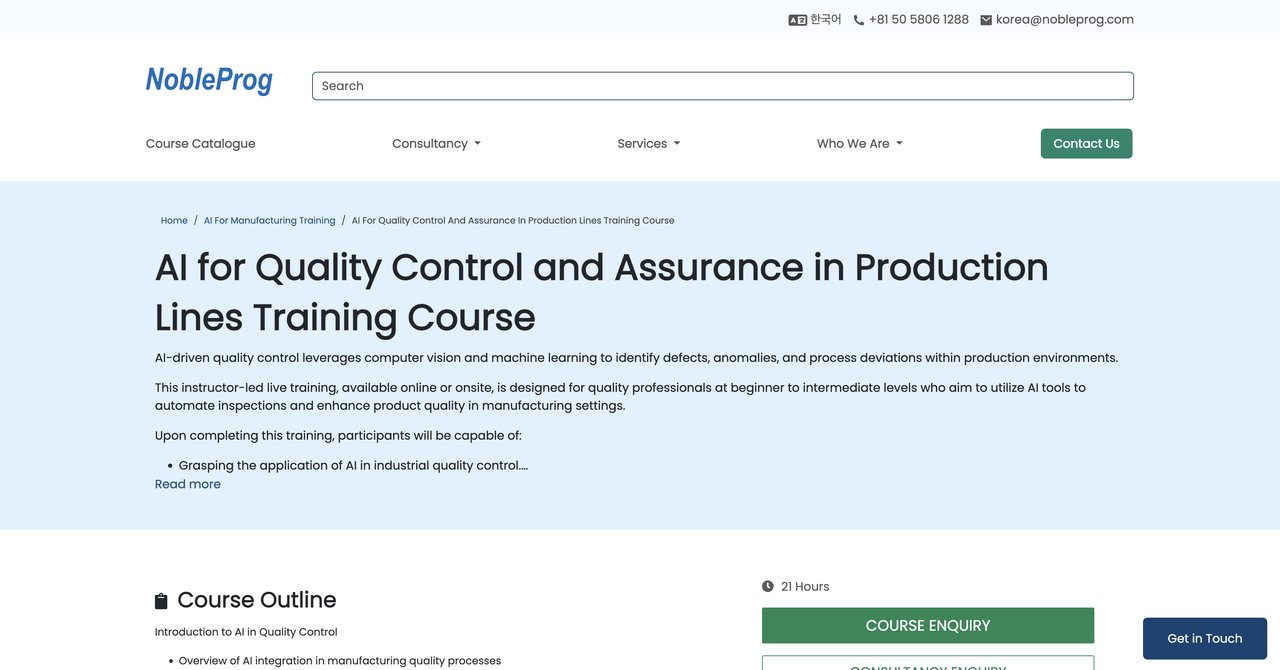
NobleProg delivers a live, instructor-led course focused specifically on automating quality inspections. The title says a lot: this is not about strategy, it's about directly applying AI tools to inspect, detect, and improve processes in a hands-on environment. Participants perform exercises and implement AI tools in a live-lab setup, so you're not listening to a lecture; you are actually working with the tools.
The class is designed for QC inspectors and QA technicians at the line level, maybe people need to start using automated systems for inspection and removing bottlenecks. The instructor-led format, online or on-site, gives you attentive help from someone who knows the content.
Key topics covered: AI in inspection, automated defect detection, image recognition in production quality, and implementing AI in a live-lab environment.
Target audience: production level quality and inspection personnel. Skill level: beginner/intermediate, no prior AI data scientist skills expected.
Pros:
- Instructor-led live training (online or onsite)
- Hands-on implementation in live-lab environment
- Tailored for automating inspections in manufacturing
Cons:
- Expensive
- Limited to beginner/intermediate scope
Who would benefit most: hands-on QC inspectors who want to understand and try AI tools directly, in the actual environment of their day-to-day work, with help from an available instructor.
Link: View Course
Course 4: Artificial Intelligence for Quality Control and Assurance in Production Lines (Singapore) by NobleProg
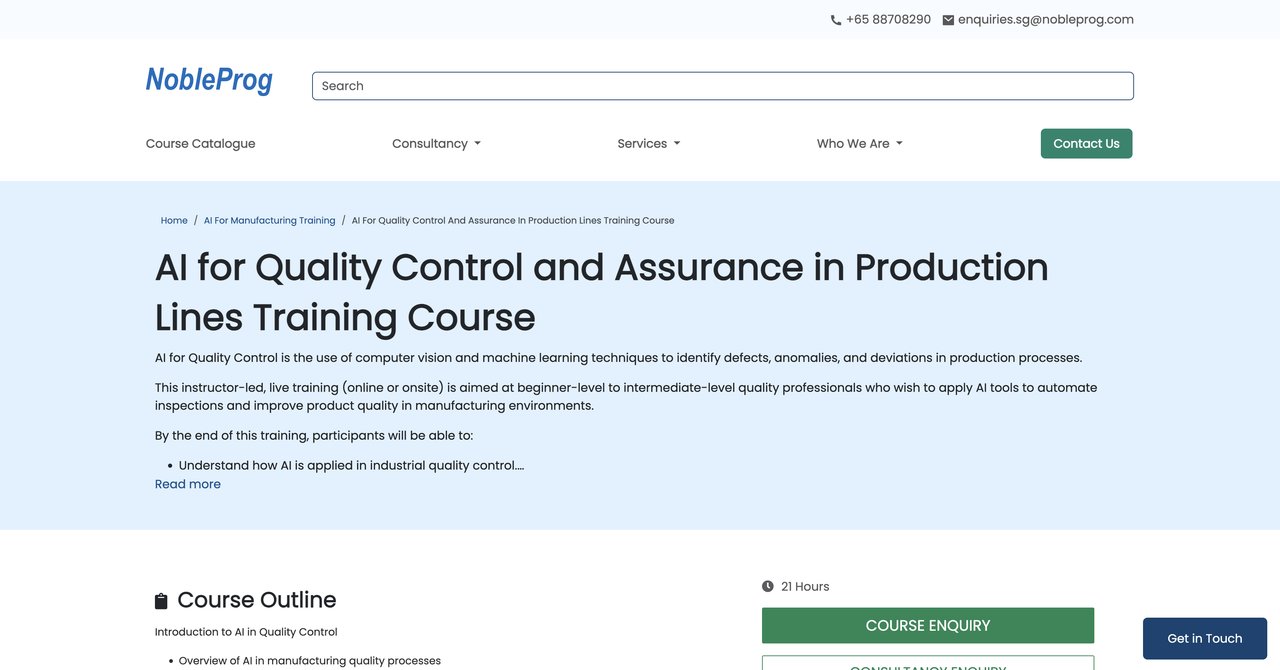
This is the same NobleProg course but it is set in Singapore and is specific to onsite or online, regional delivery. It covers similar curriculum, emphasizing how to automate inspection tasks and what the uses are to maintain product quality. The course uses interactive lectures plus exercises. Because it's in Singapore time zones, those are in APAC could use this easier, although the "regional focus may not suit all time zones for remote participants overseas."
Key topics covered: AI techniques for inspection, automated defect identification on production lines, integrating quality assurance with AI tools, and hands-on exercises.
Target audience: QC inspectors and QA teams based in Asia or those who want training in the region. Beginner skill level.
Pros:
- Interactive lectures with exercises
- Hands-on implementation
- Available onsite or online in Singapore
Cons:
- Premium pricing
- Regional focus may not suit all time zones
Who would benefit most: QC professionals based in Asian time zones that want structure and instructor interaction.
Link: View Course
Course 5: Artificial Intelligence for QC and QA in Production Lines (Switzerland) by NobleProg
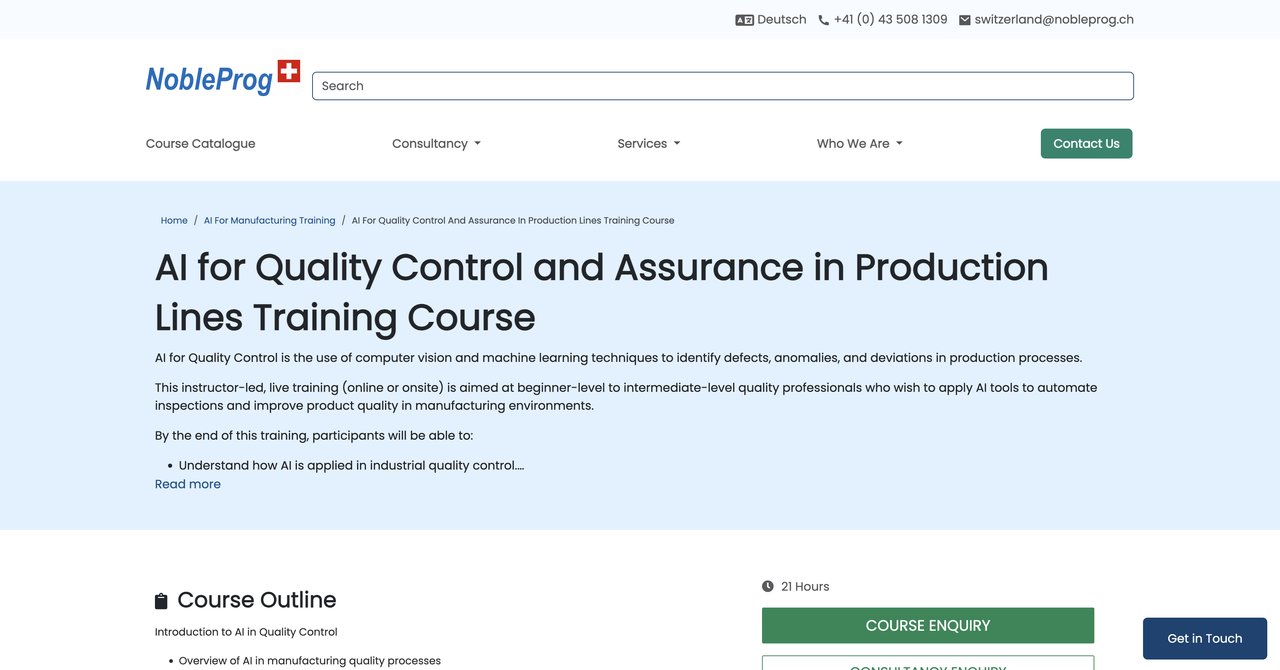
Again, the same NobleProg course with a locale using Switzerland. The approach is similar: instructor-led, onsite or online, covering AI tools for automated inspections and improvement in manufacturing QC. It emphasizes practical exercises for manufacturing QC needs. A significant disadvantage is that the price is not listed publicly, so you need to contact them for a quote, complicating the evaluation between options.
The course covers technology inspection in detail. It might be useful for Swiss-based manufacturer or someone who wants to attend in-person in Switzerland in the name of good quality. However, the price is unknown and skill-level is still limited to beginner/intermediate, which doesn't have that "advanced" ceiling for CAD-type applied inspectors who need experienced knowledge.
Pros:
- Instructor-led live training
- Available onsite or online in Switzerland
- Practical exercises for manufacturing QC
Cons:
- Price not listed publicly
- Limited to beginner/intermediate level
Who would benefit: Professionals who prefer instructor led training in Switzerland and want to study in a small group.
Link: View Course
Course 6: Certified Artificial Intelligence (AI) for Quality Managers Training by The Knowledge Academy
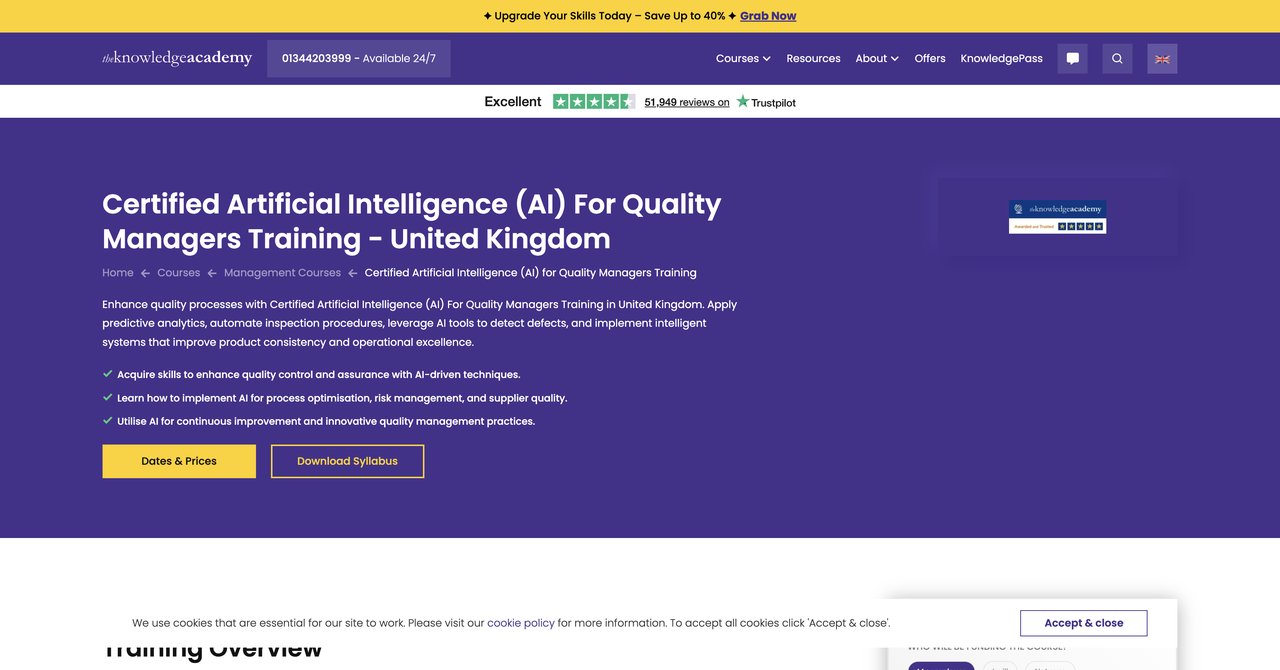
Based in the UK, Knowledge Academy has a certification path for quality managers and QA specialists. The content specifically addresses quality as a system, including risk management and supplier quality, not just defect detection. It's taught with a wider viewpoint-how AI fits in audits, documentation, and care around risk across processes, not just in inspecting the product.
The price is in USD approx $1,900, but actual rate may vary; the training duration stays unspecified, so you'll have to email them. One convenience: it's one of the few AI courses that focus on 'quality' as a full process rather than just line-inspection, so if you manage suppliers or are responsible for multiple QA standards, this one's worth looking into.
Pros:
- Certification recognized in the UK
- Covers AI for quality managers, QA specialists, and QC inspectors
- Includes risk management and supplier quality
Cons:
- Price not fully transparent
- Duration not specified
Who would benefit most: Quality Managers and people with responsibility for quality systems at organizational level, and those in the UK or working with UK markets to get a recognized cert.
Link: View Course
Course 7: Graduate Certificate in AI Enabled Food Quality Inspection by Stanmore UK
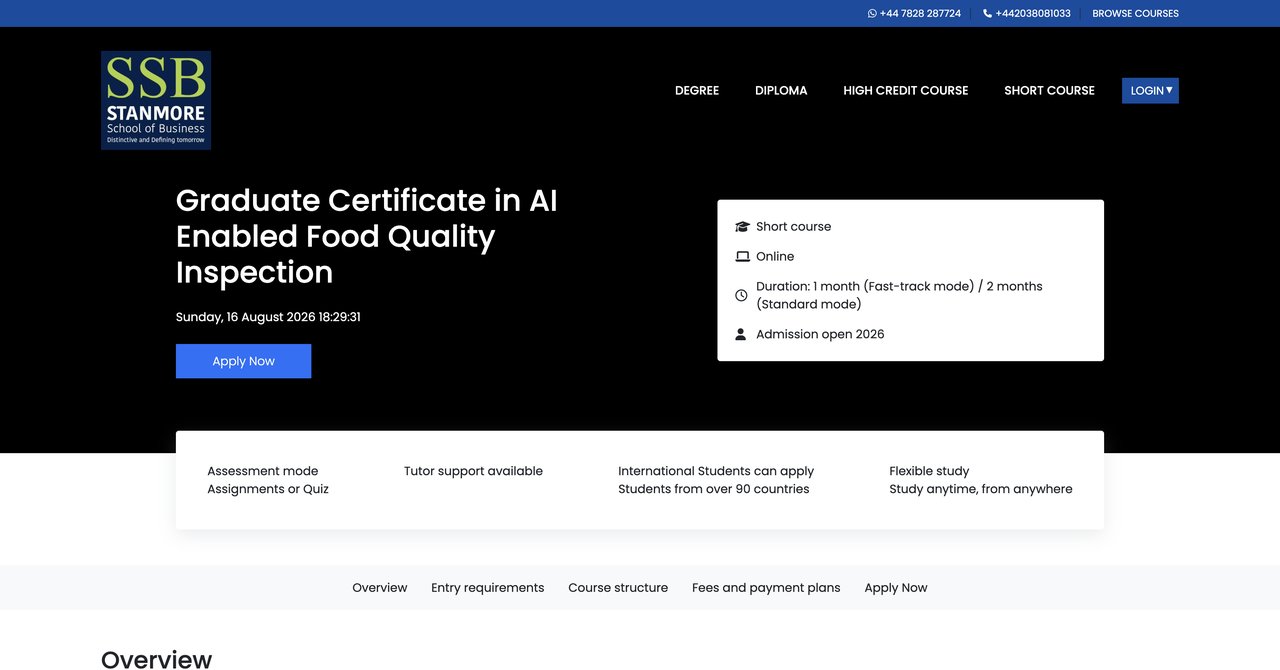
This is an online certificate that is cheap, only about $115-178 depending on fast-track. The target is people in food manufacturing: with AI and food safety, visual inspection, and food quality assessment. It's domain-specific, so you won't get general topics about QC; just food industry. The price makes it accessible, and it's literally a flexible online certificate you can do around a job.
The content, from the description, is focused on AI for food quality inspection - how to use machine vision and automated quality assessment in a food context, whether we talk safety or classification standards. Stanmore's stuff is typically self-paced.
Pros:
- Affordable
- Online and flexible
- Focused specifically on AI in food quality inspection
Cons:
- Niche to food industry
- Beginner level only
Who would benefit most: entry-level inspectors or food processing workers who want a low-cost, industry-specific start without deep technical commitment.
Link: View Course
Course 8: AI Food Quality Inspection: Professional Certification by Stanmore UK
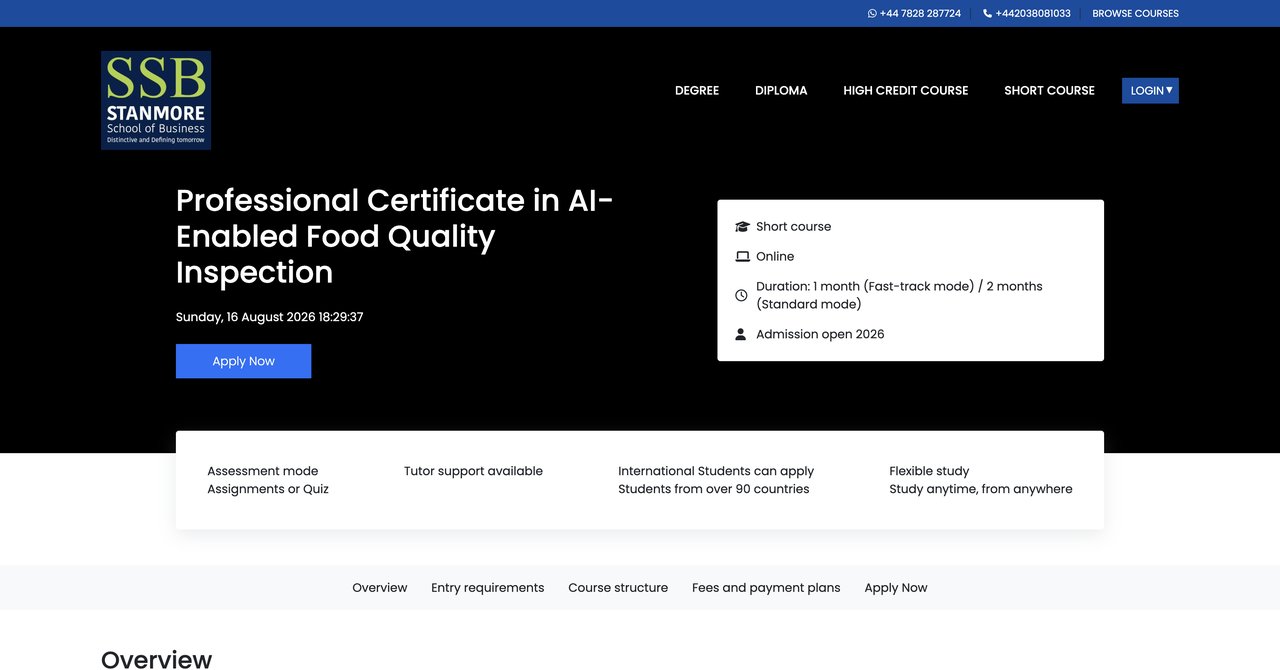
This is again Stanmore's second option, but it sets itself as a "professional" certification. The content is heavier on machine learning applications and automated quality assessment. It's intense and more technically detailed than the graduate certificate. It says "professional", a progression for inspectors who have already known the basics and want to move past may not be caught up to a broader scale.
They focus exclusively on food. The problem: price is unknown, duration not listed, which is a deterrent for practical professionals who need a clear estimate upfront. If you work exclusively in food manufacturing at a deeper, level, and you're okay with price discovery, consider.
Pros:
- Focuses on AI-driven inspection techniques
- Covers machine learning applications and automated quality assessment
- Tailored for food industry
Cons:
- Price and duration not listed
- Limited to food sector
Who would benefit most: experienced food industry inspectors/technologists wanting a deeper focus on AI applications
Link: View Course
Course 9: IA aplicada à Qualidade by Petra Cursos EAD
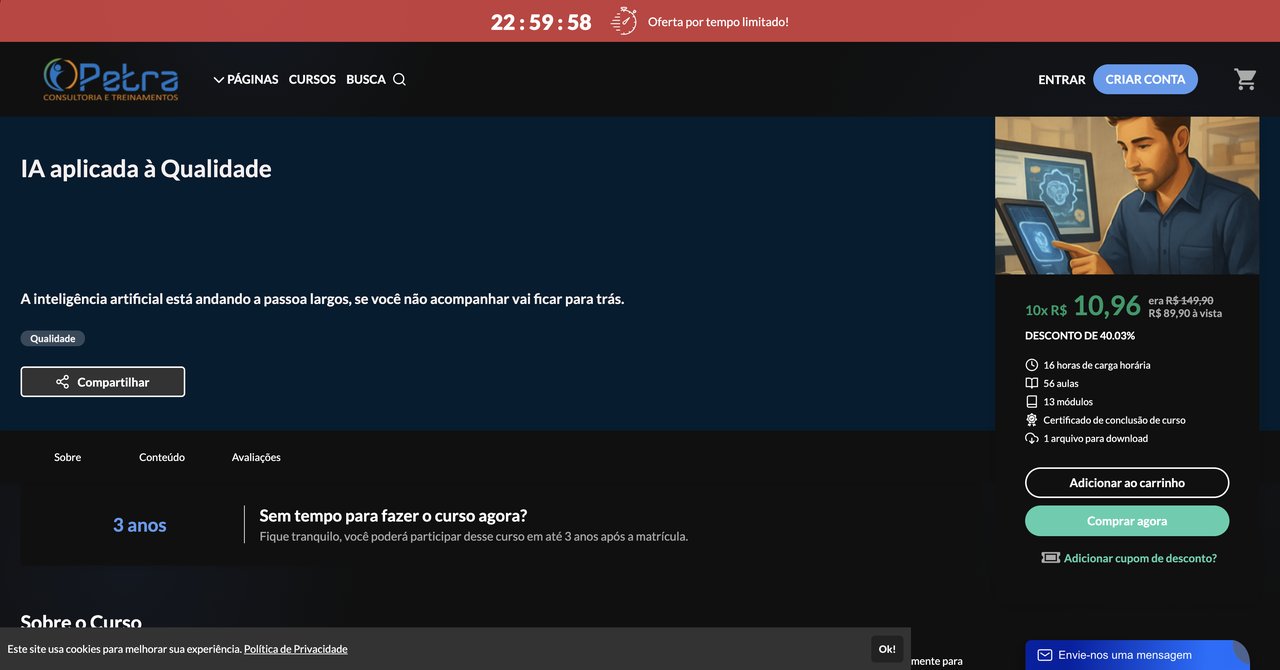
This Brazilian course is one of the most affordable options and focuses entirely on practical applications. It's in Portuguese; with AI tools like ChatGPT, Excel, Power BI, and Copilot, with QC-specific use like audits, inspection reports, non-conformity analysis, and ISO preparation. What stands out is the 100% practical and ready-to-use prompts. You can copy from the modules and use them in your daily job immediately, designed for people who aren't looking for high theory-
The main challenge: it's Portuguese-language only, so if you are fluent in Portuguese and work in QA, this is a particularly good value. For non-Portuguese speakers, no. It uses the tools around you, on your desktop as is - ChatGPT, Power BI, etc. - so there's no installation of complex platforms... a great way to make AI tangible.
Key topics: audits, inspection reports, non-conformity analysis, ISO 9001 prep and quality documentation, automation of reporting with AI.
Pros:
- 100% practical with case studies
- Ready-to-use AI prompts for QC tasks
- Covers ChatGPT, Excel, Power BI, and Copilot
- Portuguese language
Cons:
- Portuguese only
- Beginner level
Who would benefit most: Portuguese-speaking QC professionals quality of who want a cheap, fast, way to use AI tools in their current tasks; perfect for small businesses and no budget.
Link: View Course
Overall Recommendations: Choosing the Right AI Course for Quality Control Inspectors
Selecting the right course requires looking what matters to you: cost, scope, depth in AI, limitations of domain, and how you like to learn. Here is a honest summary:
If you want the most comprehensive value and you're committed to staying in quality field for longer, the CompleteAI Training subscription is a safe bet. One subscription unlocks all courses and all certifications-not just this one, but on the entire platform across all job roles. That means if you're a QC inspector that also does production or compliance, you can cross-train without paying extra. The ability to access any other job role materials provides real flexibility for growth. It's the only training listed with almost unlimited scope, and the subscription price - especially with the annual billing - turns out to be a very small amount of money compared to the cost of a single course. It's hard to beat for individual learners.
If you are being sent to training by an employer and they're paying, NobleProg's instructor led courses will give you live interaction. But the high price and intermediate scope mean that you might need to get a second course later. Oxford Managers Center offers a more strategic vision, suitable for senior managers who are expected put in place AI at a factory floor, but it's also expensive. If you are very concerned about the UK certification specifically as a formal credential, the Knowledge Academy route has its place, however their price opacity was a sour spot.
For those in food manufacturing and on a limited budget, Stanmore's low cost beginner options are excellent for entry. But if you're in another industry, they have less need. If you speak Portuguese, Petra's quality & AI course is the best cheap option possibly in the whole list - It's closest to real life routines you actually do day to day.
The 'best' option depends on who is paying and what you're in a position to do as part of your ongoing professional journey. A team lead with a budget may go for Oxford. An individual looking for quick, practical skills will find more value in CompleteAI Training, because of its breadth, value, and full included certifications. And if you're early in your job and only want a certificate that says something, the Stanmore or Petra courses work for their various niches. For most existing QC inspectors and those planning everything else around quality, the SMA of breadth and relatively low cost from a CompleteAI subscription is the best all-around recommendation. It doesn't force you into the beginner/or intermediate course forever and the subscription model means as AI evolves, so do you at no added cost.
Looking at actual cost would like to tell who not to pay 5,000 for a beginner/intermediate course when an affordable platform that does the same job, plus more, is more budget friendly; the majority of them could get skill required from less expensive. Spend wisely, activate on one, and do the work.