
Certification
Certification: AI Engineering Foundations
Earn the AI Engineering Foundations certification from Complete AI Training by completing the AI Engineering Fundamentals course and demonstrating you can design, debug, evaluate, and productionize LLM agents, RAG systems, and model infrastructure.
The exam
Take the certification exam
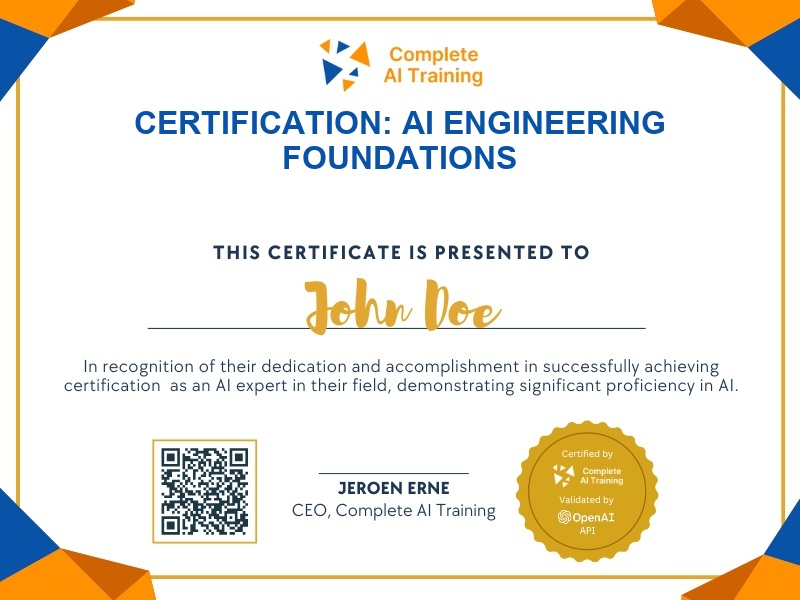
Multiple-choice questions about the course. Pass with 70% or more and your certificate is issued at once, with a public page and an "Add to LinkedIn" button.
What the exam covers
2 questions from each of the 34 chapters of the course
20 multiple-choice questions, drawn fresh for every attempt. Pass with 70% or more.
- 01Course Introduction: What an AI Engineer Builds2:46
- 02What Makes Something an Agent3:57
- 03Five Core Subsystems Around an Agent4:17
- 04Single Agent vs. Multi-Agent: When One Isn't Enough4:12
- 05Agent Memory: Why Agents Forget4:19
- 06The Context Window as a Budget5:43
- 07Tool Calling: How an Agent Does Something6:38
- 08MCP (Model Context Protocol)5:01
- 09MCP vs. Agent Skills4:32
- 10Agent Roles and Boundaries3:51
- 11The AI Gateway6:15
- 12Beyond Basic RAG: Why Simple Retrieval Stops Working5:34
- 13A Field Guide to RAG Variants5:23
- 14Knowledge Graphs vs. GraphRAG vs. Graph Engineering5:22
- 15Agentic RAG4:37
- 16Building a Living Knowledge Base Instead of a Notes Graveyard7:17
- 17Data Architecture for AI6:26
- 18From Early Neural Networks to Transformers5:33
- 19Changing a Model: Knowledge, Behavior, or Size?5:09
- 20LoRA: How Teams Fine-Tune Without Retraining Everything4:08
- 21Distillation: Teaching a Small Model to Act Like a Big One4:40
- 22Reinforcement Learning's Role in Modern Model Training6:58
- 23The Chip Alphabet5:55
- 24What CUDA Does, and Why AI Depends on It4:52
- 25Inside a GPU: Training vs. Inference5:07
- 26Clouds Built for AI: Why Cloud Isn't One Thing5:06
- 27Prompt Caching and Other Cost Levers Most Teams Miss6:50
- 28SDLC vs. AIDLC5:41
- 29DevOps vs. MLOps vs. LLMOps, and Tracing Every Request4:43
- 30AI Evals: How Production Teams Know a System Still Works5:21
- 31Why AI Projects Fail in Production4:28
- 32AI Red Teaming: Testing a System Before Someone Else Does5:11
- 33Platform Engineering for AI5:24
- 34Putting It Together7:48
What it certifies
This certification from Complete AI Training confirms that you have completed the AI Engineering Fundamentals: Agents, RAG, Models and Production course and can make practical, production-oriented decisions about AI systems. It certifies foundational competence in designing agent architectures with memory and tool calling, selecting retrieval approaches, customizing models, managing GPU-based infrastructure, and applying evals, tracing, and red teaming to make AI systems more reliable.
Skills you prove
- Designing single-agent and multi-agent systems with memory, context budgets, and clear agent roles
- Connecting tools through tool calling, MCP, and agent skills, and routing requests through an AI gateway
- Choosing and implementing RAG variants including basic, self-correcting, graph, GraphRAG, and agentic RAG
- Deciding when to fine-tune with LoRA, distil a model, or apply reinforcement learning
- Optimizing GPU usage, CUDA, AI cloud infrastructure, prompt caching, and inference cost levers
- Running evals, tracing, red teaming, and platform engineering controls for production AI systems
Who it is for
This certification is for software engineers, ML engineers, data professionals, platform engineers, and technical product managers who build, operate, or evaluate production AI systems. It is also appropriate for experienced engineers moving into AI engineering and for teams that want a shared foundation across agents, RAG, models, and production reliability.
How the exam works
The certification exam is an online, timed, multiple-choice assessment. Questions are drawn from every lesson in the course, including agent subsystems, memory, tool calling, RAG variants, model customization, GPUs and CUDA, evals, tracing, red teaming, and platform engineering. A passing score demonstrates mastery of the foundational concepts and practical trade-offs covered in the course.