
Certification
Certification: Build Large Language Models from Scratch with Python
Show the world you have AI skills with a certification in building large language models from scratch using Python. Gain hands-on experience designing, training, and evaluating advanced AI models to boost your expertise and career prospects.
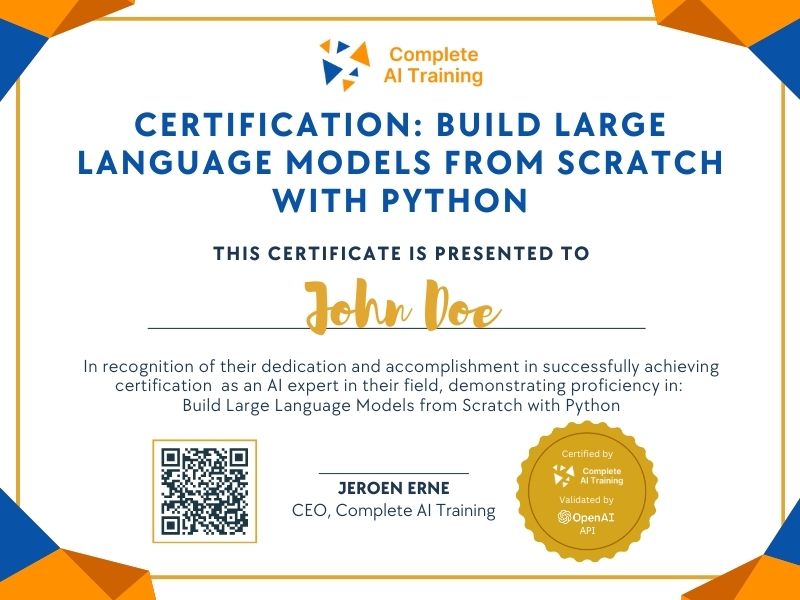
The exam
Take the certification exam
Multiple-choice questions about the course. Pass with 70% or more and your certificate is issued at once, with a public page and an "Add to LinkedIn" button.
What the exam covers
2 questions from each of the 15 chapters of the course
20 multiple-choice questions, drawn fresh for every attempt. Pass with 70% or more.
- 01Intro and setup12:11
- 02Data, tokenizers and tensors21:17
- 03PyTorch overview and GPU32:35
- 04Embeddings and dot products19:39
- 05Matmul, batches and gradient descent25:11
- 06Logits, generation and training loop27:18
- 07Loss, normalisation and activations28:44
- 08Transformer architecture30:59
- 09Building a GPT29:02
- 10Standard deviation for parameters13:54
- 11Transformer blocks and attention18:53
- 12Scaling by 1/√dk and hyperparameters18:13
- 13Scaling the data27:36
- 14Scripts and GPU memory16:32
- 15Prompt completion and next steps21:37
The Certification: Build Large Language Models from Scratch with Python equips you with the hands-on skills to develop advanced language models using Python and leading deep learning frameworks. By completing this program, you will gain practical expertise in neural network components, training methodologies, and advanced techniques, giving you a competitive edge and future-proofing your career in AI and machine learning. Enroll today to unlock higher income potential and adaptability in the evolving world of artificial intelligence.
This certification covers the following topics:
- Core Concepts of Language Models (Bigram)
- Introduction to PyTorch
- Neural Network Components
- Attention Mechanisms: Self-Attention and Multi-Head Attention
- Training Methodologies and Hyperparameter Tuning
- Embedding Vectors and Their Importance
- Significance of Positional Encoding in Transformer Networks
- Utilizing GPUs for Efficient Model Training
- Role of the Loss Function and Gradient Descent
- Tokenizers: Character-Level vs. Word-Level