
Certification
Certification: Build Stable Diffusion VAEs from Scratch with PyTorch
Upgrade your CV with hands-on skills in building Stable Diffusion VAEs using PyTorch. Gain practical AI experience by designing, training, and evaluating custom models—demonstrating your expertise in one of today’s most innovative fields.
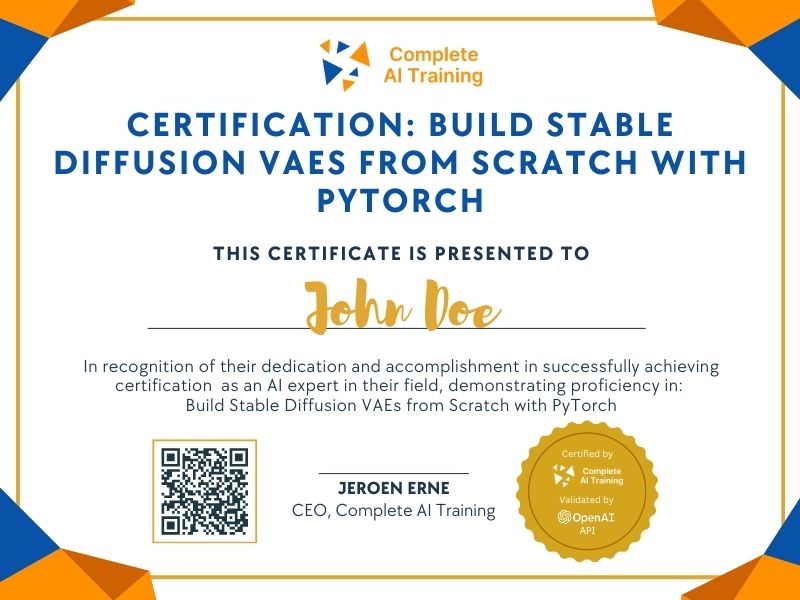
The exam
Take the certification exam
Multiple-choice questions about the course. Pass with 70% or more and your certificate is issued at once, with a public page and an "Add to LinkedIn" button.
What the exam covers
2 questions from each of the 5 chapters of the course
10 multiple-choice questions, drawn fresh for every attempt. Pass with 70% or more.
- 01Understanding VAEs3:36
- 02Implementing model blocks13:29
- 03Building encoder and decoder7:46
- 04Training the VAE10:12
- 05Integration with diffusion8:15
The Certification: Build Stable Diffusion VAEs from Scratch with PyTorch equips you with in-depth knowledge of designing and implementing advanced Variational Autoencoders for image generation. Gain valuable skills such as improved decision-making, increased productivity, and a competitive advantage in the rapidly evolving field of AI-powered image synthesis. Enroll today to boost your expertise and future-proof your career in machine learning.
This certification covers the following topics:
- Understanding Variational Autoencoders (VAEs)
- VAE Architecture and Training
- Implementation Details and Key Modules
- Self-Attention Mechanism
- Encoder and Decoder Architectures
- Training the VAE
- Integrating the Custom VAE with Stable Diffusion
- What loss functions are used to train the VAE, and what does each component aim to achieve?
- What is the reparameterization trick and why is it necessary?
- How does self-attention enhance the performance of a VAE?
- What are the key components of the training loop for a VAE?
- What are the advantages of using a VAE over a GAN for image generation?