
Certification
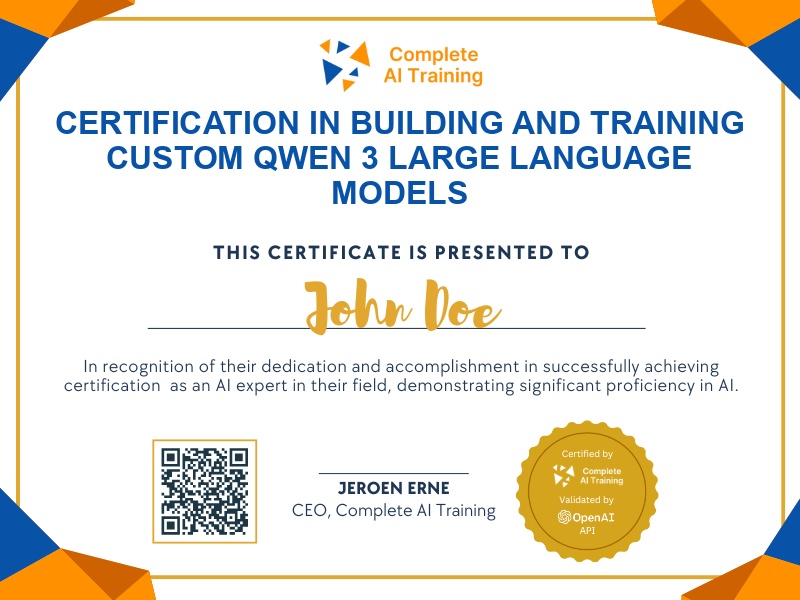
Certification in Building and Training Custom Qwen 3 Large Language Models
Get certified in LLM Development with Qwen 3. Demonstrate skills in designing, coding, and training multilingual AI models,enabling you to build, customize, and deploy advanced language solutions for real-world applications.
The exam
Take the certification exam
Multiple-choice questions about the course. Pass with 70% or more and your certificate is issued at once, with a public page and an "Add to LinkedIn" button.
What the exam covers
2 questions from each of the 15 chapters of the course
20 multiple-choice questions, drawn fresh for every attempt. Pass with 70% or more.
- 01Intro and demo1:46
- 02Architecture and setup3:40
- 03Model configuration3:00
- 04Qwen 3 specifics3:58
- 05Training hyperparameters4:54
- 06Grouped query attention logic1:38
- 07Muon optimizer10:06
- 08Data loading and tokenization3:35
- 09RoPE positional embeddings4:19
- 10Self-attention code7:32
- 11Feed-forward and SwiGLU3:08
- 12Building the final model4:58
- 13Evaluation and the training loop3:09
- 14Running the training2:55
- 15Inference and results4:26
The "LLM Development Essentials: Build and Train Qwen 3 from Scratch (Video Course)" certification equips you to design, code, and train your own multilingual large language model using Qwen 3. By mastering these advanced techniques, you'll gain a competitive edge, enhance your adaptability, and open doors to higher income potential in the rapidly evolving AI landscape. Enroll now to future-proof your career and unlock new opportunities in large language model development.
This certification covers the following topics:
- Understanding Qwen 3 and its core architectural features
- Implementing advanced Transformer architectures
- Applying Grouped Query Attention (GQA)
- Utilizing SwiGLU activation functions
- Integrating Rotary Positional Embeddings (RoPE)
- Implementing RMS Normalization
- Optimizing training with the Muon optimizer
- Designing and preparing effective datasets
- Training Qwen 3 from data preprocessing to model building
- Measuring model performance with loss and perplexity metrics
- Managing computational constraints and hardware limitations
- Advanced inference techniques and output fine-tuning