
Certification
Certification in Building & Deploying LLMs and Transformers with PyTorch
Get certified in AI Research: Math, PyTorch, LLMs & Transformers , prove you can read papers, build and train GPT-style models in PyTorch, fix shape bugs, evaluate results, and ship production-ready prototypes.
The exam
Take the certification exam
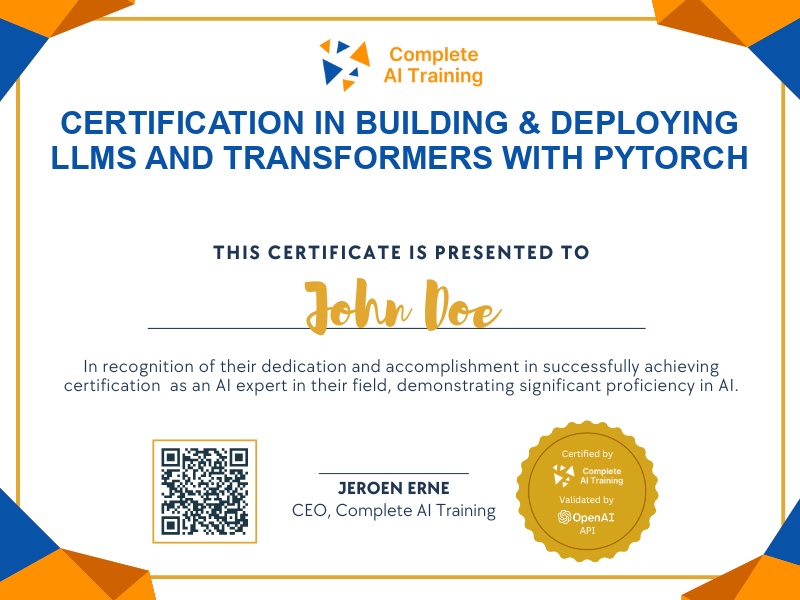
Multiple-choice questions about the course. Pass with 70% or more and your certificate is issued at once, with a public page and an "Add to LinkedIn" button.
What the exam covers
2 questions from each of the 15 chapters of the course
20 multiple-choice questions, drawn fresh for every attempt. Pass with 70% or more.
- 01Welcome and setup10:48
- 02Functions8:22
- 03Derivatives14:09
- 04Vectors12:48
- 05Gradients8:56
- 06Matrices13:36
- 07Probability and tensors19:09
- 08Squeezing and unsqueezing13:14
- 09Indexing and slicing8:53
- 10Special tensors and neurons13:12
- 11Multi-layer networks and backprop11:07
- 12Attention: queries, keys, values18:25
- 13Self-attention, causal masks and RoPE11:28
- 14Multi-head attention10:56
- 15Transformer block and tokenization11:49
Become an AI Researcher: Math, PyTorch, LLMs & Transformers (Video Course) is a practical, video-first certification that takes you from Python basics to reading papers and building GPT-style models. You'll develop the math intuition that makes training work, the PyTorch chops to fix shape bugs and move fast, and career benefits like Increased Productivity, Competitive Advantage, Improved Decision-Making, Adaptability and Growth, Higher Income Potential, and a Future-Proof Career. If you're ready to contribute,not just watch,enroll and turn curiosity into working systems and research-ready skills.
This certification covers the following topics:
- Python-to-PyTorch fundamentals: tensors, indexing, slicing, and boolean masking
- Tensor shapes and operations: reshape, view, squeeze/unsqueeze, transpose, and permute
- Core math for deep learning: functions, derivatives, gradients, vectors, and matrices
- Probability for reasoning under uncertainty
- Neural network building blocks: single neurons, activation functions, and forward passes
- Loss functions, optimization, and a minimal training loop in PyTorch
- Autograd and backpropagation for end-to-end differentiation
- Attention mechanics: Q, K, V, scaled dot-product, softmax, and causal masking
- Transformer architecture: multi-head attention, positional embeddings, residual connections, layer normalization, and feed-forward blocks
- Decoder-only GPT stack and step-by-step training (data, batching, evaluation)