
Certification
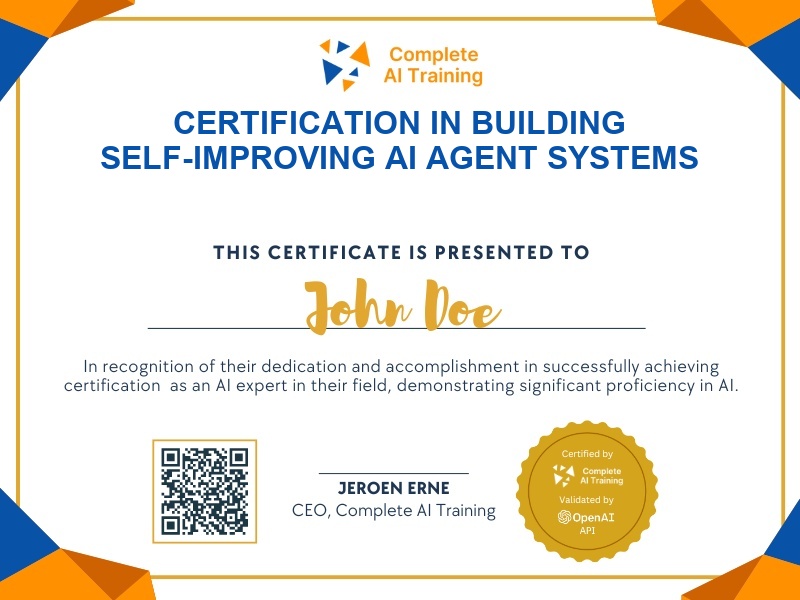
Certification in Building Self-Improving AI Agent Systems
Become certified in Self-Improving AI Agents. You'll prove you can build agentic systems that scale inference-time compute and self-correct on their own,turning model knowledge into reliable solutions for hard problems.
The exam
Take the certification exam
Multiple-choice questions about the course. Pass with 70% or more and your certificate is issued at once, with a public page and an "Add to LinkedIn" button.
What the exam covers
2 questions from each of the 11 chapters of the course
20 multiple-choice questions, drawn fresh for every attempt. Pass with 70% or more.
- 01Course introduction2:00
- 02Scaling laws5:48
- 03Emergent reasoning5:18
- 04Fine-tuning and alignment6:54
- 05Test-time scaling and monkeys10:00
- 06Scaling at inference and self-improvement10:47
- 07From chatbots to agents9:13
- 08Self-improvement and verifiers7:03
- 09Research agents and AI scientists4:26
- 10Logistics and assignments1:05
- 11Final project7:08
The Self-Improving AI Agents: From Scaling Laws to Agentic Systems (Video Course) certification digs into a fascinating idea: ask a hard problem once and a model might fail, but give it ten thousand tries and it can succeed. This course teaches you how inference-time scaling and self-improvement loops turn latent model knowledge into working systems, giving you a serious edge in productivity, decision-making, and future-proofing your career. If you want to build AI agents that actually learn and improve, this is the certification to grab.
This certification covers the following topics:
- Inference-time scaling and test-time compute
- Scaling laws and their implications for agent design
- Self-improvement loops and iterative refinement
- Search and sampling strategies for hard problems
- Reward modeling and feedback signals
- Designing agentic systems with LLMs
- Evaluation and benchmarking for self-improving agents
- Common failure modes and how to avoid them
- Building autonomous workflows and pipelines
- Real-world case studies from Stanford CS329A