
Certification
Certification in Building Self-Improving AI Agents with Constitutional Feedback
Get certified in building self-improving AI agents who use tools and feedback to cut hallucinations, repair code in production, and ship safer, more reliable AI features.
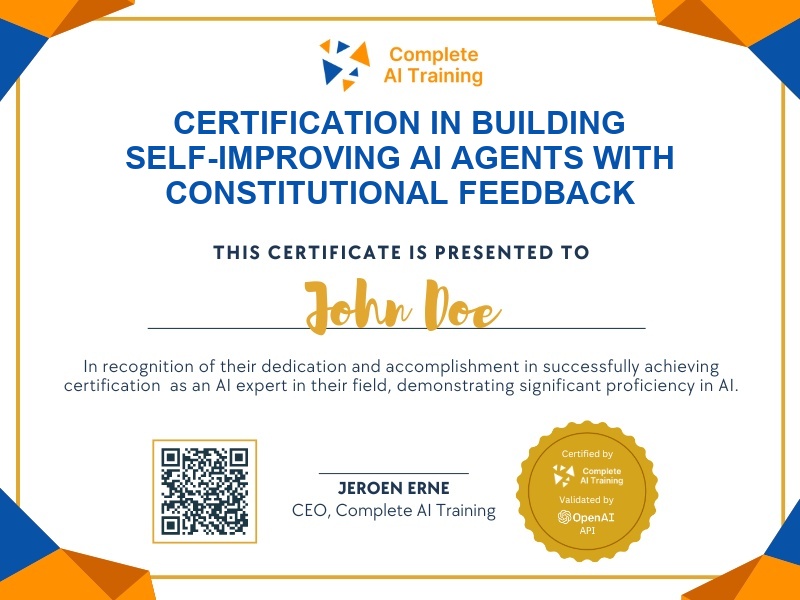
The exam
Take the certification exam
Multiple-choice questions about the course. Pass with 70% or more and your certificate is issued at once, with a public page and an "Add to LinkedIn" button.
What the exam covers
2 questions from each of the 10 chapters of the course
20 multiple-choice questions, drawn fresh for every attempt. Pass with 70% or more.
- 01Building on LLMs1:47
- 02ReAct8:33
- 03ReAct on grounded tasks13:00
- 04ReAct's challenges12:40
- 05RLEF: execution feedback for code5:27
- 06RLEF deep dive4:59
- 07Constitutional AI6:51
- 08Constitutional AI results12:38
- 09Experience versus reasoning1:08
- 10Summary and takeaways4:10
This certification, built around Stanford's CS329A video course, takes you from static LLMs to self-improving AI agents that actually think, act, and get better over time. You'll pick up hands-on skills in tool integration, execution feedback, and constitutional design,which translates into fewer hallucinations, faster debugging, and sharper decision-making, not to mention a serious competitive advantage and a future-proof career. If you're ready to build AI that learns from its own mistakes and earns trust in real-world systems, this is the course for you.
This certification covers the following topics:
- Building autonomous agents from base LLMs
- Connecting agents to external tools and APIs
- Execution feedback loops for self-correction
- Constitutional AI principles and behavior guardrails
- Reducing hallucinations through iterative reflection
- Automated debugging and code repair with agents
- Designing safe multi-step reasoning workflows
- Evaluating agent performance and reliability
- Prompt engineering for agentic behavior
- Deployment strategies for production-ready agents