
Certification
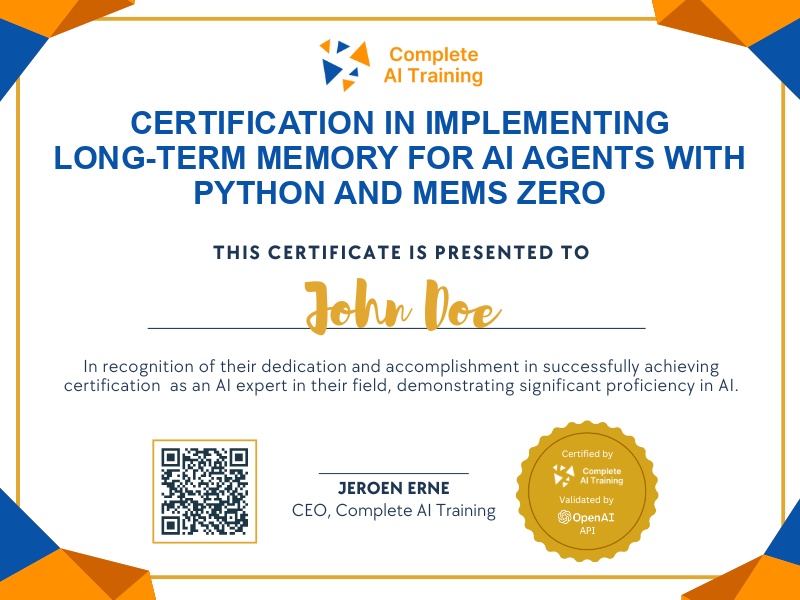
Certification in Implementing Long-Term Memory for AI Agents with Python and MEMS Zero
Get certified in Building Persistent Memory for AI Agents with Python and MEMS Zero. Demonstrate your ability to create context-aware AI assistants that recall user data, adapt interactions, and deliver smarter, more personalized support.
The exam
Take the certification exam
Multiple-choice questions about the course. Pass with 70% or more and your certificate is issued at once, with a public page and an "Add to LinkedIn" button.
What the exam covers
2 questions from each of the 9 chapters of the course
18 multiple-choice questions, drawn fresh for every attempt. Pass with 70% or more.
- 01AI memory systems1:17
- 02Memory management and ChatGPT memory1:42
- 03The Mem0 framework2:49
- 04Code examples3:23
- 05Cloud quickstart1:33
- 06Open-source version2:27
- 07Qdrant for long-term memory5:31
- 08Memory challenges1:13
- 09Summary and next steps2:41
The "Building Long-Term Memory for AI Agents with Python and MEMS Zero" certification empowers you to create AI assistants that remember, adapt, and deliver truly personalized experiences. Gain in-demand skills such as context-aware memory development, advanced Python implementation, and persistent data management,boosting your productivity, adaptability, and career opportunities. Enroll now to master the tools and techniques that set top AI professionals apart.
This certification covers the following topics:
- The Memory Problem in AI Agents
- Introducing MEMS Zero: The Open-Source Memory Framework
- MEMS Zero’s Two-Phase Memory Pipeline: How It Works
- The Role of LLMs in MEMS Zero Memory Management
- How MEMS Zero Stores and Retrieves Memories
- Integrating MEMS Zero with Qdrant for Persistent Memory
- Building an AI Chat Assistant with MEMS Zero and Qdrant: Step-by-Step
- Prompt Engineering for Reliable Memory Management
- Understanding and Customizing MEMS Zero Prompts
- Tips, Pitfalls, and Best Practices for Production-Ready Memory Systems
- Case Studies: Applying MEMS Zero in Real-World Scenarios