
Certification
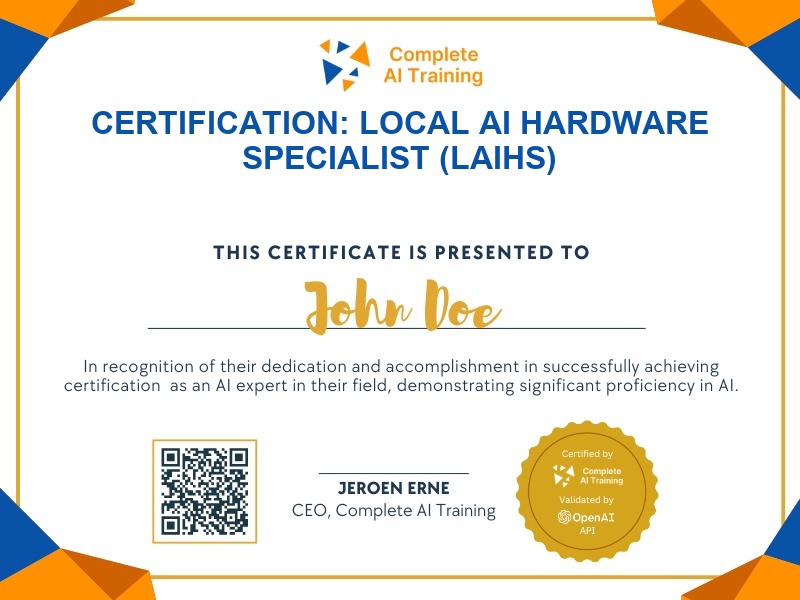
Certification: Local AI Hardware Specialist (LAIHS)
Validates your ability to evaluate and select local AI hardware across Apple, AMD, and NVIDIA platforms for real-world model deployment.
The exam
Take the certification exam
Multiple-choice questions about the course. Pass with 70% or more and your certificate is issued at once, with a public page and an "Add to LinkedIn" button.
What the exam covers
2 questions from each of the 4 chapters of the course
8 multiple-choice questions, drawn fresh for every attempt. Pass with 70% or more.
- 01Apple Mac Mini M6 / M5 Pro: Local AI in a Compact Setup17:43
- 02HP Z2 Mini G1a: 128GB AI Workstation19:40
- 03NVIDIA DGX Spark: CUDA for Local AI11:39
- 04Apple Mac Studio M5 Ultra: High-End Local AI19:25
What it certifies
The Local AI Hardware Specialist certification confirms you can compare memory bandwidth, estimate model fit, and calculate cost per token across four major local AI machines: Mac Mini M6/M5 Pro, HP Z2 Mini G1a, NVIDIA DGX Spark, and Mac Studio M5 Ultra. You understand how prefill and decode speeds affect chat and coding workflows, and you can match hardware tiers to model sizes before purchase.
Skills you prove
- Compare unified memory bandwidth across Apple, AMD, and NVIDIA platforms
- Estimate which model sizes fit in onboard memory before purchase
- Identify how prefill and decode speeds change real-world chat and coding use
- Evaluate cost per token of local models versus cloud APIs
- Choose a machine tier that matches model size and workflow needs
- Recognize practical limits of memory ceilings, GPUs, and upgrade paths
Who it is for
This certification is for developers, IT buyers, AI enthusiasts, and technical decision-makers who want to run local AI models confidently and avoid costly hardware mismatches. If you are evaluating a first local AI machine or upgrading an existing setup, this certification proves you can make evidence-based choices.
How the exam works
The exam is multiple choice, with questions drawn from each of the four course lessons. You must pass questions covering all four machines, including memory bandwidth comparisons, model-size estimation, token cost analysis, and workflow speed expectations. A passing score confirms you can apply the course frameworks to future hardware releases as well.