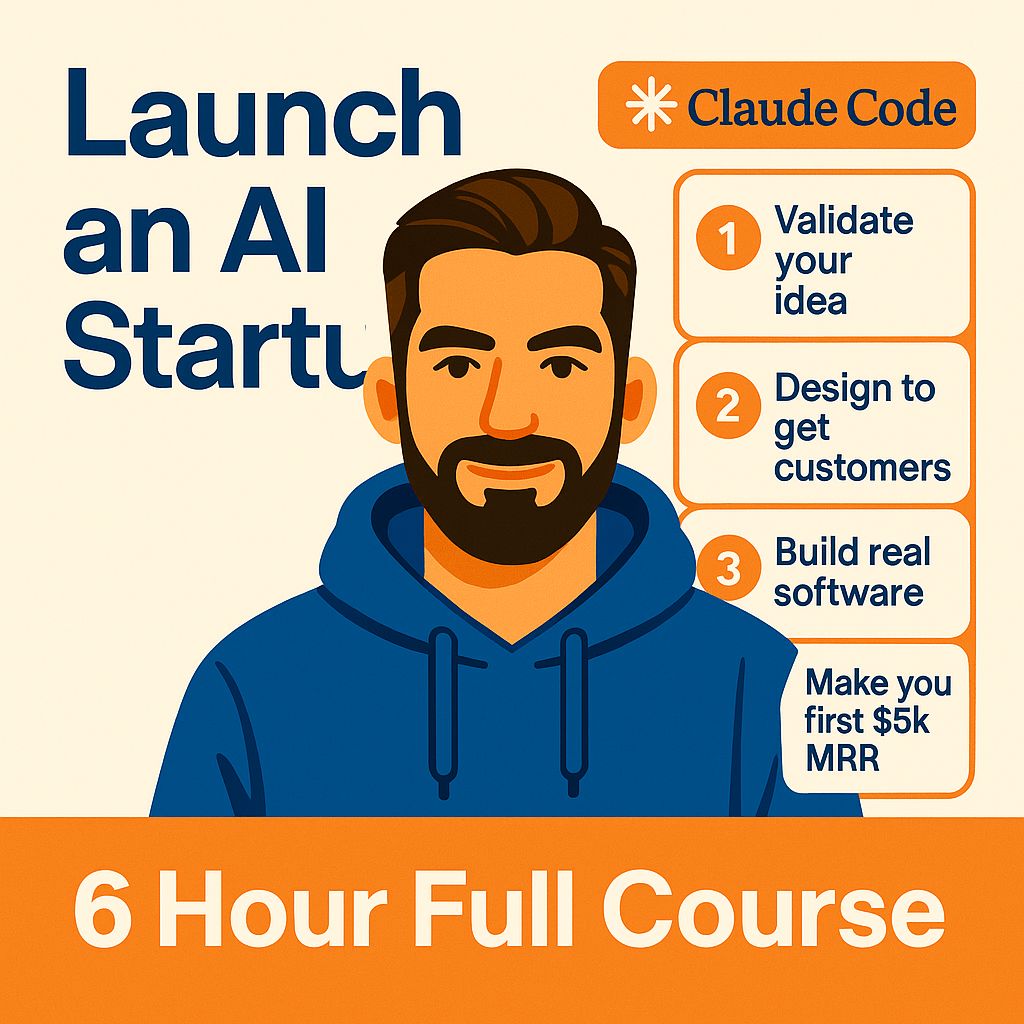
Build and Launch an AI Startup with Claude Code & Product OS (Video Course)
Learn how to turn a vague idea into a real AI startup with paying customers,without a CS degree or big dev team. This course walks you through defining your offer, building with Claude Code, and launching a product people actually buy.
Related Certification: Certification in Building and Launching AI Startups with Claude Code
Also includes Access to All:
What You Will Learn
- Create a one-page Product Offer and a detailed customer persona
- Set outcome-based pricing and reverse-engineer revenue targets
- Design a minimum-viable brand and a reusable design system (design.md + design.html)
- Build a production-grade MVP using a PRD, roadmap, and the Build MVP automated agent loop
- Deploy live with Convex, Clerk, Stripe, and Vercel and verify end-to-end payments
- Run mini-launches and repeatable GTM experiments to acquire and scale paying customers
Study Guide
The landscape of software creation has flipped. It used to be that the biggest barrier between you and a successful product was the ability to code. You needed years of experience, a technical co-founder, or a hefty budget to hire a dev team. That world is gone. With tools like Claude Code, the technical barrier has all but evaporated. Anyone can generate a functional application in a weekend. But here's the catch,that's the problem. When everyone can build, the things that actually make a product succeed have shifted. They've moved to the messy, human parts of the business: figuring out exactly what to build, designing something that doesn't look like generic AI slop, and getting it in front of paying customers. This course is a complete, end-to-end system for navigating that new reality. It's not just about writing prompts. It's about a structured methodology,a Product OS,that takes you from a vague idea to a deployed, revenue-generating product. We'll walk through four distinct phases: Define, Design, Develop, and Distribute. You'll learn to articulate your product offer before writing a line of code, create a brand identity that stands out, build a production-grade MVP using automated loops, and execute a go-to-market strategy that brings in customers. This isn't a theoretical exercise. The framework you're about to learn has been battle-tested. It includes real case studies of founders who used these exact skills to achieve significant results. One non-technical founder built a SaaS platform generating over $20,000 in monthly recurring revenue. Another pivoted from a failed idea to a specialized tool he now licenses to other writers. A third is using his deep industry knowledge to build a niche solution for the construction trade. They all have one thing in common: they didn't let the code define their product. They defined the product, and then used AI to execute. If you're an entrepreneur, a product manager, or a business owner with a specific problem you want to solve, this is your playbook. It's time to stop being a spectator and start building. Let's get into the framework.The Four Key Problems with Building Software Using AI
Before we dive into the solution, we need to understand the problems it solves. The Product OS framework was born from watching hundreds of people try to build with AI and hitting the same four walls, over and over again. Problem 1: You Can Build Anything,So What Do You Build?This is the paradox of choice, amplified. Because AI can generate nearly any code, you're paralyzed from the start. You open Claude Code, you stare at the blank terminal, and you have no idea what to type. You jump between ideas, you start a project, you abandon it for another shinier idea. It's a cycle of endless possibility and zero progress. Without a defined process, you're just a tourist in the world of code. The framework solves this by making you do the hardest work first: defining your product offer, understanding your customer, and setting your pricing. The code becomes an afterthought, an execution detail. Problem 2: Building Fast Is No Longer an Advantage
Here's the blunt truth: anyone can build software in 24 hours now. The ability to ship quickly is table stakes. It's not a moat. It's not an advantage. When speed is commoditized, the advantage shifts to building the *right* thing. The framework forces you to slow down and validate before you build. It's less about how fast you can code and more about how thoughtfully you can design and how quickly you can learn from real users. The goal isn't to build fast; it's to build the right thing, fast. Problem 3: Non-Technical Founders Lack Confidence
This is a big one. Most people entering this space aren't traditional programmers. They're marketers, designers, domain experts, and operators. They have great ideas, but they worry their output won't be scalable, secure, or even functional. They get halfway through a build, hit a scary error about a missing dependency, and think, "I don't know what this means, I'm not a developer." This fear is a killer. The Product OS framework addresses this by giving you a trusted tech stack and verified processes. It replaces guesswork with a clear, repeatable path. You don't need to be a developer to follow a checklist and run a test. Problem 4: Launching to Silence
You've built the product. You've deployed it. You hit the big launch button on Product Hunt. And... crickets. The silence is deafening. This happens to thousands of founders. The reason is rarely the product itself. It's almost always one of three things: you used the wrong channel, you targeted the wrong customer, or your positioning and pricing are fundamentally off. The framework's Distribute phase is designed to prevent this. It's about reverse-engineering your revenue target and building a distribution plan before you even write a line of code.
Phase 1: DEFINE,Deciding What to Build
The Define phase is the strategic foundation. It's the least glamorous, most unskippable part of the process. Its sole goal is to ensure you're building something valuable for a specific customer before you waste a single dollar on design or development. This is where you answer the question: "What are we even doing?"The Product Offer: Your Pre-Build Blueprint
The single most important document you will create is the Product Offer. Think of it as your constitution. It's a one-page document that forces you to articulate six critical elements of your business. If you can't fill this out, you don't have a business idea,you have a hobby. Customer: Who is this for?You need to be painfully specific here. The "narrow wedge" principle is the most important concept in this phase. The best products start by solving a single, painful problem deeply for a specific type of customer. You should be able to name who you are *not* building for. If you can't exclude people, your wedge is too wide. Let's look at a real example from the framework. For a design system tool we'll call "Eyropper," the target customer wasn't "designers" or "developers." It was narrowed down to "design-conscious co-founders of 2-5 person AI-native startups who are shipping multiple products across separate repositories." That's a mouthful, but it's precise. It tells you exactly who you're talking to and who you're ignoring. Pain: What problem are we solving?
The pain must be named, felt, and quantified. You can't solve a problem that doesn't hurt. You need to understand what this problem *costs* the customer in time, money, or frustration. Ask yourself: What is the trigger moment that makes them finally seek a solution? Have they already tried to buy their way out of this? How often do they experience this pain? For Eyropper, the pain was the "design drift" that happens when AI agents build with no visual reference. It costs teams 3-5 hours a week in corrective reprompting, and often leads to $2,000 contractor rework fees. Outcome: What result does the customer get?
The outcome should be concrete, tangible, and time-bound. "A design system your entire team can connect to in under 10 minutes" is a thousand times more compelling than "A cloud-based design platform." You're selling the result, not the features. Mechanism: How do we deliver that outcome?
This is where you describe *how* you will technically deliver the outcome. Be specific. For Eyropper, the mechanism was an MCP server that serves a cloud-based design system to any AI coding agent, accessible from any project. But here's a warning from the framework: "An MCP server alone is not a mechanism." There are 11,000 MCP servers out there. Your mechanism must include the differentiators that make your approach unique,the secret sauce. Proof: What evidence shows this will work?
This is your credibility. What have you done before? Do you have testimonials, case studies, or demo artifacts? If you're starting from zero, your proof might be a strong demo video or a waitlist of eager beta users. For a new product, the proof is often the founder's own experience and willingness to build in public. Guarantee: What risk mitigation can we offer?
This reduces the perceived risk for the buyer. It's a promise. What happens if the product doesn't work? For a design system, a strong guarantee might be: "Your design system is yours. Portable always. One-click export. Free for solo use." Or, "If your team isn't generating on-brand output within 10 minutes of signing up, a full refund." This is how you build trust in a world of cheap software.
Building the Customer Persona
The Product Offer is about the *what*. The Customer Persona is about the *who*. It's a detailed map of your ideal customer's life, behaviors, and psychology. This isn't a demographic profile. It's a behavioral one. By building a detailed persona, you can write copy that speaks directly to their soul and make feature prioritization decisions that actually matter. The framework guides you through a structured Q&A process covering: 1. **Background & Demographics:** What did they do before their current role? Are they pre-revenue or generating revenue? 2. **Problem Context:** When does this problem occur? What's the emotional register? Are they frustrated, fearful, or resentful? For example, a founder might feel "resentful" that they have to spend time fixing design issues instead of building their product. 3. **Behaviors & Habits:** What are their current workarounds? Are they copying and pasting code? Are they using a half-broken internal tool? What are the costs of doing nothing? This is where you find the perfect hook for your marketing. 4. **Tools & Tech Fluency:** What tools do they currently use? Are they technical enough to use a CLI, or does it need to be a GUI? This will dictate your product's complexity. 5. **Job to Be Done:** What is the core "job" they're hiring your product to do? Is it to "make my life easier" or to "help me get promoted"? The frequency of the pain matters here too. 6. **Objections & Evaluation Criteria:** What is their #1 objection to buying a solution? Is it price? Is it trust? Is it the time to implement? What proof would overcome that objection? 7. **Willingness to Pay:** What do they currently spend on this problem? What price ceiling would cause them to stall? Do they get approval for a $20/month tool, or a $500/month tool? **The Anti-Persona:** Equally important is defining who you are *not* building for. This prevents scope creep. It keeps your brand focused. If you're building a tool for "AI-native startup founders," your anti-persona might be "enterprise design system managers at Fortune 500 companies." You're not building for them, and you don't care if they like it. This clarity is liberating.Pricing and Business Strategy
The era of charging per-seat for a generic tool is over. Because AI can clone features in an afternoon, your pricing must be anchored to the outcome you deliver. The framework is a huge advocate for outcome-based pricing. If your tool saves a customer $2,000 a month, charging $500 is a no-brainer for them. Here are the key principles for pricing: - **Price the outcome, not the features.** Stop listing features and start quantifying value. "Save 5 hours a week" is a feature. "Get 5 hours back every week" is an outcome. - **Anchor to a target revenue number.** Reverse-engineer from your goal. If you want $5,000 MRR at $29/month, you need roughly 172 customers. At $49/month, you only need 102. This math shapes your entire distribution strategy. - **Use founder pricing strategically.** A discounted "founding member" price for the first 100 customers creates urgency and rewards early adopters. It gets you to that first revenue milestone faster. - **Start high, discount later.** It's much easier to drop a price than to raise it. If you start at $49 and then discount to $29 for the first 100, you've created a value anchor. If you start at $29 and try to raise to $49, you'll face a revolt. Let's look at the revenue math for Eyropper. The target was $5K MRR at $49/month. The founder planned to offer a $29/month founding price to the first 100 teams. That's $2,900 MRR. The remaining gap is $2,100. To close that gap at $49/month, you need about 43 more customers. So, the total is 143 paying customers. If you have a 20% monthly churn rate, you need about 29 new customers a month. That's roughly 7 new customers a week. If you're posting 3 times a week, that's 2-3 signups per post. Suddenly, "just get a few customers" becomes a clear, measurable target.The Mini-Launch: Validating Before You Build
Before you spend two weeks designing and developing, you need to validate your concept. This is called a "mini-launch." It's a simple, low-effort outreach message to your target audience to gauge genuine interest. It's not about selling. It's about listening. Here's an example of a mini-launch post that was used for the Eyropper product: > "Your AI agent has no idea what your brand looks like. Every new repo, new colors, new styles. You end up shipping five things that all look slightly off. I'm building Eyropper to solve this right now. Your design system served to every agent on every project via MCP. Even the most basic prompt follows your design system perfectly. $49/month founding price. First 100 teams. Who wants in?" This post does several things. It calls out the pain (AI agents have no idea what your brand looks like). It introduces the solution (design system via MCP). And it creates urgency (founding price, first 100). The responses you get,or don't get,are pure gold. They validate the problem, give you a "believers list" of interested users, and provide feedback on your positioning.Case Study: Zach and the $20K MRR SaaS
Zach is a perfect example of a non-technical founder who used this framework. He had zero coding background. He started by building "Lip Pal AI," a SaaS platform for Amazon KDP book creators. His "narrow wedge" was pinpointing the inefficient process of creating coloring books. He built an initial, buggy version and put it in front of users. He didn't wait for perfection. He shipped, got feedback, iterated, and shipped again. His distribution wasn't through ads or partnerships. It was through YouTube content about the Amazon KDP business model. He built an audience around the *problem*, and then positioned his tool as the fastest solution. His key lessons are simple but profound: ship imperfectly, respond to user feedback with urgency, and build a personal brand that attracts your target customer for free.Phase 2: DESIGN,Creating the Visual Foundation
You've defined what you're building and who you're building it for. Now, you have to make it look like something people actually want to use. This phase is about avoiding the "AI slop" problem,that generic, visually indistinguishable design that screams "low quality" to customers. It's about creating a deliberate, differentiated, and professional visual foundation.Minimum Viable Brand Identity
Your brand isn't just a logo. It's the fingerprint of your product's personality. The framework walks you through five key elements to define it: 1. **Name:** This is your anchor. Test it against four criteria: Can you say it? Can you spell it? Can you search for it? Can you feel it? If it fails any of these, it's a bad name. 2. **Worldview:** This is what you see in the world that is unique to your product. It's your lens. For example, a design tool might have the worldview: "Taste shouldn't depend on who's in the room." That's a powerful, opinionated statement. 3. **Contrarian Belief:** What do you believe that others in your category don't? This is your stance. Instead of saying "a design system is a document humans maintain," you might say, "A design system is live infrastructure that agents consume." This differentiates you from the status quo. 4. **Tone of Voice:** How do you speak to your customers? Options include warm plain talk, calm authority, or dry deadpan humor. For a dev tool, you might use a tone like: "You didn't quit your job to argue with a robot about border radius." It's relatable and shows you understand the user's frustration. 5. **Visual Direction:** How does the product look? This should be a clear, distinct choice. Instead of the default "dark mode with purple gradients," you might choose a "monochrome Swiss style" where the customer's design system is the only color on screen. That's a bold, differentiated choice. The distinctiveness check is simple: could you tell your brand apart from five competitors without seeing the logo? If you can't, you look like AI slop.The Design System: Your Single Source of Truth
A design system is a comprehensive set of design tokens and guidelines that ensure consistency. When building with AI, it serves a dual purpose: it's the reference your coding agent uses to generate on-brand UI. This is how you stop the agent from "inventing" new colors and fonts every time. The framework creates two files: - **design.md:** A text-based spec following Google's open-source format. This is for the AI agent to read. - **design.html:** A visual preview of the design system. This is for you and your users to see. **Components of the design system include:** - Color palette (hex codes, usage rules) - Typography (fonts, sizes, weights, line heights) - Spacing scales (consistent margins and padding) - Border radius values (for buttons, cards, inputs) - Elevation and shadows (depth and hover states) - Button styles and states (primary, secondary, disabled, hover) - Input fields and focus states - Card styles - Chips and tags - Dos and Don'ts for usage **A critical anti-pattern to avoid:** Mono fonts used for subheadings and pills are a massive "AI slop tell." It screams "I generated this with AI." Use monospace fonts only for actual code values like hex codes. This is a tiny detail that makes a huge difference in perceived quality.Initial Screen Design & Prototyping
Before you write a line of code, you can create visual designs of your key screens using AI design tools like MagicPath. This is a massive advantage. It lets you validate your visual direction early, show stakeholders and early customers what to expect, and refine design decisions before development begins. When you prompt the design tool, make sure to reference your design system: "Use tokens from docs/design.md for exact colors, type, spacing, and component styling." This ensures the prototype matches the spec.Mapping the Onboarding Flow
This is the most critical part of your product. It determines whether a user becomes an "activated user",someone who experiences the core value,or churns after 30 seconds. The #1 principle is to identify your **Magic Moment**. This is the single moment when a new user realizes your product's value. For Eyropper, the Magic Moment was defined as: "The first time a 'lazy prompt' typed into their coding agent comes back on-brand without any additional prompting." That's the "aha!" moment. Once you know the Magic Moment, you engineer the onboarding flow to get there as fast as possible. The framework maps out a specific flow: | Step | Action | |------|--------| | 1 | Sign up (Single Sign-On via GitHub or Google) | | 2 | Point at your repository or import your design.md | | 3 | Extraction reveal , the design system materializes from your code | | 4 | Connect a project (one-command CLI setup) | | 5 | "Type the laziest prompt" , the user's agent generates on-brand output | | 6 | On-brand result displays with a verification pass | | 7 | Paywall , upgrade to a team plan | | 8 | Checklist home , a dashboard with getting-started tasks | Notice that the paywall is placed *after* the Magic Moment. The user has just seen the value. Their intent is at its peak. That's the perfect time to ask for payment. Interrupting them before they've seen the value is a recipe for churn.Phase 3: DEVELOP,Building the Product
Now, we get to the part that most people think is the whole game: building. But with the groundwork laid, this becomes an execution phase. It's about transforming your documented spec into a working, deployable product using structured skills and automated loops.Creating the PRD and Roadmap
The PRD (Product Requirements Document) is the complete specification for your product. It's the "source of truth" for your coding agent. It includes: - Overview and objectives - Market differentiation - Magic moment description - Success criteria - Technical architecture (stack, integrations, environment variables) - Database schema/data model - API specifications - MCP server information - User stories - Open questions with recommended defaults The **Roadmap** is a phased development plan. Each phase has a stated goal and tasks that are sized appropriately for AI coding agents. This is critical. If a task is too vague ("build the app"), the agent will fail. If it's too specific ("change the color of this button"), it's a waste of time. The roadmap structure includes the build philosophy, phases with tasks, and cross-references to PRD sections.The Build MVP Skill: Automating the Loop
This is the core innovation of the Develop phase. The "Build MVP" skill is an automated loop instruction set that directs the AI coding agent to: 1. Find the first unchecked task in the roadmap. 2. Read what the task needs. 3. Implement the task exactly as specified. 4. Test and verify the task before moving on. 5. Mark it complete. 6. After each phase, run the application end-to-end and confirm the phase goal is true. Additional rules for the agent: - Visual styling comes from design.md; never invent colors, type, or spacing. - Follow the roadmap order strictly. - Self-verify before declaring completion. This loop significantly reduces the need for continuous human prompting. You're no longer babysitting the agent. You're managing a process. Before running the build, you must configure connectors for all your tech services (Convex, Clerk, Stripe, etc.) so your coding agent can access these accounts directly.The Right Tech Stack for AI Builders
The framework recommends a specific, AI-friendly stack. This isn't because it's the "best" in every category, but because it's the stack that AI agents can mutate most easily. | Layer | Recommended | Alternatives | |-------|-------------|--------------| | **Coding Agent** | Claude Code | Codeex, Cursor | | **Database/Backend** | Convex | Supabase, Cloudflare, Firebase | | **Authentication** | Clerk | Supabase, Convex, WorkOS | | **Payments** | Stripe Managed Payments | Polar, Autumn | | **Deployment** | Vercel | Railway, Render, AWS/GCP | **Why Convex?** It lives inside your codebase. This is a game-changer. It means your coding agent can modify the backend and database without switching to a separate dashboard. It's all just code to the agent. This reduces friction and errors. **Why Stripe Managed Payments?** This is a huge deal for global SaaS. Stripe acts as the merchant of record. That means they handle international tax compliance for you. You don't have to worry about VAT or GST when you're selling to customers in Europe or Australia. It's a massive headache avoided.Testing, Iteration, and the Build Loop
After the initial build, the real work begins. The framework mandates thorough testing: - **Unit tests:** Automated tests across all workspaces. - **Adversarial review passes:** AI agents review the codebase for issues and inconsistencies. - **Security audit:** A full codebase audit for vulnerabilities. - **Lighthouse rating:** Performance scoring on the landing page. - **End-to-end magic moment test:** Verify the core loop works from signup through value delivery. For ongoing improvements, the **Build Loop skill** is used. This is different from the Build MVP skill. It's for iterating on a live product. It uses a cycle of: plan → build → test → fix → report. You maintain a `backlog.md` file to track all pending improvements rather than making one-off changes. This creates a continuous, disciplined improvement process.Deployment and Going Live
The "Go Live" skill generates a comprehensive deployment checklist (docs/deploy.md) with phases marked by who does what (you vs. the agent). Key components include: **Environment setup:** - Create accounts for all services (Clerk, Stripe, Convex, PostHog, Sentry). - Purchase your domain. - Set up environment variables in production. - Connect Clerk production instance. - Set up Stripe products and webhook endpoints. - Deploy backend to Convex production. - Deploy frontend to Vercel with the correct root directory. **Critical deployment details:** - Vercel project root directory: `apps/web` for monorepos. - Build command must include Convex push so backend and frontend never drift. - Set `CLERK_DISABLE_AUTOPROXY=1` if Clerk fails after domain attachment. - Add DNS records for Clerk in your domain registrar. **Payment verification:** After deployment, you must complete a real purchase test using the live Stripe environment to confirm the entire payment flow works end-to-end. This is non-negotiable. You don't want to discover a broken checkout after you've started getting traffic. **The Refactor Path:** What if you're already building something and you're stuck? The Product OS framework supports a refactor path. You can use a "refactor plan" skill to convert an existing codebase based on your defined product offer and persona. The system can evaluate what you've built against your spec and plan adjustments. It's a way to get back on track.Case Study: Jim and the Authoring Harness
Jim's story is a perfect example of why adaptability is key. He started with the goal of building a mobile app. But as he got into the weeds, he discovered a personal pain point: AI was incapable of writing books to his standard. It was great at generating text, but terrible at maintaining continuity, character consistency, and editorial quality. So he pivoted. He evolved a system of rules, skills, and agents that check these things throughout the book-writing process. This became a "harness" that he now distributes as a Claude desktop plugin. He monetizes it through Lemon Squeezy's licensing system. His lesson is profound: the final product may not match the original idea. The framework is about finding the right product, not blindly executing the first one.Phase 4: DISTRIBUTE,Getting Customers
You've defined, designed, and developed. Now comes the hardest part: getting people to actually use and pay for your product. This is where most products die. The Distribute phase maps the path to revenue. It's about creating a repeatable, measurable system for customer acquisition.Go-to-Market Strategy
The GTM strategy skill analyzes your product, customer, and market to produce three ranked channels with a clear primary channel. The process is: 1. Two research agents sweep the landscape. - One identifies communities, directories, search queries, and creators. - One tears down competitors who are already monetizing in your category. 2. It produces a ranked channel plan with specific tactics for each channel. For Eyropper, the GTM strategy produced this: | Rank | Channel | Tactic | |------|---------|--------| | 1 | Build in public on X | Gated beta loop: hook + demo video + comment for access | | 2 | Agent-native directories | MCP registries, Claude Code plugins, skills listings | | 3 | Reddit AI builder communities | Useful replies in r/ClaudeAI, r/vibecoding | The key insight from the research was that the proven revenue path in this category came from a founder building in public with a gated "comment for access" mechanic. They didn't rely on cold outreach or traditional marketing. They built an audience around the problem and made their product the solution.Growth Experiments
Your GTM strategy is a plan. Your growth experiments are the actions. Each experiment should have a clear goal metric, a deadline, specific tactics, and success criteria. You're not just posting and hoping. You're running a scientific process to find what works. **Example experiments:** 1. **Split-screen demo post:** A 30-60 second video showing side-by-side outputs (with/without your tool). Goal: 5 cold comments in replies. 2. **Pain reply sprint:** Search for people complaining about your exact problem (e.g., "design drift," "Agent ignored my design system"). Reply with genuinely useful help, *not* pitches. Max 15 replies/day. Then send a follow-up DM only after a real exchange has happened. 3. **Hook testing:** Rotate three opening hooks across posts to see which drives the most profile visits. **Critical distribution rules:** - Reply to every commenter publicly within an hour. This builds community and signals that you're a real person. - DM in batches under 100/hour to avoid being flagged as spam. - Add every stranger to your "believers list" for future product updates. - Measure everything. Stop what isn't working within 2 weeks. Don't waste time on a losing channel.Automation and Scaling
When you find something that works, you automate it. You turn successful content into repeatable processes. You use AI to help write variations of proven posts. You scale successful channels before adding new ones. The "two-channel trap" is a huge mistake. Avoid spreading efforts across seven channels simultaneously. Focus on what works, do it more, do it better, and then expand.Case Study: Elton and the Construction Industry
Elton is a non-technical founder in the UK construction sector. He built software for subcontractors in the windows and doors trade. His advantages weren't technical. His defining advantages were his deep industry knowledge (he ran his own business) and his access to a network of 1,500 potential customers. He didn't rely on digital channels alone. He met customers where they are,turning up with physical mockups and demonstrations. His approach to selling was simple: define the gap between the cost of the software and the savings it provides, making adoption a financial no-brainer. "If you can save somebody an hour a month and it's only going to cost them £500 a week, then it might be a great product technically, but it's not really helping them." He's a master of the "narrow wedge" and using domain expertise as a moat.Reverse-Engineering Revenue Targets
This is the most important exercise in the Distribute phase. It's about turning your revenue goal into a concrete, daily action plan. The framework includes a revenue math exercise: To reach $5K MRR at $29/month, you need ~172 customers. If you have a 20% churn, you need ~29 new customers a month. That's ~7 per week. If you post 3 times a week, you need 2-3 signups per post. This is the math that turns "I need to get customers" into a clear, measurable target.Case Study: The Product Designer-Builder
The final case study is about the emergence of the "product designer-builder." This is the new archetype of founder. They are deeply empathetic to a specific market's problems. They understand the user's pain on an emotional level. They use AI to build the solution, but their real skill is the design thinking and the distribution strategy. They are the ones who will win in this new era. The framework gives non-technical founders the playbook to become this person.Key Insights & Takeaways
Let's boil this down to the core principles that will guide your journey. - **AI removes the coding barrier, not the thinking barrier.** The most important work,definition, design, and distribution,cannot be outsourced to an AI agent. You have to do the thinking. - **Documentation before development.** Your Product Offer, Customer Persona, PRD, and Roadmap are your "source of truth." They massively improve the quality of your agent's output. Garbage in, garbage out. - **Design distinctiveness is a competitive weapon.** Over-reliance on AI defaults produces visually identical products that customers perceive as low quality. Invest in a design system. - **Production-grade deployment is achievable without deep technical knowledge.** Use guided deploy checklists and modern managed services, but be diligent. Read the docs. - **Distribution should be reverse-engineered from revenue targets,** not improvised after launch. Know your numbers. - **Niche focus creates better products and simpler marketing.** If everybody can use your product, distribution becomes harder. Narrow your wedge. - **Warm outreach outperforms cold pitching** for early-stage products. Personal networks and content channels build trust more effectively than cold DMs at scale. Send the DM after the organic reply. - **Ship before you feel ready, then iterate relentlessly on user feedback.** Waiting for perfection is a strategy for never launching. Never be afraid to ship something to production just because it might break. Your users will find the things that break before you will.Action Items / Recommendations
Here's your homework. If you want to apply this framework, start with these steps: 1. **Begin with the Product Offer, not the code.** Spend at least one session completing the six-element offer framework before any technical work begins. 2. **Define pricing from the outcome.** Quantify the cost of the problem you're solving, and price against that value, not against your feature count. 3. **Conduct a Mini-Launch validation before building.** Share the product concept publicly, measure authentic interest signals, and adjust your positioning before allocating development resources. 4. **Create a distinct design system before development.** Invest the two hours needed to produce a design.md and design.html. This single artifact prevents the "AI slop" problem. 5. **Map the onboarding flow and identify the Magic Moment.** Design the first-session experience to deliver core value as quickly as possible, then place the paywall immediately after that moment. 6. **Deploy production-grade infrastructure from day one.** Use Convex, Clerk, Stripe Managed Payments, Vercel, PostHog, and Sentry to ensure scalability, security, and monitoring readiness. 7. **Run a structured go-to-market plan.** Choose 2-3 channels (not 7), set a 4-week commitment window, track experiments systematically, and double down on what works. 8. **Reverse-engineer the $5K MRR target.** Calculate how many paying customers you need, translate that into required signups per post, and design your content cadence to achieve it. 9. **Send the DM after the organic reply.** Warm outreach to people already talking about the problem is dramatically more effective than cold pitching. 10. **Keep a public backlog and work through it in build loops.** Regular, iterative improvements prevent stagnation and build momentum.Conclusion
The Product OS framework represents a fundamental shift in how software products are born. It moves us from a code-first mentality to a product-first methodology. AI agents are your execution partners, not your creative directors. Their power is unlocked not by better prompts, but by better strategy. The framework connects strategic definition, design discipline, technical execution, and market distribution into a single, teachable system. As AI coding tools democratize software creation, the differentiator between products that fail and products that thrive will increasingly be the quality of thinking applied before and around the code. Those who adopt structured processes,documenting the offer, understanding the customer deeply, designing with intent, building from specifications, and distributing with targeted experimentation,will be positioned to capture significant market opportunities. The case studies of Zach, Jim, and Elton validate that this approach is accessible to non-technical individuals who possess domain expertise and are willing to systematically apply it. The framework's emphasis on industry knowledge as the foundation for product development suggests a broader promise: AI tools may ultimately enable a new generation of domain-led software innovation across sectors that have long been underserved by traditional technology companies. The tools are available today. The roadmap is in front of you. The only thing left is for you to take the first step. Define rigorously, design deliberately, build iteratively, and distribute experimentally. The era of the product designer-builder has arrived, and it's your turn to build.Frequently Asked Questions
This FAQ answers the questions that surface most often when people decide to build software with AI agents. It covers the full arc,from deciding what to build, through design and development, to getting paying customers,following the Product OS framework. If you're new to this, start with the early questions. If you're mid-build or already launched, jump to the distribution and scaling sections. Each answer is practical and references real examples from the course.What is Product OS and why is it important for building AI-powered software?
Product OS is a complete system of skills, context documents, guidelines, and processes for building, launching, and scaling software products using AI coding tools like Claude Code, Codex, and Cursor. It structures the entire product development arc,from raw idea to distributed product in the hands of paying customers.
The system was created to solve four specific problems: knowing what to build when AI can build anything, recognizing that speed alone is no longer an advantage, giving non-technical builders confidence through a trusted process, and preventing the "launch to silence" problem that kills most products.
Product OS provides a structured path through four phases,Define, Design, Develop, and Distribute,with specific skills and checkpoints integrated directly into AI coding agents. Each phase ends with some form of validation to ensure you're building the right thing at the right time.
What are the four main phases of the Product OS framework?
Product OS is organized around four key phases that flow in sequence:
Define: Figure out what to build and validate the idea. Create a product offer, define your customer persona, set pricing strategy, and run a mini-launch to validate interest.
Design: Establish the visual and experiential identity. Create a minimum viable brand identity, build a design system, map the onboarding flow, and create design mockups.
Develop: Build and launch the product. Write a PRD and roadmap, build the MVP using AI agents, test and improve, then deploy to production.
Distribute: Get the product in front of customers. Develop a go-to-market strategy, run growth experiments, and automate what works to scale.
Each phase ends with validation,sharing drafts, posting teasers, or collecting feedback,so you stay aligned with real market demand.
What is "vibe coding" and why does the framework push back against it?
Vibe coding is the casual, unstructured approach to AI-assisted programming where you prompt an AI agent to build things without a clear specification, design system, or validation process. It feels productive because you're generating code rapidly, but it produces inconsistent results, generic design, and products that don't solve a specific customer's problem.
The core problem with vibe coding is that it optimizes for output volume rather than customer value. You end up with something that looks like every other AI-generated app and doesn't address a real pain point deeply enough for anyone to pay for it.
Product OS replaces vibe coding with a structured methodology. Every prompt, skill, and checkpoint is designed to keep you anchored to your product offer, customer persona, and design system. The framework treats building as a discipline, not a vibe.
What is a "product offer" and why should I create one before writing code?
A product offer is a formal statement that defines exactly what you're building, who it's for, and why they'll buy it. It contains six elements: customer, pain, outcome, mechanism, proof, and guarantee.
The product offer is the single most important document to create before building software because it forces specificity. Many people fail because they build for a broad customer type or address a problem too vague to solve well. The offer helps you identify a narrow initial wedge,a small entry point into the market,solve that problem deeply, and position your product in language your target customer recognizes.
For example, instead of saying "a design tool for teams," a strong product offer says "a design system served to every AI coding agent on every project, so even the most basic prompt follows your brand perfectly." That specificity guides everything that follows.
What is the "narrow wedge" principle and how do I apply it?
The narrow wedge principle states that the best products start by solving a single problem deeply for a specific type of customer. Instead of trying to help everyone with a broad platform, you pick one small segment and solve their problem completely.
When defining your customer, actively exclude people. If you can't name who you're not building for, your wedge is too wide. The framework's example product, Eyropper, targeted "design-conscious co-founders of 2-5 person AI-native startups",not all design teams, not all developers, not all companies.
Applying the principle means asking: What's the smallest group of people who share this exact pain? What's the simplest version of the solution that delivers real value to them? The narrow wedge gives you focus for your design system, your copy, your channel selection, and your pricing. Once you dominate that segment, you can expand outward.
How do I identify the right customer persona for my product?
A customer persona is a detailed profile of your ideal customer including their background, behaviors, pains, goals, and objections. To build one effectively:
Start with the product offer's customer line, then research where they hang out. Look at communities, forums, and social platforms where your target customer asks questions and shares problems. Define the trigger moment,exactly when they feel the pain. Analyze their current workarounds: what do they do today to cope with the problem? List their objections and what proof would overcome those objections. Assess their willingness to pay based on what they currently spend on tools.
Also define the anti-persona: explicitly state who you are not targeting. A well-constructed persona ensures both you and your AI coding agent know exactly who you're building for, how to write copy that resonates, and which features matter most.
What is the "anti-persona" and why does defining it matter?
The anti-persona is the explicit definition of who you are not building for. It's the counterpart to your customer persona and serves as a guardrail against scope creep.
Defining the anti-persona keeps your product focused and your brand sharp. When you know who you're excluding, you can say no to features, design choices, and marketing channels that don't serve your core customer. For example, if your anti-persona is "enterprise procurement teams," you won't waste time building SSO integrations or writing compliance documentation.
The anti-persona also clarifies your messaging. When you know who you're not talking to, you can write copy that speaks more directly to the people you are targeting. It prevents the vague, generic positioning that makes products invisible.
What is the "mini launch" and how does it help validate an idea?
A mini launch is a low-cost, low-effort public announcement of your product idea used to validate whether anyone is actually interested before you invest significant time building. It typically takes the form of a direct message to 8-10 people who fit your target customer profile, a community post describing the problem and your intended solution, or a public build-in-public post inviting people to comment for early access.
The mini launch tests whether your pitch resonates and whether people feel the pain you're addressing. You should run mini launches at multiple points: after defining the offer, after creating design mockups, and after building the MVP. Each post is an opportunity to collect names for a beta list and gather qualitative feedback.
A useful format includes the problem, the mechanism you're using to solve it, the cost, and a clear call to action like "Comment below if you want early access."
What is a "believers list" and how do I build one?
A believers list is the collection of people who have expressed interest in your product before or during your build,everyone who commented on your mini launch posts, replied to your DMs, or asked to be notified when you launch. These are the people most likely to become your first paying customers.
The believers list is the most valuable asset you'll accumulate during the build process. It's a warm audience that already knows your problem exists and wants your solution. When you finally launch, you're not posting into the void,you're announcing to people who've been waiting.
Build it by running mini launches at each phase, replying to every commenter publicly, DMing interested people in batches, and adding every stranger who expresses interest to your list. Track names, contact info, and where they came from. This list becomes the foundation of your launch email sequence and your first wave of testimonials.
Why is defining a pricing strategy important before the build, and how do I approach it?
Pricing strategy directly influences the business model, the target customer you attract, and the revenue you can generate. Defining pricing upfront forces you to think about the value your product delivers and who can pay for it.
Anchor pricing to outcomes rather than features. Quantify the outcome your product delivers,like "saves your business $2,000 per year",and price as a fraction of that value. This makes the purchase a no-brainer. Research what your customer already spends on related tools and what price point feels comfortable versus what triggers hesitation.
Choose a pricing structure that fits the product. If your product is accessed via an API or MCP server, per-seat pricing may not work. A flat monthly price per brand or team with unlimited users might be more appropriate. Consider promotional founding pricing: launch with a discounted price for the first set of customers and a higher standard price afterward. This creates urgency and trades early revenue for proof and testimonials.
Certification
About the Certification
Become certified in AI startup development with Claude Code and Product OS. You'll prove you can define a marketable offer, build a working product without a dev team, and launch to paying customers,real skills you can apply on day one.
Official Certification
Upon successful completion of the "Certification in Building and Launching AI Startups with Claude Code", you will receive a verifiable digital certificate. This certificate demonstrates your expertise in the subject matter covered in this course.
Benefits of Certification
- Enhance your professional credibility and stand out in the job market.
- Validate your skills and knowledge in cutting-edge AI technologies.
- Unlock new career opportunities in the rapidly growing AI field.
- Share your achievement on your resume, LinkedIn, and other professional platforms.
How to complete your certification successfully?
To earn your certification, you’ll need to complete all video lessons, study the guide carefully, and review the FAQ. After that, you’ll be prepared to pass the certification requirements.
Join 20,000+ Professionals, Using AI to transform their Careers
Join professionals who didn’t just adapt, they thrived. You can too, with AI training designed for your job.