How to Build & Sell AI Digital Products: Complete Guide (Video Course)

Most digital products fail because people build first and hope buyers appear. This course flips that: pick a painfully specific audience, craft an offer that sells outcomes, then use AI to build a simple app. No tech skills needed.

Duration: 45 min
Rating: 3/5 Stars
Beginner

Related Certification: Certification in Building, Launching, and Selling AI Digital Products

How to Build & Sell AI Digital Products: Complete Guide (Video Course)
Access this Course

Also includes Access to All:

700+ AI Courses
700+ Certifications
Personalized AI Learning Plan
6500+ AI Tools (no Ads)
Daily AI News by job industry (no Ads)

Video Course

What You Will Learn

  • Use the Staircase Framework to validate product-market fit
  • Choose and research a painfully specific audience
  • Craft an outcome-focused offer with a guarantee and starter pricing
  • Build and iterate an AI Resource App from plain-English prompts
  • Acquire customers without ads using Hook-Story-Offer and email follow-up
  • Scale to multiple products and expanded AI tools for growing revenue

Study Guide

Introduction: Why This Matters Now

Most people think building a digital product is about having a great idea, spending months creating it, and then hoping someone buys it. That's backwards. And it's exactly why most digital products fail.

This course is different. It's built on a simple truth: the offer comes before the product. Not after. Not during. Before.

Over the next few thousand words, I'm going to walk you through the entire process of building and selling AI digital products from absolute zero. No technical skills. No paid advertising. No giant audience. Just a clear framework, a specific audience, and a product that actually solves a real problem.

The landscape has shifted. AI tools can now build functional software, landing pages, payment systems, and membership areas from plain English descriptions. That means the barrier to entry is lower than it's ever been. But lower barriers mean more noise. The people who win are the ones who understand the fundamentals: who they're serving, what outcome they're selling, and how to communicate that outcome with brutal clarity.

Here's what you'll learn in this guide:

First, you'll understand the staircase framework,a mental model for how digital products actually work. Then you'll learn how to pick a painfully specific audience and study them until you know them better than they know themselves. After that, you'll craft an offer that sells outcomes, not deliverables. Then we'll build the product using AI, test it until it works, and finally, you'll learn how to get customers without spending a dime on ads.

This isn't theory. The strategies in this guide have generated over $1.8 million in monthly revenue. But more importantly, they're accessible to you right now, starting from wherever you are.

Let's get into it.

The Staircase Framework: What a Digital Product Actually Is

Forget everything you think you know about digital products. A digital product is not a PDF. It's not a course. It's not a piece of software.

A digital product is a staircase.

It's a pathway that carries a specific person from their current frustrating situation to a desired outcome. That's it. If your product doesn't do that, you don't have a product,you have a file that nobody wants.

For a customer to willingly climb your staircase, four things have to be true:

Destination alignment.
The staircase has to lead somewhere they actually want to go. If you're selling a fitness program to someone who wants to learn guitar, no amount of features will save you. The destination has to match their desire.

Perceived safety.
Each step has to feel secure enough that they keep moving forward. They need to believe they won't waste their money, time, or effort. Risk kills conversion.

Personal feasibility.
The path has to feel doable for them specifically. Not for some idealized version of them. For the real person with real constraints, real doubts, and real past failures. If they can't see themselves completing the journey, they won't start.

Comparative speed.
Your staircase has to look faster than the alternatives. People are impatient. They'll choose the route that promises the quickest credible path to their goal.

Most entrepreneurs get this backwards. They build a product first,a course, an app, a guide,and then go looking for buyers. They spend months creating something they think is valuable, only to discover that nobody wants it. The graveyard of failed products is full of beautiful apps that never functioned, and even more that functioned perfectly but solved a problem nobody had.

The correct sequence is simple: figure out what a specific group of people desperately wants, then build that. Offer first, product second. Always.

Practical application: Before you write a single word of content or build anything, take a blank sheet of paper and write down the specific person you want to help. Then write down their current situation and their desired outcome. Then ask yourself: does my product idea actually bridge that gap? If you can't describe the staircase clearly, you don't have a product yet.

Best practice: Spend at least a full day thinking about this before moving on. The staircase framework is the foundation everything else builds on. Get it wrong and you'll waste months.

Finding Your People: The Art of Painful Specificity

Here's a mistake that kills more digital product businesses than anything else: trying to help everyone.

If you try to help everyone, you end up helping no one. That's not a clichΓ©,it's a market reality. The market pays for depth, not range. A brain surgeon earns more than a family doctor every single time. Why? Because specificity commands premium pricing and instant trust.

Let me show you with an example.

Imagine a time management course priced at $19. A generic version,"Time Management for Busy People",will be ignored by an outbound B2B sales rep whose schedule is chaotic and unpredictable. They've tried generic time management advice before. It didn't work. So they scroll past.

Now take the same course, same price, but position it specifically for outbound B2B sales representatives. Suddenly it's not a generic course anymore. It's a precision tool built by someone who clearly understands their exact life. The purchase decision happens before they even read the details.

That's the power of specificity.

But how specific is too specific? There's a sweet spot.

Too broad: "Young people" , useless, no clear problem, no clear audience.

Effective sweet spot: "18 to 24-year-old men who train at the gym and want to achieve their first muscle-up" , specific enough to resonate deeply, large enough to sustain a business.

Too narrow: "18 to 24-year-old left-handed men in Milwaukee training at 5 AM who want to achieve a muscle-up" , the audience is so small you can't build a business on it.

Here's the key: 99% of beginners fail by going too broad. When you're stuck between too broad and too narrow, always choose narrower. You can always expand later, but you can't recover from a launch that spoke to nobody.

Once you've picked your audience, you need to study them like an obsession. This is the step almost nobody actually does properly. You need to answer four questions:

What does their current situation look like on a random Tuesday?
Not their highlight reel. Their actual daily grind. What time do they wake up? What frustrates them? What do they avoid?

What dream do they hold that they would never articulate publicly?
Everyone has a secret aspiration. The thing they want but are too embarrassed to say out loud. That's the emotional driver behind purchases.

What approaches have they already tried and failed?
Understanding their failed attempts tells you what doesn't work for them and what gaps your product can fill.

What do they secretly believe is wrong with themselves?
This is the deepest level. The core psychological barrier that prevents action. If you can address this, you become the only person who truly understands them.

Here's the psychology: humans make decisions based on emotions first, then justify them with logic afterward. When your content and offers describe someone's life more accurately than they can describe it themselves, they hand you their trust. And if you understand your audience five times better than your competition, the results compound far beyond five times. Deep audience understanding creates exponential returns.

Practical application: Spend 20-30 hours minimum researching your audience. Go to forums, subreddits, Facebook groups, YouTube comment sections. Read what they say, how they say it, what they complain about, what they ask for. Take notes. Document everything. This research will pay for itself a thousand times over.

Best practice: Don't just read,engage. Ask questions. Have conversations. The goal is to know their random Tuesday so well that when you write content, they think you've been reading their diary.

Crafting an Offer That Sells Itself

The offer is the highest-leverage element of your entire business. Get this right and everything else becomes easier. Get it wrong and no amount of product quality will save you.

The first rule: sell outcomes, not deliverables.

Apple doesn't sell a 6.1-inch OLED display with an A16 chip. They sell the ability to capture memories of your children in stunning 4K resolution. Same phone, completely different purchase decision. One describes the staircase; the other places you at the top of it.

Here's a coaching example:

Wrong approach: "I offer eight coaching sessions and a workbook."

Right approach: "Break free from the heartbreak and become the one who got away."

The first describes logistics. The second describes a transformation. Nobody buys logistics. Everybody buys transformation.

Now apply the split-second test. When a potential customer encounters your offer, they should instantly understand three things:

1. What problem does it solve?
2. Who is it for?
3. Why is this different from everything else on the market?

If it takes longer than a split second to understand what you actually do, they're gone. There is no second read. Clarity always beats cleverness. Write your offer at a fifth-grade reading level. If a 10-year-old can't understand it, it's too complicated.

Now let's talk about certainty. Consumer skepticism is at an all-time high. Fake countdown timers, invented scarcity, fabricated screenshots,people have seen it all. The trust crisis created by these tactics means the honest operator now has the advantage.

The primary reason people buy today is certainty. Specifically, three forms:

Outcome certainty: The result they'll achieve is real and attainable.

Path certainty: The system they'll follow after purchase makes logical sense.

Capability certainty: They feel personally capable of completing the transformation.

Your offer needs to stack all three. And one of the most powerful tools for doing that is a guarantee.

Think of the guarantee as a trampoline beneath the staircase. People climb much more confidently when falling won't hurt. A money-back guarantee signals confidence in your product and removes the risk asymmetry that prevents purchases. If you're genuinely confident in what you've built,and you should be,offer a guarantee without hesitation.

Now let's talk about pricing, because this is where most creators freeze.

Common internal objections: "Who am I to charge for this?" "What if nobody will pay?" "There's somebody else who can teach this better than I can."

Here's a thought experiment that fixes this. If someone offered you a Lamborghini in perfect condition for $10,000, with only 24 hours to come up with the money, would you buy it? Of course you would. You'd beg, borrow, and sell your possessions to make the purchase.

The lesson: when a customer says they can't afford your product, what they're almost always saying is, "You haven't shown me a Lamborghini." Price is not the problem. Clarity is. If you clearly demonstrate a transformation worth far more than the asking price, affordability becomes a non-issue.

For your first digital product, the sweet spot is $30 to $100. Low enough for an easy "yes," high enough that buyers take the product seriously. Below $30 feels like a cheap PDF. Above $100 requires more trust and authority than a new creator typically has.

Four elements of a strong offer: outcome over deliverables, instant clarity, a real guarantee, and a fair price within that range.

Practical application: Write your offer now. One sentence that describes the outcome. One sentence that identifies who it's for. One sentence that explains why it's different. Then test it on five people who match your target audience. If they don't immediately get it, rewrite.

Best practice: Don't be clever. Be clear. The offer is not where you show off your vocabulary. It's where you show you understand the customer's problem better than anyone else.

Building Your First AI Digital Product

Everything up to this point could have been done years ago. What's changed is the product creation process itself.

Before accessible AI tools, creating a software-based product meant hiring an agency for tens of thousands of dollars, or duct-taping together five different subscription tools at a recurring cost of hundreds per month. Both options required months of back-and-forth before anything actually worked.

Now, AI app builders have changed the game. You describe what you want in plain English, and the platform generates landing pages, design elements, database structure, user accounts, payment processing, and functional software ready for deployment. It's a paradigm shift.

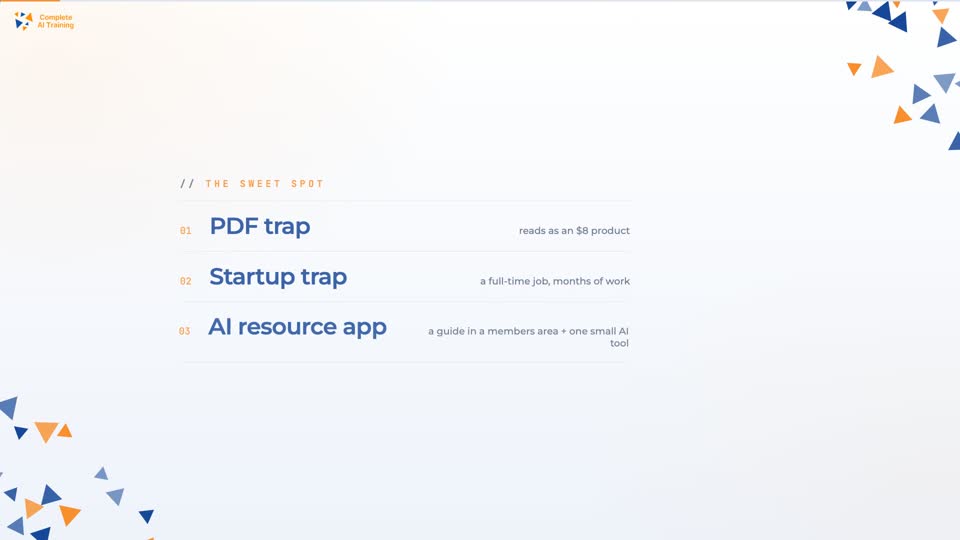
But here's the trap: most creators gravitate toward one of two extremes, and both are mistakes.

The PDF trap: Instinctively creating a simple PDF guide. It screams "low value" and positions your product at an $8 price point.

The software startup trap: Attempting to build a full-blown software application. That's effectively a full-time job you didn't sign up for, with complexity far beyond a first product's needs.

The optimal sweet spot is what I call an AI Resource App. It packages your transformation method as a guide within a clean, paid membership area, supplemented by a small AI tool that performs part of the work for the customer.

Let me give you a concrete example. Say you're targeting gym-goers who want to achieve their first muscle-up. You don't just sell a training guide. Instead, the customer accesses a structured 6-week program inside a members area. Then a supplemental AI tool generates personalized weekly workout programs based on their specific inputs,current pull-up capacity, dip capacity, false grip comfort, training frequency, body weight, and specific challenges.

The perceived value to the buyer is a premium, legitimate software experience. The actual effort to build is approximately equivalent to writing the transformation method as a document. That's the magic.

Here's the building process step by step.

Step 1: Define your product in plain English.
The AI builder accepts natural language prompts. A comprehensive prompt should specify the customer and their problem, the result the product delivers, the product name and price, and the structure of the product. For example: "Build an app that sells and delivers my paid guide to [specific customer]. Their painful problem: [describe the pain]. The result my product gets them: [describe the outcome]. This product is called [name] and costs [price] one time. The app has a landing page, paywall, members area, and an AI tool."

Step 2: Set up payment processing.
The app builder will ask for Stripe integration to process payments. This connection enables account creation, payment collection, and automatic email follow-up systems. If payment processing is temporarily unavailable, a waitlist with email capture is an acceptable interim solution,but only temporary.

Step 3: Review and test the generated product.
The AI generates a complete product including a sales landing page, a payment wall, and a members area. Here's what each component should look like:

The sales landing page: A hero headline stating the transformation promise, a sub-headline identifying the target audience and what they receive, pain-point bullet points, a section detailing what's included, pricing information with a buy button repeated at least twice, and no navigation menu. One page, one action.

The payment wall: One-time payment processing, account creation for paying customers, and access to the membership area upon completion.

The members area: A guide with clean sidebar navigation, chapter organization, "mark complete" functionality for progress tracking, a bonus resource page, and an AI tool that accepts member inputs and generates personalized outputs.

Now here's the reality: the AI's first pass will be about 80% correct. The remaining 20% is where most beginners quit. Mastering the refinement process is the skill that separates successful creators from everyone else.

Refinement protocol: Make one change per prompt. Small, specific prompts produce clean results. Large, vague prompts produce unusable output. Put yourself in the customer's shoes,the product must work well before it looks pretty. Prioritize functionality over aesthetics. The graveyard of failed products is full of beautiful applications that never functioned.

Launch protocol: When satisfied, flip the product live, connect payment processing, publish the application, and then buy your own product with a real credit card. If a complete stranger could purchase your product right now without any assistance, you have created a real business. This end-to-end purchase test validates the entire system.

Practical application: Don't skip the self-purchase test. It's the single most important quality assurance step. If you can't buy it, neither can your customers.

Best practice: Iterate in small bites. One change per prompt. Functionality first, aesthetics second. And don't get attached to your first version,it's supposed to be rough.

Getting Customers Without Paid Advertising

A functional product with a working checkout page does not automatically generate revenue. Customer acquisition is the next critical skill.

First, kill the myth that you need to be a big creator. You don't need 100,000 subscribers or viral videos. What you need is a small number of qualified viewers,people who actually have the problem your product solves.

There are creators with seemingly unimpressive view counts quietly generating seven-figure annual revenue. The right 1,000 views beats a million random views every single time. This works because modern platform algorithms excel at placing content in front of exactly the people who would benefit from it. View count is not the metric that matters,viewer relevance is.

Two factors drive this effectiveness: algorithmic precision and content relevance. When your content speaks directly to a specific audience's lived experience, conversion rates are dramatically higher even with lower overall reach.

The content framework is simple: Hook, Story, Offer.

Hook: The first few seconds serve one purpose,stopping the scroll. This requires immediate relevance to the target viewer's specific interest or pain.

Story: The narrative component makes the customer feel understood. This is where deep audience research pays off. When your story reflects their random Tuesday better than they could describe it themselves, they're primed to trust your recommendations.

Offer: Once understanding is established, directing them to the next step becomes a natural progression rather than a sales pitch.

Recommended posting cadence: short-form content daily, supplemented by one searchable long-form video per week for the long game. Evergreen content consistently outperforms viral content in this business model. Viral gives you a spike; evergreen gives you a steady stream.

Now, where do you send all this traffic? To a single destination: a simple product landing page.

The landing page is a hallway with one door. It must contain no menu, no about page, no multiple links, no portfolio elements. One page. One action. Maximum frictionlessness. If visitors can do ten different things on your page, they'll end up doing the eleventh: leaving.

And from day one, collect emails. Your email list is the only audience you will ever truly own. Everything else,social media accounts, platform audiences,is rented land. The platform can change the algorithm tomorrow and your reach disappears. Your email list is yours forever.

Here's the touch point reality: most sales happen after the fifth touch point. Most sellers give up after one or two. The person who didn't buy today is not a "no." They're simply a "not yet" sitting on a list you own. Consistent weekly follow-up ensures that when timing aligns, you remain positioned to capture the sale.

Practical application: Start your content engine now. Commit to daily short-form posts and one weekly long-form video. Use the Hook-Story-Offer framework every time. Set up an email capture on your landing page from the very first day, even before your product is fully built.

Best practice: Don't chase virality. Chase relevance. A hundred qualified viewers who feel seen will outperform a million random ones who don't care. Consistency beats intensity every time.

Scaling and the Long Game

A first product executed well can generate approximately $10,000 per month. That's not a ceiling,it's a foundation. Here's the evolution path:

Stage 1: First product. An AI Resource App in the $30-$100 range, built, tested, and launched independently. Initial sales come through content marketing and email follow-up.

Stage 2: System expansion. Multiple products serving the same audience, expanded AI tool functionality, a growing email list enabling more sophisticated follow-up, and potential for higher-ticket offerings.

Stage 3: Full-scale digital product business. Products supporting thousands of members, comprehensive support systems including onboarding, Q&A sessions, and community, additional features like expert consultations and advanced tools, and revenue scaling toward and beyond millions per month.

The principles that scale remain the same: audience specificity, outcome-focused offers, genuine transformations, consistent follow-up, and certainty over hype.

This framework has implications beyond individual creators. Educators can package specialized knowledge into monetized products. Small business owners and independent professionals can build functional, payment-ready products within a single day. Training departments can use the staircase framework to evaluate whether programs will achieve meaningful adoption. And for policy discussions, this model represents a meaningful shift in the future of work,lowering barriers for individual economic participation in digital markets.

Action items for you right now:

1. Select a specific audience. Validate that you can describe their random Tuesday in detail.
2. Conduct 20-30 hours of audience research. Document what they've tried, what failed, what they secretly believe.
3. Draft your offer before building anything. Test it against the split-second test.
4. Design your AI Resource App structure: transformation method, supporting resources, one small AI tool.
5. Build with AI. Iterate in small, focused changes until it functions flawlessly.
6. Buy your own product with a real credit card.
7. Establish a content rhythm: daily short-form, weekly long-form evergreen.
8. Build your email list from day one. Follow up weekly. Most sales require five or more touch points.

Conclusion: The Staircase Exists,Will You Climb It?

The convergence of AI development tools, advanced content distribution algorithms, and changing consumer expectations has created a unique moment. The path from idea to revenue-generating business is shorter than at any prior point. But the fundamental principles remain unchanged: understand your customer deeply, build something they already want, communicate its value clearly, and follow up consistently.

The most important insight in this entire guide is the inversion of conventional product development wisdom. The product,however impressive, however functional,is not the starting point. The starting point is understanding a specific human being's problem well enough to describe it more vividly than they can, and building the staircase that carries them to where they want to go.

AI tools have made the construction process dramatically more accessible. They have not replaced the foundational work of understanding, specificity, and clear communication. The barriers that once made this path inaccessible,software development costs, advertising budgets, audience size requirements,have largely dissolved. What remains is the discipline to follow the sequence: audience first, offer second, product third, and customer acquisition as a consistent, patient practice of publishing content and nurturing an owned audience.

The staircase exists. The tools exist to build it. The only remaining variable is whether you'll take the steps in the correct order.

Don't wait for permission. Don't wait for the perfect idea. Pick a specific person, understand their pain, craft an offer that speaks to their desired outcome, build a simple AI resource app, and start publishing. The market rewards those who show up with clarity and consistency.

Now go build.

Frequently Asked Questions

This FAQ section addresses the most common questions about building and selling AI digital products. It covers everything from choosing a target audience to scaling a full business, with practical answers for both beginners and experienced entrepreneurs. Each answer is designed to give you actionable insight without fluff.

Fundamentals of the AI Digital Product Business

What exactly is a digital product business?

A digital product business involves creating and selling intangible products,such as guides, courses, templates, resource apps, or software tools,that customers can access online. Unlike physical products, digital products have no inventory, shipping, or manufacturing costs. Once built, they can be sold an unlimited number of times with minimal marginal cost.

The core concept can be understood through the "staircase" analogy: you are building someone a staircase from their current situation to their dream situation. For a customer to walk up your staircase, it must meet four conditions in their mind:

1. It takes them where they actually want to go,the outcome matches their desire.
2. It feels safe enough to keep taking steps,the path is credible and trustworthy.
3. It feels doable for them specifically,they believe they can complete the transformation.
4. It is faster than other staircases,your solution offers a more efficient path than alternatives.

This framing shifts the focus from the product itself to the transformation it enables, which is the foundation of successful digital product businesses.

What is the most common mistake beginners make when starting a digital product business?

The most common and costly mistake is building the product first and then searching for someone to buy it. Many entrepreneurs spend months creating a course, app, or guide, then discover that nobody wants what they have built.

The correct sequence reverses this entirely: the offer comes first, the product comes second. You must first identify what a specific group of people desperately wants, and only then build the product that delivers it. This sequence flip is the difference between selling something people already want and begging people to buy something you have already made.

This principle,offer before product,applies regardless of the type of digital product you are creating or the niche you are targeting.

Who should I sell to? How do I choose a target audience?

Your target audience must be painfully specific. The answer can never be "everyone." If you try to help everyone, you end up helping no one.

Consider the analogy of medical professionals: a family doctor earns less than a brain surgeon because the market pays for depth, not range. The same logic applies to digital products. A generic time management course at $19 will be scrolled past by an outbound B2B sales representative whose unusual schedule has never been addressed by generic solutions. But a time management course built specifically for outbound B2B sales reps,at the same price,feels like a product built after studying that person's exact life.

There is a sweet spot for specificity:
- Too broad: "Young people"
- The sweet spot: "18- to 24-year-old guys who go to the gym and want to achieve their first ever muscle-up"
- Too narrow: An audience of nine people

When in doubt between going too broad and too narrow, 99% of beginners fail because they go too broad. Err on the side of specificity.

How do I actually understand my target audience?

Once you have picked your people, you need to study them with obsession. You should be able to answer these questions:

- What does their current situation look like on a random Tuesday?
- What is the dream they would never say out loud?
- What have they already tried and failed at?
- What do they secretly believe is wrong with them?

This depth of insight matters because humans make decisions based on emotions and then justify them with logic afterward. When your content and offer describe someone's life better than they can describe it themselves, they hand you their trust.

The compounding effect is significant: if you know your audience five times better than your competition, you do not just get five times the results,it compounds far beyond that.

What are the four requirements of a functional staircase, and how do I evaluate my product idea against them?

The staircase framework defines four conditions a customer must mentally confirm before they will "walk up" your product:

1. Direction alignment,the product takes them where they actually want to go. If the destination doesn't match their desire, no features will save it.
2. Safety assurance,the path feels safe enough to keep taking steps. This means risk is low, and each step won't waste their time or money.
3. Perceived doability,the transformation feels achievable for them specifically. If they can't see themselves completing the journey, they won't start.
4. Competitive speed,your solution is faster than other staircases they could take. The market rewards efficiency.

To evaluate your product idea, ask: Does my offer clearly state the outcome? Does it reduce perceived risk? Does it match the customer's self-image? Is it quicker than alternatives? If any answer is no, refine the offer before building.

Why does depth beat range when choosing a niche?

The market pays for specialization, not generalization. A family doctor helps many people but earns less than a brain surgeon who helps fewer. The same applies to digital products.

When you go deep into a specific audience, you can speak their language, address their unique pain points, and create a product that feels custom-made. A generic time management course gets ignored by an outbound B2B sales rep because it doesn't address their unusual schedule. But a course built just for them feels like someone studied their exact life.

Depth also reduces competition. There are thousands of generic fitness guides, but very few for "18-24 year old guys who want their first muscle-up." You become the obvious choice in a smaller pond. Specificity is not a limitation; it's a competitive advantage.

How do I conduct audience research without spending money?

You don't need expensive surveys or focus groups. Free research methods work better because they show real behavior, not self-reported answers.

Start by hanging out where your target audience already gathers: Reddit forums, Facebook groups, YouTube comment sections, and niche Discord servers. Read their complaints, questions, and language. Note the exact words they use to describe their problems.

Next, analyze competitors. Look at reviews of similar products,both positive and negative. Negative reviews reveal gaps you can fill. Positive reviews show what people value most.

Finally, talk to a few people directly. Send DMs or emails asking open-ended questions like "What's the hardest part about X?" Don't pitch anything. Just listen. Ten deep conversations will teach you more than a thousand survey responses.

Crafting Offers That Convert

What is the most important principle of crafting an offer?

The first rule of offers is to sell the outcome, never the deliverables. People do not buy features; they buy results and transformations.

Consider Apple's approach: they do not sell a "6.1-inch OLED display with an A16 chip." They sell "capturing memories of your kids in stunning 4K." Same phone, completely different purchase decision.

For a relationship coach helping people move on after divorce:
- Deliverables-focused (dead on arrival): "I offer eight coaching sessions and a workbook."
- Outcome-focused (compelling): "Break free from the heartbreak and become the one who got away."

One statement describes the staircase; the other describes the customer already standing on top of it. Your offer must always speak to the destination, not the vehicle.

What is the split-second test and how do I pass it?

The split-second test refers to the brief moment a prospective customer encounters your offer. In that instant, they should instantly understand:

1. What problem it solves
2. Who it's for
3. Why it's different from everything else on the market

If it takes more than a split second to figure out what you actually do, the prospect is gone. You do not get a second read.

To pass the test: Do not be clever. Just be clear. Talk in plain, human English. Strip your messaging down to a fifth-grade reading level. Clarity always beats creativity in offer presentation.

What is "stacking certainty" and why does it matter?

Stacking certainty means building multiple elements into your offer that reduce the perceived risk for the buyer. This matters more now than ever because the general consumer is exhausted by the "guru circus",fake countdown timers, artificial scarcity claims ("only three spots left"), and fabricated screenshots.

The honest operator wins in this environment. The number one reason people buy today is certainty:

- Certainty that the outcome is real,the result they get from buying is genuine.
- Certainty that the path makes sense,the process they will follow after buying is logical.
- Certainty that they can pull it off,they feel capable of making the transformation.

Every element of your offer,the copy, the proof, the guarantee,should reinforce these three forms of certainty.

Should I offer a guarantee on my digital product?

Yes. If you are confident in your product, offer a money-back guarantee.

Using the staircase metaphor: if the product is the staircase, the guarantee is the trampoline underneath it. People climb a lot more confidently when falling down does not hurt.

A guarantee reduces the perceived risk of purchase and signals confidence in your product. It directly contributes to the "certainty stacking" discussed earlier. For digital products, a straightforward money-back guarantee,typically 30 to 60 days,is standard and effective.

How should I price my first digital product?

For your first digital product, the sweet spot is between $30 and $100.

This range works because:
- Low enough that most prospective buyers can say yes easily without extensive deliberation.
- High enough that buyers take the product seriously.

Products priced too low (like a $8 PDF) signal low value, while products priced too high may deter first-time buyers who have no prior relationship with you. As you build proof, testimonials, and audience trust, you can explore higher price points.

How do I overcome fear of pricing and rejection?

The fear of pricing ("Who am I to charge for this? What if nobody wants to pay me?") is nearly universal among first-time creators. Here is a thought experiment that addresses this directly:

If someone offered you a Lamborghini in perfect condition for $10,000, but you only had 24 hours to come up with the money, would you buy it? Most people would say yes,they would beg, borrow, or sell their possessions to secure that deal.

The lesson: when somebody tells you they cannot afford your product, what they are almost always saying is, "You have not shown me a Lambo." Price is not the real problem. Clarity is. If your offer demonstrates value so clearly that it feels like an exceptional deal, price objections largely disappear.

How do I apply the Lamborghini thought experiment to my own pricing objections?

When a prospect says "I can't afford it," don't lower your price. Instead, ask yourself: Have I shown them a Lamborghini? The thought experiment works because a Lamborghini at $10,000 is an obvious steal,the value is undeniable.

To apply this, audit your offer. Does your landing page clearly show the transformation? Do you have specific examples, testimonials, or a demonstration of the result? If not, the objection is a clarity problem, not a price problem.

Next time you hear "too expensive," go back and strengthen the outcome communication. Show the before-and-after. Make the value so obvious that the price feels like a rounding error. Price objections are almost always value communication failures in disguise.

What are common pricing mistakes beyond setting the wrong number?

Beyond the $30-$100 range, creators make three frequent errors:

1. Pricing based on effort, not value. You spent 100 hours building it, so you charge $500. But the customer doesn't care about your effort,they care about their outcome. Price based on the transformation's worth to them.
2. Discounting too early. Launching with a 50% off sale signals low confidence and trains buyers to wait for deals. Hold your price and let the value speak.
3. Ignoring anchoring. If you offer a $97 product, show a comparison to a $500 alternative (like a coaching program) to make $97 feel reasonable. Without an anchor, the number floats without context.

Fix these by focusing on the customer's perceived value, not your internal costs.

How do I create a sense of urgency without being manipulative?

Urgency works when it's real, not fabricated. Fake countdown timers and "only 3 spots left" destroy trust. Instead, use honest urgency:

- Price increases: Announce that the price will go up after a certain date because you're adding more content or support. This is true and gives a reason.
- Limited bonuses: Offer a bonus (like a live Q&A call) only for the first 20 buyers. Once it's gone, it's gone,no fake scarcity.
- Seasonal relevance: If your product solves a problem that peaks at certain times (e.g., tax season, New Year's resolutions), highlight that timing.

The key is that the urgency must be tied to a real constraint. Honest urgency builds trust; fake urgency burns it.

Building Products with AI

What type of product should I build as a beginner?

Skip two extremes: the basic PDF (which signals low value at a price point like $8) and the full-blown software startup (which is a full-time job you did not sign up for).

The sweet spot for a first AI digital product is an AI resource app. This is essentially your transformation method or "staircase" packaged as a guide inside a clean, paid members area,plus a small AI tool embedded within it that does part of the work for your customer.

For example, a calisthenics trainer does not just provide a written guide on how to achieve a muscle-up. The buyer also uses an AI tool that generates a personalized weekly training program based on their inputs. To the buyer, this feels premium,like legitimate software. To build, it requires roughly the same effort as writing out the transformation in a document.

This model supports pricing in the $27 to $97 range and provides a software-like experience that buyers perceive as high value.

What AI tools can I use to build a digital product?

AI-powered app builders now allow you to describe what you want in plain English and watch the tool generate the entire product. Modern platforms can produce:

- Landing pages
- Design elements
- Databases
- User account systems
- Connected payment processing
- Functional member areas
- Embedded AI tools

Before these tools existed, building software required either paying an agency tens of thousands of dollars or cobbling together multiple subscription tools over months of back-and-forth. Now, a complete digital product can be generated in minutes from a well-crafted prompt.

When using these platforms, you typically interact through a chat interface similar to common AI assistants. You can specify the model to use or let the system auto-select based on the complexity of what you are building. Some platforms also support integration with messaging apps like WhatsApp, Telegram, or Discord, allowing you to build and manage products from your phone.

What does a good AI prompt look like for building a product?

A comprehensive prompt should include specific details about your customer, their problem, the result your product delivers, and the product structure. Here is a framework:

Customer: Who is this for? (e.g., fitness enthusiasts trying to learn their first muscle-up)

Painful problem: What have they tried and failed at? (e.g., tried many calisthenics exercises, bodybuilding for years, still unable to complete a muscle-up)

Result: What will the product help them achieve? (e.g., confidence, respect, fulfillment from achieving a long-sought goal)

Product details: Name, price, and structure (e.g., "Zero to Muscle Up in 6 Weeks," $39 one-time)

App components to request:
- A public sales landing page (no navigation menu, headline, subheadline, pain-point bullets, "what's inside" section, price, repeated buy buttons)
- A payment wall (one-time payment, account creation, members-only area)
- A members area with specific pages (guide with chapters and completion checkboxes, bonus resources page, AI tool that takes member inputs and returns personalized output)

The more specific and detailed your prompt, the closer the AI's initial output will be to your vision.

What should I do when the AI's first output is not perfect?

The first output from any AI tool will typically be about 80% right. The remaining 20% is where most beginners quit,and where successful builders distinguish themselves.

The fix is a skill anyone can learn: iterate in small bites.

- One change per prompt: Do not try to fix everything at once.
- Small, specific prompts get clean results: "Make the headline font size 32px" works better than "make everything look better."
- Big, vague prompts get spaghetti: They produce inconsistent, messy outputs.

Put yourself in your client's shoes: Before focusing on aesthetics, make sure the product actually works well for the end user. Test the functionality thoroughly. The graveyard of failed products is full of beautiful apps that never functioned.

Only after the product works properly should you focus on making it visually appealing. Function before beauty, always.

How do I know my product is ready to sell?

Once you are satisfied with your product, there is one definitive test: buy your own product with a real credit card.

Complete the entire purchase flow as a stranger would:
- Navigate to the landing page
- Click the buy button
- Enter payment information
- Create an account
- Access the members area
- Use every feature

If a stranger could buy your product right now without your help, congratulations,you have a real business. If they could not, continue iterating until they can.

Additionally, you should:
- Connect your payment processor (such as Stripe) and verify payments are working
- Publish the product live
- Test the email capture and waitlist functionality if payments are temporarily unavailable

How do I choose the right AI tool functionality for my niche?

The AI tool inside your resource app should do one specific task that saves your customer time or effort. It doesn't need to be complex,just useful.

Ask: What is the most tedious or confusing part of the transformation my product promises? That's where the AI tool adds value.

Examples:
- A fitness product: AI generates a personalized weekly workout plan based on the user's equipment and schedule.
- A copywriting product: AI rewrites a user's draft headline in three different styles.
- A productivity product: AI creates a daily schedule from the user's task list and energy levels.

The tool should feel like a natural extension of the guide, not a gimmick. If it removes friction from the customer's journey, it justifies the higher price point and makes the product feel like software.

Certification

About the Certification

Get certified in building AI digital products that sell. This credential proves you can pick a niche audience, create outcome-focused offers, and build simple AI apps without code. Show employers you can go from idea to launched product.

Official Certification

Upon successful completion of the "Certification in Building, Launching, and Selling AI Digital Products", you will receive a verifiable digital certificate. This certificate demonstrates your expertise in the subject matter covered in this course.

Benefits of Certification

  • Enhance your professional credibility and stand out in the job market.
  • Validate your skills and knowledge in cutting-edge AI technologies.
  • Unlock new career opportunities in the rapidly growing AI field.
  • Share your achievement on your resume, LinkedIn, and other professional platforms.

How to complete your certification successfully?

To earn your certification, you’ll need to complete all video lessons, study the guide carefully, and review the FAQ. After that, you’ll be prepared to pass the certification requirements.

Join 20,000+ Professionals, Using AI to transform their Careers

Join professionals who didn’t just adapt, they thrived. You can too, with AI training designed for your job.