
AI news ·
A Health Plan Leader’s Practical Guide to AI Benefits, Risks, and Readiness
Health plan leaders must balance AI’s benefits—like efficiency and insights—with risks such as data privacy and compliance. A strategic, ethical approach ensures safe, effective AI adoption.
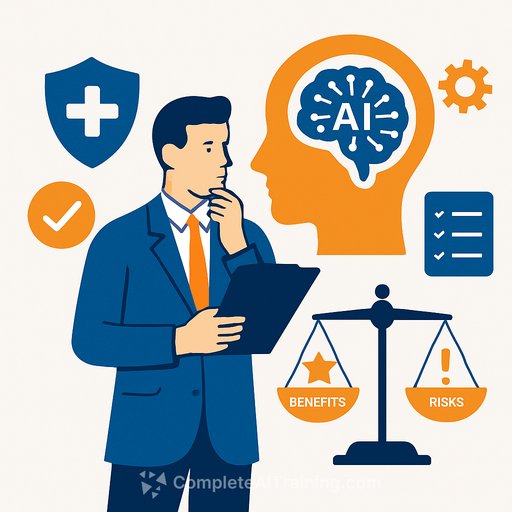
Embracing AI Wisely: A Health Plan Leader’s Guide to Benefits, Risks, and Readiness
Artificial intelligence (AI) is everywhere. Health plan executives face a flood of vendor solutions promising innovation and efficiency through AI. Pressure mounts from members, providers, regulators, and shareholders to adopt AI responsibly while managing risks.
Health plans have used AI in some form for years—think data processing and predictive analytics for population health. But AI technology has advanced, presenting new opportunities and challenges. This guide helps health plan leaders focus on what matters most for their organizations and members when considering AI adoption.
AI Readiness: Weighing Risks and Benefits
AI can streamline operations, reduce manual tasks, and improve decision-making. However, it also brings risks such as data privacy concerns, regulatory compliance challenges, cybersecurity threats, and potential disruptions to workflows and staff roles.
Every health plan is unique and must balance these factors based on its specific needs and risk tolerance. A practical evaluation framework ensures AI solutions fit smoothly into existing processes while protecting member safety and promoting equity.
Key Considerations for AI Implementation
AI adoption isn’t a one-size-fits-all solution. Health plans face strict regulatory environments, including HIPAA requirements for protecting health information. AI systems must deliver accurate, policy-compliant interactions and resist manipulation or misinformation—especially in clinical advice.
Implementation requires examining multiple dimensions beyond efficiency gains. This includes data security, compliance, clinical accuracy, ethics, and operational fit. A structured approach helps align AI with organizational goals and regulatory standards.
Strategic Alignment and Business Case
- What specific problem does AI solve?
- What goals are we pursuing? (Cost reduction, faster processes, better outcomes)
- Does the AI align with our mission and strategic priorities?
- Have we done a cost-benefit analysis to justify investment?
- Does AI offer clear advantages over current workflows?
- Will AI enable new capabilities?
- What level of risk tolerance does our organization have for AI?
- Are some functions (member-facing vs. back-office) more sensitive to risk?
Data Integrity and AI Model Performance
- What data sets trained the AI model?
- Is training based on real-world healthcare data, synthetic data, or both?
- If plan-specific data is used, how is confidentiality safeguarded?
- Is the model validated across diverse patient groups?
- How frequently is the AI updated to reflect new medical knowledge?
- Are model biases identified and addressed?
- What cybersecurity protections are in place internally and at the vendor?
Ethical and Compliance Considerations
- Does the AI comply with HIPAA and relevant privacy laws?
- Are there any state or federal restrictions on AI use for the intended function?
- Can the vendor explain how AI decisions are made (transparency vs. black-box)?
- How is bias prevented in care recommendations?
- Does the AI raise equity concerns for certain patient groups?
- Are there vendor safeguards and third-party verifications for error-free AI communication?
Clinical Validation and Patient Safety
- Has the AI undergone independent peer-reviewed validation?
- What is the AI’s error rate compared to human judgment?
- What risks exist if AI provides incorrect guidance?
- How will human oversight be maintained?
- Have clinical trials or pilot studies demonstrated the AI’s safety and effectiveness?
Integration and Workflow Compatibility
- Can AI integrate smoothly with electronic health records and claims systems?
- Will AI simplify workflows or add complexity for staff?
- How does AI fit into current decision-making for clinicians and administrators?
- Does AI provide real-time insights or require delayed processing?
Vendor Transparency and Support
- Is the vendor open about technology, methodology, and training data?
- What customer support is available for troubleshooting and improvements?
- Are ongoing monitoring and updates provided?
- Is there a contingency plan for AI failures or incorrect outputs?
Financial and Legal Issues
- What are total costs including licensing, training, and maintenance?
- What savings or benefits are expected, and how will they be tracked?
- What liability concerns exist if AI leads to medical errors?
- Are accountability measures in place to mitigate errors?
- Does the vendor contract clearly address data ownership, performance guarantees, and compliance?
Training and Change Management
- How will staff be trained to use AI effectively?
- What resistance might arise from staff or members?
- Is there a change management plan to support adoption?
- Will audits monitor AI performance to catch and correct issues?
Health plan executives must weigh AI’s benefits against its risks carefully. Prioritizing alignment with strategy, data quality, and patient safety helps develop AI solutions that boost innovation without compromising trust or ethical standards.
For executives seeking structured AI education tailored to their roles, exploring resources like Complete AI Training's courses by job function can offer practical insights to support responsible AI adoption.