
AI news ·
AdvancedMD uses AI to cut physician pajama time and recover revenue
AdvancedMD CEO Amanda Sharp says AI's near-term payoff for independent practices is ending "pajama time" - cutting the hours doctors spend on charts after patients go home.
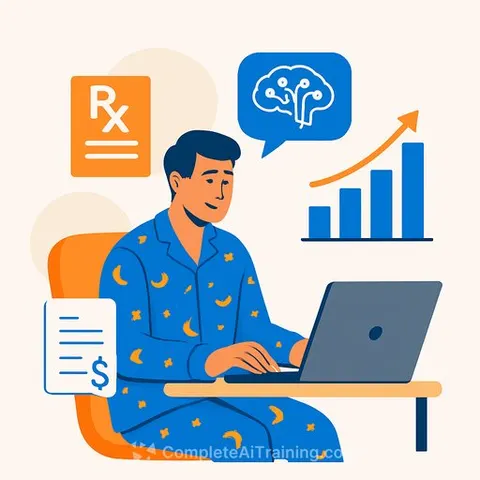
The last patient has gone home, but the physician hasn't finished working. Hours later, doctors are still completing charts and catching up on documentation that didn't fit into the day. Healthcare has a deceptively comfortable name for it: "pajama time."
For Amanda Sharp, CEO of AdvancedMD, this is where artificial intelligence can prove itself in an independent medical practice. The immediate opportunity isn't a distant promise to reinvent medicine. It's giving physicians back the hours that administrative work has taken from their evenings.
"Our foot in the door tends to be on the clinical side," Sharp said in an interview with PYMNTS CEO Karen Webster. AI-assisted transcription and documentation can help physicians, nurses and medical assistants populate a chart, she said, while leaving the clinician responsible for reviewing and approving the result.
That makes documentation a useful starting point because the benefit is immediate and personal. A physician doesn't need a complicated return-on-investment model to understand the value of finishing charts earlier and closing the laptop before bedtime. It also gives AI a relatively contained test inside practices that remain cautious about accuracy, security and financial returns. Sharp described the market as still being in an "early adopter phase," with enthusiasm at one end and considerable skepticism at the other.
"You always want the human in the loop," Sharp said. "You wouldn't rely on AI completely to do all these tasks."
From pajama time to payment time
Giving doctors their evenings back is the human case for AI. The business case begins with what happens after the chart is complete, when a patient visit becomes a chain of eligibility checks, coding decisions, claims, contracted rates, denials, appeals and patient balances.
Providing healthcare and getting paid for it remain two different processes. Independent practices must navigate the same complicated payment system as much larger health systems, but with fewer people and less room to absorb a denied claim or a reimbursement that doesn't match the contract.
"Anything that has large amounts of data with repetitive tasks, that's where AI really shines," Sharp said. She pointed to coverage detection, denial management, appeals, patient estimates and payment posting as areas where automation can do more of the sorting and surface the exceptions that require human judgment.
That can change the economics of work a practice may otherwise leave undone. Staff spend hours correcting claims, pursuing denials and reconciling payments, while some difficult denials aren't chased because collecting the money takes more time than the practice can spare. For professionals working in revenue cycle roles, the shift toward AI for Medical Billers is already reshaping how these tasks get done.
"We've seen people focus more on reimbursement, making sure their financial health is better than it's ever been," Sharp said. "Now they can more reliably predict when denials are going to happen … and can eliminate them."
AdvancedMD provides clinical and financial software for independent practices. Its July expansion with Waystar brought coverage, claims, denial, remittance and patient-estimate capabilities into the AdvancedMD portal.
AI doesn't mean nobody's watching
Sharp said AdvancedMD hasn't generally seen practices use automation simply to cut staff. Instead, AI can move employees away from repetitive tasks and toward work that requires judgment, including the cases most likely to affect patient experience or the financial health of the practice.
The technology also has to fit securely into the software a practice already uses. In healthcare, sending data to an outside tool immediately raises questions about patient information, cybersecurity and compliance, which makes native integration and clear human review especially important. Those concerns are central to how AI for Healthcare is being adopted across the industry.
Once clinicians see AI reduce a burden they feel every night, practices may be more willing to trust it with the less visible administrative and financial work surrounding patient care.
Webster asked whether reducing that burden could change the economics of independent medicine. If physicians need less administrative infrastructure, she suggested, AI could alter the calculation for doctors deciding whether to join a health system or open a practice.
"Is it possible that what you're describing as a platform for independent physicians to leverage could, in fact, create more independent practices because the investment in starting one is different?" Webster asked.
Sharp agreed that administrative burden can influence physicians who choose employment over private practice, although she stopped short of predicting a resurgence. Technology can simplify startup work, but whether doctors choose independence remains an open question.
For practices already operating independently, the payoff is more immediate. AI can put capabilities within reach that a solo physician or small group would otherwise struggle to support internally.
Why this matters for healthcare professionals
The near-term test for healthcare AI is less dramatic than transforming medicine. It is whether a physician can close the laptop earlier, whether staff can spend less time chasing repetitive work and whether the practice gets paid accurately for the care it already delivered. For a doctor finishing charts at 10:30 at night, that's transformation enough.
For physicians and practice staff, the practical takeaway is that AI adoption is starting with the work they already do daily - documentation, claims, denials - rather than abstract futuristic applications. The tools are designed to keep a human reviewer in the loop, which means the role of the clinician and billing staff shifts toward oversight and exception handling rather than disappearing. Practices that understand where AI fits into their existing workflow stand to recover both time and revenue.