
AI news ·
AgentCraft turns multi-agent coding into a walkable Minecraft studio
AgentCraft runs Claude-powered coding agents in isolated git worktrees, with a $6 test run landing six features. You review real diffs and click merge-nothing is ever pushed without that approval.
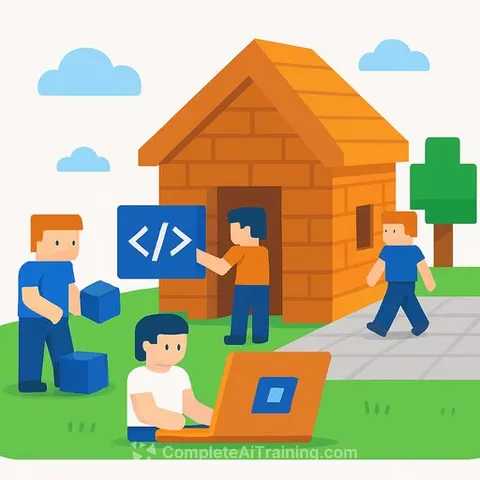
AgentCraft transforms multi-agent coding from a wall of terminal text into a walkable Minecraft studio. Built on Anthropic's Claude, the open-source project lets you assign goals to a team of AI agents who plan, code in isolated worktrees, and walk over to ask questions when they need a decision. You review real diffs and press merge-nothing touches your branch without that click, and nothing is ever pushed.
How the studio works
You type a goal into the console. A lead agent named Marlow reads your repository, writes a plan, and pins tasks to a wall. Worker agents-Juniper, Kit, Wren, Rowan, and Tove-walk to their desks, sit down, and start coding. Each agent works in its own git worktree under agentcraft/, so your checkout is never touched. Their monitors stream every file they read and every line they change in real time.
When a decision genuinely requires your input, a clay exclamation mark appears above an agent, the bell rings, and the agent walks to the podium. You press J to answer. Once work is complete, you review a full diff screen-file list, line numbers, collapsed context, the worker's summary-and decide whether to merge. The system refuses a merge if your checkout has uncommitted changes. Conflicts go back to the worker for resolution.
Close the game and the agents keep working. Open it again and the studio catches up. The Foreman, a Node and TypeScript orchestrator, owns all state: tasks, dependencies, messages, shared memory, decisions, and worktrees. Everything survives restarts and crashes.
Safety on real repositories
AgentCraft enforces several guardrails. Agents get no git network access at all-this is enforced inside git itself, so even a push hidden in a test script fails. Risky commands that write outside the worktree or attempt network access trigger an in-game permission prompt showing exactly what "Always allow" would cover. Agents commit as AgentCraft; only the merge you approve carries your name.
"This is not a mockup," the project documentation states. Screenshots come from a real run with Claude agents on a sample repo, driven entirely through the game. Six features landed with passing tests, including a merge conflict the worker resolved and sent back for review.
Costs and setup
The Claude backend bills per token to your Anthropic or cloud provider account. A small goal costs a few dollars. Using a Sonnet model with low effort settings on a sample repo, three two-task goals-including two merge conflicts-took 2 to 10 minutes each and about $6 total. A free simulated backend is available for trying the studio without API usage.
You need Windows 10 or 11, or macOS, plus Java 25, Node 22+, git, and a copy of Minecraft: Java Edition. For real agents, you need either an Anthropic API key or a supported cloud provider like Amazon Bedrock, Google Vertex AI, or Microsoft Foundry. The project is MIT-licensed, with all art generated by scripts in the repository.
Why this matters for IT and development teams
AgentCraft makes multi-agent coding observable in a way that terminal output cannot match. The studio gives you glanceable status-lamps and a cupola beacon show who is working, who is stuck, and who is waiting on you-while the merge-only gate keeps you in control. For teams exploring how AI agents fit into real development workflows, it provides a sandbox where the safety boundaries are visible and the cost of experimentation is measured in single-digit dollars. Professionals evaluating AI Code Generation Courses or AI Agent Courses will find the project's architecture-worktrees, permission prompts, and a human-in-the-loop merge step-a practical reference for how agentic tools can be built without sacrificing repo integrity.