
AI news ·
AI-assisted diagnosis gains traction in lower-income rural healthcare systems
AI-assisted TB screening reduced misdiagnosis rates by 30% and improved outbreak forecasting by 80%. Hardware and data gaps still block wide-scale deployment across Asia-Pacific healthcare.
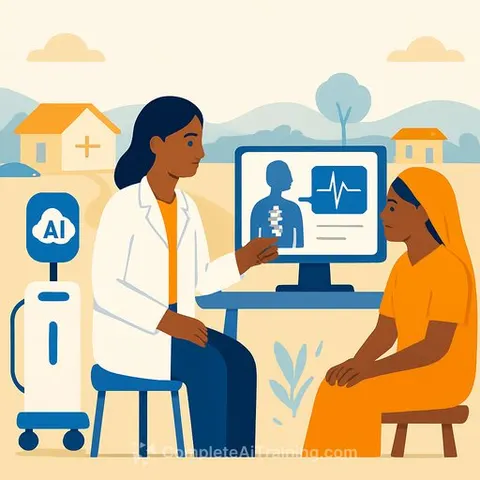
In a dusty rural town south of Manila, a doctor types a patient's symptoms into ChatGPT before making a diagnosis and prescribing medication. The scene captures how artificial intelligence is reshaping healthcare in lower-income regions where trained physicians are scarce, diagnosis errors are common, and smartphones double as medical tools.
From Africa to Southeast Asia, doctors with limited training are turning to AI for backup on diagnosis and prescription decisions. A recent study found that AI-assisted tuberculosis screening reduced misdiagnosis rates by more than 30 percent and improved seasonal disease outbreak forecasting by more than 80 percent. The technology is pushing into faster screening, sharper diagnostic accuracy, and fewer prescription errors across public health systems.
Yet adoption remains deeply uneven. In the Asia-Pacific, which has some of the world's largest unmet healthcare needs, AI adoption highlights exactly how much the region's health infrastructure relies on technology to compensate for a shortage of human expertise.
Where AI is already at work
In the Philippines' Sulu province, a hub-and-spoke teleradiology model was introduced last year to address diagnostic imaging gaps in one of the country's most underserved areas. The system has built-in potential for AI application pathways. The Philippines, like many lower-income nations, increasingly depends on telemedicine to overcome geographic and specialist-access barriers, and AI is growing as a separate but relevant layer in its digital-health ecosystem.
Singapore offers a more advanced example. Since 2020, the city-state has integrated the SELENA+ AI software system into its national diabetic-retinopathy screening infrastructure. Singapore has one of the highest rates of childhood myopia in the region - almost one in three children need glasses by age 7 - and significant rates of diabetic retinopathy. By 2019, a centralized national tele-ophthalmology program with trained human graders examining retinal photos at a central reading center had pushed annual screening numbers above 100,000. That scale gave developers the data they needed to build SELENA+ in 2018, a deep-learning system trained on more than 500,000 retinal images. Since 2021, SELENA+ has been widely recognized for how it extends scarce specialist capacity to cope with a larger screened population through faster diagnostic triage.
Médecins Sans Frontières has used AI since 2022 to expand healthcare workforce capability in lower-income countries. Its Antibiogo offline smartphone app lets non-specialists analyze and interpret antimicrobial susceptibility testing without fully trained microbiologists. Since 2024, MSF has also used AI to increase throughput and accuracy of tuberculosis community screening in the Philippines.
Two obstacles still block wide-scale deployment
The first obstacle is hardware. Data centers needed for AI processing demand large amounts of electricity, an acute concern in the Asia-Pacific where energy rationing has been triggered by the fallout from Iran's disruption of Middle Eastern maritime energy imports. The UN projects the region will account for 85 percent of global power demand growth in 2026, much of it driven by rising data center needs.
Second is data relevancy. Many developing economies are still establishing the digital-health foundations needed for large-scale AI deployment. The majority of models from Western AI companies use Western-centric datasets, limiting relevance for patients in Asia, Latin America, and Africa.
WHO, as far back as 2021, listed six guiding principles for AI healthcare ethics, focusing on human autonomy, transparency, and accountability in using appropriate datasets across diverse societies.
Why this matters for healthcare workers
Evidence remains limited for the positive impact of generative AI and large language models in routine healthcare, clinical decision support, and administration. That will change only if healthcare systems consciously integrate AI-assisted diagnostics and triage into existing physical and telemedicine infrastructure - not replace it with a fully AI-enabled, telemedicine-only model. For clinicians in underserved regions, this means AI will remain a supplement, not a shortcut, unless their governments solve the hardware and data problems first.