
AI news ·
AI competence illusion erodes worker skills, learning leaders warn
The competence illusion makes employees overestimate their skills because AI does the heavy lifting, leading to skill degradation and security risks. Organizations must redesign training to force verification and metacognition, or risk losing the human capability needed to oversee AI.
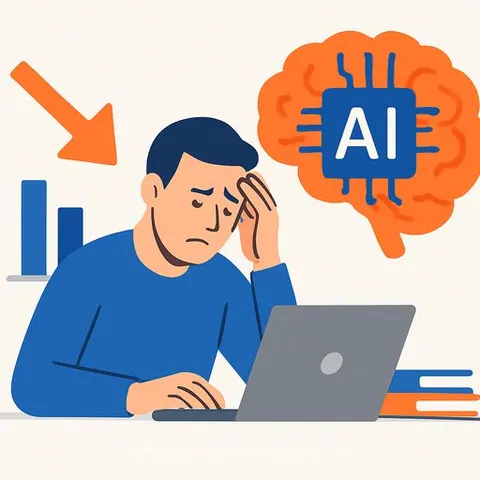
The competence illusion is a psychological phenomenon in which people overestimate their own ability to perform a task because AI tools are doing the heavy lifting. When an AI drafts a report, writes code, or analyzes a dataset, the user experiences a feeling of mastery. The output looks coherent, so they believe they could replicate it or fully understand it - even when they can't.
This is distinct from simple automation. With automation, a machine replaces a repetitive task and the human knows they've delegated it. With AI, the interaction is collaborative: the user prompts, the AI generates, and the user edits. That loop creates a feedback cycle that inflates self-assessment. The mind attributes the AI's competence to itself, a cognitive bias amplified by technology.
Why the illusion takes hold
Three mechanisms drive the effect. First, effort discrepancy: when you struggle to write something, you remember the effort. When AI writes it, you skip the struggle. Effort is a key signal for memory formation and skill acquisition, and without it, the brain doesn't encode the knowledge.
Second, fluency bias: AI output is typically fluent, well-structured, and confident in tone. Humans mistake fluency for accuracy and depth. If it sounds good, we assume the underlying logic is sound.
Third, immediate gratification: getting an answer in seconds short-circuits the exploration, iteration, and trial-and-error that lead to genuine learning. Employees become consumers of answers rather than producers of solutions.
The cost for organizations
The implications for Learning and Development are profound. If employees stop exercising their mental muscles, those muscles atrophy. The competence illusion leads to skill degradation - employees may lose the foundational knowledge needed to recognize when the AI is wrong, becoming dependent on a black box.
Critical thinking declines when AI presents a solution and there's little incentive to question it. Over time, the habit of skepticism and verification fades. There are security risks too: an employee who doesn't deeply understand the code or data they're using is more likely to introduce vulnerabilities or misinterpret compliance requirements.
And there's a business continuity risk that is rarely discussed. When the AI system fails or is unavailable, the illusion shatters. The employee is left exposed, unable to perform the task they believed they had mastered.
What learning leaders can do
The solution is not to ban AI - that is both futile and counterproductive. Instead, learning experiences should be redesigned around the new reality. For executives and strategy leaders, this means treating AI literacy and workforce capability as strategic priorities rather than IT concerns. AI for Executives & Strategy courses can help leadership teams understand how to manage these risks at an organizational level.
One approach is shifting from outcome to process: measure how employees arrive at an answer, not just the answer itself. Require them to document their prompts, explain their reasoning, and justify why they accepted the AI's output. This forces metacognition.
Another is introducing "cognitive friction": deliberately design exercises where the AI is wrong. Give employees a generated report with a hidden flaw and ask them to find it. This builds verification habits and reinforces the need for human oversight.
AI literacy should be taught as a core competency - not how to use a specific tool, but how to evaluate outputs, understand the limitations of training data, and recognize the difference between correlation and causation in AI-generated insights. AI Learning Path for Training & Development Managers offers a structured approach for L&D teams building these capabilities.
Use AI as a tutor, not just a worker. Encourage employees to ask AI to explain why a solution works, not just to provide the solution. Prompt them to ask for counterexamples or alternative approaches.
Finally, re-evaluate assessment methods. Traditional tests and quizzes are increasingly useless in an AI-enabled world. Shift to oral exams, live coding challenges, or problem-solving in unfamiliar contexts where AI cannot be used. This ensures the knowledge is truly in the person's head, not just in the model.
Why this matters for executives and strategy leaders
The competence illusion is a hidden tax on AI adoption. It looks like productivity gains in the short term, but it's actually a depletion of intellectual capital over time. For executives, the strategic risk is clear: the workforce you're counting on to execute your AI strategy may be losing the very skills needed to oversee it. The mandate is to become the guardians of genuine capability in an age of artificial output - designing systems that ensure the human brain remains the most valuable asset in the organization, even when it sits alongside a powerful machine.