
AI news ·
AI gold rush leaves talent development behind as companies focus on technology
Companies are pouring resources into AI while neglecting workforce development, widening the gap between tech deployment and talent readiness. Entry-level roles will shift from data entry to analysis, and managers must bridge AI insights with business decisions to avoid long-term skill shortages.
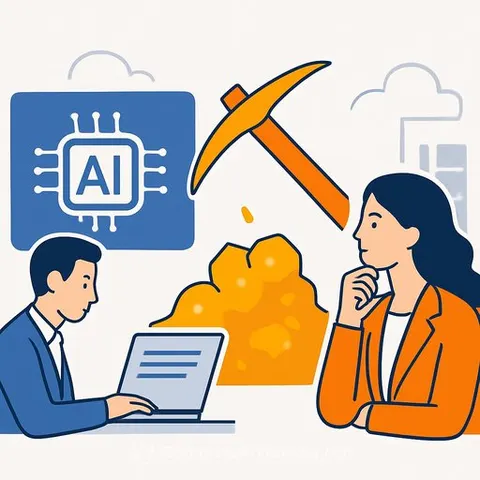
Companies are pouring resources into AI tools, but most are neglecting the workforce development needed to make those tools useful. The gap is widening between technology deployment and talent readiness, and it will reshape white-collar roles at every level. Entry-level employees will spend less time on data entry and more on analysis. Managers will need to connect AI insights to real business decisions. Senior leaders must align AI adoption with a clear plan for their people - or risk creating long-term skill shortages.
The AI gold rush and what history teaches
"We are living through an AI rush that, in many ways, resembles the gold rush of the 1800s," said an AI workforce specialist. The promise of greater productivity and faster output is real, but much of the conversation about jobs remains speculation. Data centers demand enormous amounts of electricity and water. Heavy investment is propping up adoption, and companies are still learning what long-term dependency on these tools will mean. With so many variables unresolved, it is too early to claim the destination is known.
Previous technological shifts - the Industrial Revolution, the rise of computers, the internet - each eliminated some jobs and created others. AI will likely follow the same pattern. Some roles will disappear, others will be redesigned, and new ones will emerge. The balance between disruption and creation is what remains unclear.
Rethinking entry-level roles and talent pipelines
Entry-level positions are often labeled as the most vulnerable, but eliminating them outright would create a contradiction. These roles are the pipeline for future managers and senior leaders. Without them, companies lose the next generation of talent that will eventually replace retiring workers. What changes is the nature of the work. Repetitive tasks, basic analysis, and simple reporting are increasingly handled by AI. In the past, junior employees learned by gathering data and building reports. Now, AI can perform much of that work faster.
The shift means entry-level talent needs earlier exposure to real business problems, stronger coaching from experienced professionals, and more opportunities to interpret AI outputs, question assumptions, and understand business context. Companies that redesign early-career roles around learning, judgment, and exposure - using rotational assignments, structured feedback, and data interpretation - will build a stronger talent base. If they cut entry-level pathways, they may save time now but create shortages later.
What AI means for people managers
Pure people management will not be enough. Coordinating teams, running meetings, and reporting updates to senior leadership are tasks that can be streamlined or automated. AI for Management will require fluency with data, deeper business ownership, and the ability to help employees navigate decisions in a more data-driven environment. Managers will play a critical role in guiding entry-level talent, translating AI outputs into business meaning, and identifying where human judgment is still required.
T-shaped managers - leaders with strong human skills and a deeper understanding of the business - will become especially valuable. The best managers will combine empathy, communication, process knowledge, and the ability to foster AI adoption without losing sight of talent development.
Leadership's role in aligning AI and workforce development
Many organizations are rushing into AI implementation without a clear plan for how their workforce should evolve alongside it. Some have already had to slow down or rethink AI tools after seeing how they affected employees and operations. Managers often see the day-to-day challenges more clearly than senior leadership, so leaders must create space for that feedback.
AI for Executives & Strategy is about more than deployment. It is about enabling managers and teams to use AI responsibly, effectively, and in ways that strengthen the organization over time. The challenge is not simply adopting the technology; it is building the systems and culture that make it sustainable.
Why this matters for management
The transformation will reach every level - from entry-level employees to senior executives. "The future of work will be shaped not only by AI itself, but by the decisions companies make today about people, skills, leadership and culture," the specialist said. For managers, the immediate task is to develop AI fluency, take ownership of business outcomes, and coach junior talent through a data-driven environment. Organizations that treat AI as a reason to invest in their people - not just their tech stack - will have the advantage.