
AI news ·
AI helps agents close the $542,000 underinsurance gap caused by wildfire losses
69% of LA fire victims were underinsured, with an average coverage gap of $542,000. AI tools that automate policy reviews can flag gaps before a loss, shifting agents from paperwork to protection.
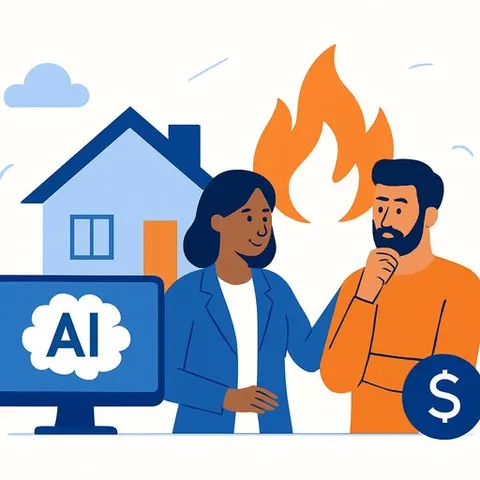
Wildfires in Los Angeles this year left 69% of homeowners who lost everything with policies that fell short of rebuilding costs. The average gap: $542,000. The data comes from a survey of households affected by the 2025 LA fires, and it mirrors a pattern researchers have tracked since Colorado's Marshall Fire, where 74% of claimants were underinsured, including 36% severely so.
Jackson Fregeau, CEO of AI platform Quandri, points to a structural failure in how agencies service existing clients. "Writing a policy and not speaking to that client again for three years is no longer an acceptable level of service," he said. "The market is moving too fast now."
The renewal that never became a conversation
Most homeowners buy a policy when a life event demands it - a home purchase, a switch for better pricing - then let coverage auto-renew. They don't call to understand coverage changes or reassess whether their needs have shifted. That's the agent's responsibility. When the agent doesn't initiate, the conversation simply doesn't happen.
Renewals are the reliable touchpoint where agents could connect, identify what's changed, and help clients adjust coverage. In practice, clients see the premium notice and either let it ride or start shopping. J.D. Power quantified what good communication is worth: homeowners facing a premium increase who understood the reason and were given options to lower it reported satisfaction scores 184 points higher than those who received neither.
Agents want to be the one their client hears from first. But reviewing a single policy can take up to 90 minutes - analysis, remarketing, drafting communications. The economics have never supported that level of attention across a standard book of business.
What AI can process that agents can't
"At its core, insurance is information processing, and AI can now handle that work directly," Fregeau said. AI can read every policy in the book, flag coverage gaps, spot mismatched limits, and surface changes that would otherwise go unnoticed. It can also communicate those findings to the client.
That shifts the bottleneck. Agents get time back for judgment and client relationships. The manual, repetitive work that consumes capacity gets handled by systems designed for it, so advisory work - the part only a licensed agent can do - can happen across the entire book, not just for the largest accounts. For agencies exploring this shift, AI for Insurance tools are moving from experimental to operational.
Volatility isn't cyclical anymore
Weather-related disasters accounted for 92% of the $224 billion in natural-disaster losses worldwide in 2025. The pace of change is accelerating, and Fregeau argues that proactive service across the full policy lifecycle has become necessary infrastructure. AI enables always-on service across the entire book, so agents reduce their workload while policyholders stay protected. The same logic is driving interest in AI Agents & Automation across back-office insurance operations.
Why this matters for insurance professionals
The underinsurance gap isn't a client education problem. It's a capacity problem. Agencies that continue treating the renewal as a passive event will keep producing the same outcomes - clients who discover they're underprotected only after a loss. AI tools that automate policy analysis and client communication change the unit economics of servicing a book. The agencies adopting them are building renewal processes where coverage gaps get flagged and addressed before the fire, not after.