
AI news ·
AI helps Missouri hospital find 50,000 incidental findings in five months
Mercy Hospital's AI system flagged more than 50,000 incidental findings in five months across CT scans, X-rays, and ultrasounds. The tool reads images in under a minute and escalates urgent cases so life-threatening conditions aren't lost in the queue.
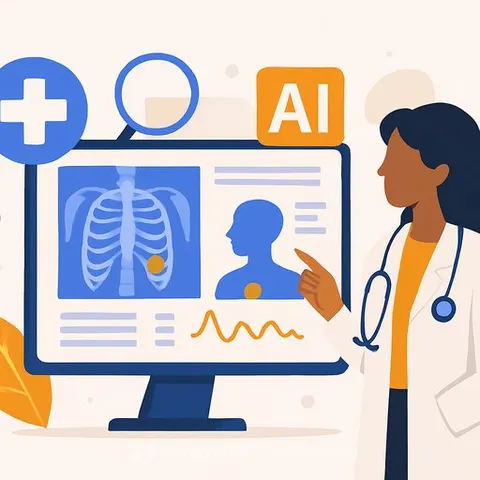
Mercy Hospital in Springfield, Missouri, has deployed an AI system called Aidoc across all its imaging locations to read CT scans, X-rays, and ultrasounds in under a minute, flagging urgent cases that might otherwise sit in a radiologist's queue for days. The technology has already identified more than 50,000 incidental findings over a five-month period - additional health issues spotted on scans ordered for unrelated reasons - helping physicians route patients to follow-up care that might have been missed.
"You could find lung clots and things that you weren't expecting. It'll flag that instantaneously and bring it up for the radiologist with a flag saying 'read me now,'" said Dr. John Mohart, Mercy's executive vice president and chief operating officer.
How Aidoc reshapes radiology workflow
Before Aidoc, imaging results from emergency rooms and outpatient facilities entered a standard queue. A patient with a life-threatening condition could wait while radiologists worked through the backlog in order. The AI now reads each image within seconds of upload and escalates high-risk cases to the top of the list. Mohart said this shift is "absolutely impacting time to treatment and quality outcomes."
The system also catches what radiologists call incidental findings - lung nodules needing follow-up, or coronary calcium signaling heart disease, even when a scan was ordered for an unrelated complaint. Mercy's scale is telling: more than 50,000 such findings surfaced in five months. "We're able to report on those and navigate patients to the next best treatment," Mohart said. "So they're followed up on and not lost in a file."
Easing workforce pressure without replacing clinicians
Radiology faces a limited workforce, and Mohart said AI has improved efficiency by allowing lower-level reads - basic chest X-rays, for instance - to be reviewed by other physicians with an AI over-read. This frees radiologists to concentrate on complex imaging that demands their specialized training. "If this can make you more efficient, take care of mundane tasks that you can focus on the more important, higher level task and communication with patients, then it works for both," he said.
Mohart was direct about job displacement concerns: physicians and providers will not be replaced by AI. Mercy evaluates every AI deployment against two questions - how does it help the patient, and how does it help the provider. The hospital has found that reduced turnaround times and automated documentation actually increase the time clinicians can spend with patients. "It makes the provider's lives so much better, but then also the patient's experience better and more reliable," Mohart said.
Privacy, security, and provider acceptance
All AI algorithms at Mercy undergo the same privacy and security review required for any attachment to the hospital's electronic systems. Mohart stressed that patient data "does not get shipped out or sold to anyone." The data remains part of the patient's record.
The harder challenge, he said, is winning trust from the people who use the tools. "I think the biggest challenges are you have to get acceptance from the providers that this doesn't compromise quality or patient safety," Mohart said. The hospital's approach ties every AI initiative to measurable improvements in workflow and outcomes rather than adopting technology for its own sake.
Why this matters for healthcare professionals
Mercy's experience with Aidoc offers a concrete model for what AI adoption looks like inside a working hospital system - not a pilot or a press release, but a scaled deployment across emergency rooms and outpatient facilities. For healthcare professionals, the takeaway is practical: AI tools that handle triage and flag incidental findings can directly reduce the risk of missed diagnoses while freeing clinicians for the complex work only humans can do. The technology is already reshaping workflows in AI for Healthcare, and administrative roles are seeing similar shifts - tools for prescription refills, medical note-taking, and documentation are automating tasks that consume hours of staff time. For those in revenue cycle and billing, these same efficiency principles apply to coding and claims processes, an area covered in depth by AI for Medical Billers training resources.