
AI news ·
AI overreliance may erode managers' practical wisdom, study finds
Managers who over-rely on generative AI risk "epistemic deskilling," gradually losing the real-world judgment needed for complex decisions. Time pressure accelerates this shift, as managers treat AI as a shortcut and stop learning from direct experience.
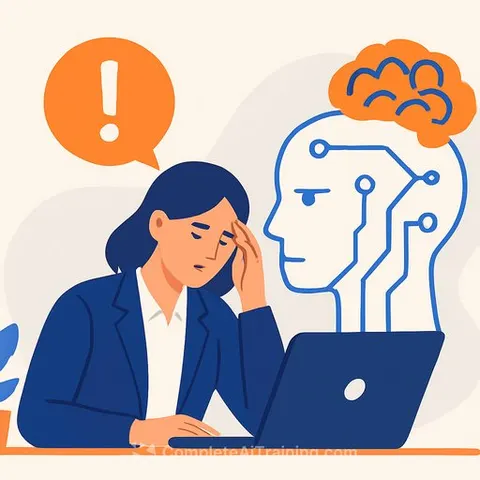
A new study from the University of Bath warns that managers who lean too heavily on generative AI tools risk losing the practical wisdom they need to make sound decisions. The research, published in the Academy of Management Review, describes a process called "epistemic deskilling" - where people gradually shed knowledge-related capabilities because they outsource too much thinking to AI.
"Gen-AI appeals because it can help people complete tasks more quickly. However, Gen-AI cannot replace the lessons learned through firsthand experience," said Professor Dirk Lindebaum of the university's School of Management. "Unlike humans, AI does not experience the world, understand the consequences of decisions or grasp the social and emotional complexities in our workplaces. Instead, it produces responses based on patterns found in existing data."
The international research team - spanning the University of Bath, Ohio State University, the University of Lausanne, and Cardiff University - focused on what academics call managerial phronesis, the judgment born from real-world experience, reflection, and human interaction. Their findings suggest that time pressure is a key accelerant. When deadlines tighten, managers treat Gen-AI as a shortcut, skipping the deep engagement that builds lasting professional instinct.
How epistemic deskilling takes hold
The researchers found that epistemic deskilling is most likely when managers stop asking questions, stop seeking different perspectives, and stop learning from direct interactions. Instead of building a nuanced understanding of employees, customers, or organizational challenges, they default to AI-generated answers. Those answers, the study notes, lack the context and moral judgment required for complex decisions.
"In these situations, managers may stop asking important questions, seeking different perspectives or learning from real-world interactions," Lindebaum said. Over time, this erodes the ability to think critically and anticipate what actions are needed now to meet future goals. The risk is not that AI makes bad decisions - it is that managers gradually lose the capacity to recognize when it does.
For leaders exploring how to integrate these tools responsibly, the AI Learning Path for Senior Managers offers structured training on AI strategy and decision support. The study's authors emphasize that technology adoption alone does not guarantee better outcomes; the design of roles and workflows matters more.
When AI strengthens judgment instead of weakening it
The team also mapped a countervailing process they call epistemic upskilling. This happens when managers use Gen-AI as a tool for reflection rather than a replacement for thinking. Instead of accepting outputs at face value, they challenge assumptions, explore alternative scenarios, and test the reasoning behind their own decisions.
"Rather than accepting AI outputs at face value, managers can use them to challenge assumptions, explore alternative scenarios and test the reasoning behind their own decisions," Lindebaum said. AI systems often struggle to explain why they produce particular answers, and those explanatory gaps can force deeper thinking. "It is that which Gen-AI cannot satisfactorily explain that managers must explain to themselves and others."
This beneficial outcome is most likely when managers know they will be held accountable for their decisions. In workplaces where individuals must justify their actions and explain their reasoning, Gen-AI becomes a trigger for deeper reflection. The researchers stressed that this requires persistent effort - managers must fill the explanatory gaps themselves rather than waiting for the technology to improve.
Why this matters for managers
The study delivers a clear message: simply introducing AI tools will not automatically improve decision-making or organizational performance. Organizations need to design roles, responsibilities, and workflows that preserve and build the human skills AI cannot replicate. This includes creating conditions where managers have both the time and the accountability to engage deeply with problems.
For managers navigating this shift, resources in AI for Management provide practical guidance on using AI to support - not supplant - leadership judgment. The research, available via the Academy of Management Review, reinforces a point that gets lost in the rush to adopt new tools: the experience you skip today is the judgment you will lack tomorrow.