
AI news ·
AI reshapes diagnosis, drug design and surgery across medicine
Stroke patients in England now recover with little or no disability at triple the previous rate after the NHS added AI decision support to brain scans, cutting treatment time by one hour.
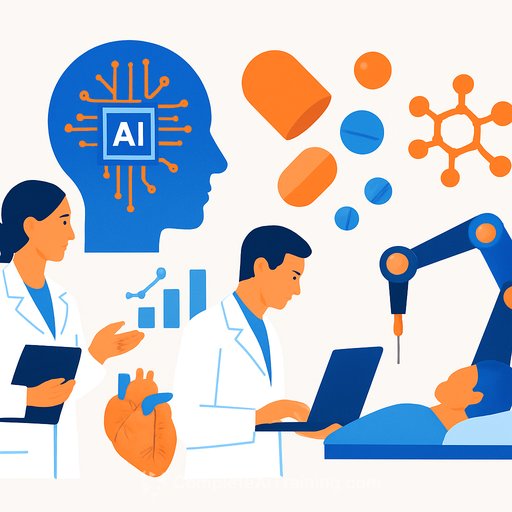
Stroke patients in England are recovering with little or no disability at triple the previous rate after the National Health Service added AI decision support tools to brain scans. The system, called Brainomix e-Stroke, cuts the time between hospital arrival and treatment by a full hour - preserving brain function during the critical "golden hour" window where intervention matters most.
This result is one example of how artificial intelligence is moving beyond the examining room and into every stage of medicine. From research labs designing novel molecules to operating rooms analyzing surgical video in real time, AI tools are changing what doctors can detect, how drugs get made, and which patients recover fully.
Diagnosis: faster decisions, fewer missed signals
A 2025 study published in JAMA Neurology found that an AI system called MELD Graph detected 64% of epilepsy-causing lesions that radiologists had previously missed. Beyond imaging, large language models are now tackling clinical diagnosis itself. A study in Science this year pitted an LLM against hundreds of physicians on challenging cases - and the model outperformed the doctors.
These tools don't just spot what humans overlook. They also compress timelines. Stroke diagnosis, seizure detection, and complex differential diagnoses all depend on speed and pattern recognition, two areas where AI systems show measurable gains. For healthcare professionals who rely on imaging and test interpretation, the shift means diagnostic support that works alongside clinical judgment rather than replacing it.
Drug design: shrinking a decade-long process
Developing a new drug typically takes 10 years or more, and 90% of candidates fail during clinical trials. AI is now being applied across every phase of development to reduce that failure rate. Fiona Marshall, president of biomedical research at Novartis, wrote for the World Economic Forum that AI makes the most arduous parts of drug discovery "faster, smarter and less prone to failure."
The work happens in distinct stages. In the targeting phase, researchers use AI-driven simulations to turn individual genes on and off in a model diseased cell, pinpointing which proteins or genes drive the condition. Novartis used this method to identify potential gene targets for the most common form of inherited kidney disease. Once a target is confirmed, AI helps generate novel molecular structures designed for a specific therapeutic effect. Insilico Medicine, an AI-driven biotech company, used a proprietary system to create the molecular structure behind Rentosertib, now in clinical trials for idiopathic pulmonary fibrosis. AI for Science & Research training covers the techniques researchers use in these exact workflows.
Surgery: AI enters the operating room
Surgical AI spans the full timeline of care. Before the procedure, algorithms analyze patient data - medical history, lab values, imaging, and social determinants of health - to predict individual risk profiles. A 2026 review in Cureus found that AI already outperforms traditional risk assessment tools for identifying ideal surgical candidates.
During surgery, the stakes are immediate. In a University College London clinical trial, a surgical team removed a vision-threatening brain tumor with help from an AI system that analyzed the surgical video feed in real time. UCL called it a world first, explaining that "the AI supported the surgical team in identifying risky areas to avoid while removing as much tumor as safely possible." After surgery, AI-generated discharge instructions, conversational chatbots, and computer vision-based wound monitoring are three applications that a literature review in The American Surgeon identified as having potential to improve recovery.
Why this matters for healthcare professionals
AI tools are already producing results in clinical settings - not in pilot programs or press releases, but in working hospitals and active drug pipelines. For healthcare professionals, the practical takeaway is that AI literacy is becoming a clinical skill. Understanding how these systems reach conclusions, where they fail, and how to integrate their output into decision-making will separate teams that get results from those that get surprises. The NHS stroke data, the epilepsy detection study, and the operating room trial all point to the same pattern: AI doesn't replace clinical expertise, but it changes what that expertise needs to include. AI for Healthcare training addresses exactly this integration challenge.