
AI news ·
AI skills gap costs companies $5.5 trillion as peers step in where corporate training fails
A $5.5 trillion AI skills gap is being filled by peers instead of corporate training, while 78% of HR leaders warn AI threatens leadership pipelines.
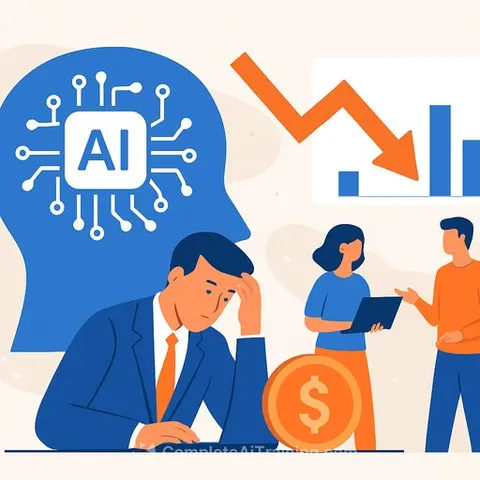
The latest research across HR, learning and development, and workplace policy reveals a series of colliding pressures. A $5.5 trillion AI skills gap is being filled by peers rather than corporate training, while 78% of HR leaders warn that AI threatens leadership pipelines. At the same time, new international standards address workplace health, and the Civil Service tops graduate employer rankings for the second year running.
AI skills gaps and the shrinking leadership pipeline
Companies are losing $5.5 trillion in productivity due to AI skills gaps, as leaders prioritise software over employee upskilling. Fewer than 25% of workers receive structured training, leaving many facing anxiety and increased workloads from uncoordinated tools. A grassroots movement is emerging in response, with peer leaders building human-centred AI pathways that emphasise the "human in the loop," ensuring AI augments rather than replaces human wisdom and ethics.
Separate research from Talogy surveyed 207 senior HR leaders, talent acquisition managers, and L&D experts. It found that 78% are concerned about the long-term loss of critical leadership skills. AI is taking on tasks traditionally associated with entry-level roles, and there is a growing risk that skills may not develop as naturally as they once did. For HR and L&D teams needing structured approaches, AI Corporate Training Courses offer pathways designed for managers who must equip teams without relying on ad-hoc peer learning.
HR under pressure and AI's cognitive cost
HR has taken on a more consequential mandate without the support to match it, according to the 2027 State of People Strategy Report from Lattice. The study found that 55% of HR leaders have considered leaving the profession over the past year. Reasons included feeling undervalued (39%), always working in crisis mode (35%), general burnout (34%), and concerns about being replaced by artificial intelligence (21%).
Meanwhile, evidence is mounting that AI tools may be degrading workers' existing skills. Beyond the threat of "workslop" - AI-generated content riddled with errors - employees have reported in various surveys that AI tool use has worsened their critical thinking skills, affected their judgment, and made them feel less intelligent. Employers are scrambling to teach workers how to use AI in line with business priorities, even as the tools themselves appear to erode the capabilities those priorities depend on.
Regulation uncertainty and finance role evolution
Mounting calls for federal AI regulation in the U.S. and debate over a global AI slowdown have introduced uncertainty for enterprises. Organisations remain unsure whether restrictions will hinder their use of open-weight models, adding unpredictability to an already unstable technology.
In quantitative finance, AI is not reducing the need for professionals - it is raising expectations. New research from the CQF Institute, part of Fitch Learning, found that 59% of quantitative finance professionals say AI has expanded their job responsibilities. Employers now seek professionals who can combine quantitative depth with practical implementation skills and the judgement to validate and challenge AI-driven outputs. Some 74% expect AI to drive major or complete transformation of their role within five years, and 84% believe continuous learning is essential for long-term career success.
Workplace health standards and graduate rankings
The International Organization for Standardization (ISO) launched ISO 45010, the world's first international standard providing guidance to help organisations support employees experiencing menstruation and menopause at work. Millions face related health challenges during their working lives, yet workplace policies often fail to reflect their impact. The standard offers practical recommendations for health, wellbeing, and inclusion.
The Civil Service Fast Stream programme was voted the nation's best graduate scheme for the second year running in The Times Top 100 Graduate Employers 2026-27. The research drew on responses from more than 15,000 final-year students, with 6.4% of all respondents naming the Civil Service as the leading graduate employer.
Why this matters for HR and L&D professionals
The data points to a structural mismatch: organisations are spending on AI tools while underinvesting in the human skills needed to use them well. For HR leaders, the pressure is compounded by burnout and a shrinking leadership pipeline. The emergence of peer-led AI learning signals that formal L&D is not meeting demand. HR and L&D teams who build structured upskilling pathways - rather than leaving AI adoption to chance - will be better positioned to protect both productivity and the critical thinking skills their workforces need. Senior HR leaders exploring strategic responses can assess AI VP HR Courses tailored to that level of responsibility.