A.I. Completes Mathematical Proof in Days, Leaving Graduate Student's Years of Work Behind
Sidharth Hariharan, a mathematics graduate student at Carnegie Mellon University, learned earlier this year that an artificial intelligence system had finished work his team had spent over two years pursuing. The news came in an email from Maryna Viazovska, a Fields Medal winner and his adviser, and sent him to her office in tears.
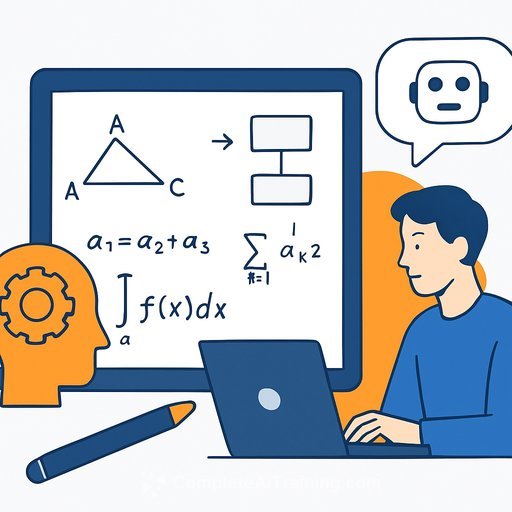
Hariharan and five other mathematicians had been formalizing one of Viazovska's proofs - breaking it into distinct logical steps. The work concerned the sphere-packing problem, which asks for the densest possible arrangement of eight-dimensional spheres. Viazovska had solved the underlying mathematics years earlier.
An A.I. system called Gauss, built by Math, Inc., a California start-up, completed the formalization in five days. Viazovska soon began describing the situation with a phrase: they had "gotten Gaussed."
A.I. Targets Academic Career-Building Work
The incident reflects a shift in how artificial intelligence is being deployed. While A.I. systems still struggle with basic arithmetic - ChatGPT famously miscounts letters in simple words - technology companies have invested heavily in reasoning systems designed to solve open mathematical problems.
Formalizing proofs is the kind of project that has traditionally helped young mathematicians build their careers. The work requires rigor and technical skill but follows a defined path, making it suited to graduate students and early-career researchers.
Competition among A.I. developers to demonstrate machine reasoning through mathematical success has intensified. Mathematics remains a field where human expertise is considered a reliable measure of machine capability.
What This Means for Mathematical Research
The question facing mathematics departments is straightforward: if A.I. can complete formalization work in days, what becomes of the career path that has long depended on it?
Viazovska's team still completed their project. But they were no longer first. In research, priority matters - it determines credit, publications, and the trajectory of a career.
For graduate students in mathematics, the implications are direct. Work that once took years and built credentials may now be completed by machines before humans finish planning the approach.
For more on how A.I. is reshaping research and technical work, consider exploring AI Research Courses or Generative AI and LLM Courses to understand these systems better.
Your membership also unlocks: