
AI news ·
AI terrorism is not fundamentally different from terrorism, a new essay argues
A Harvard working paper warns the "first major AI-enabled terrorism event" is a credible threat, but treats AI as an accelerant for existing tactics rather than a new form of political violence.
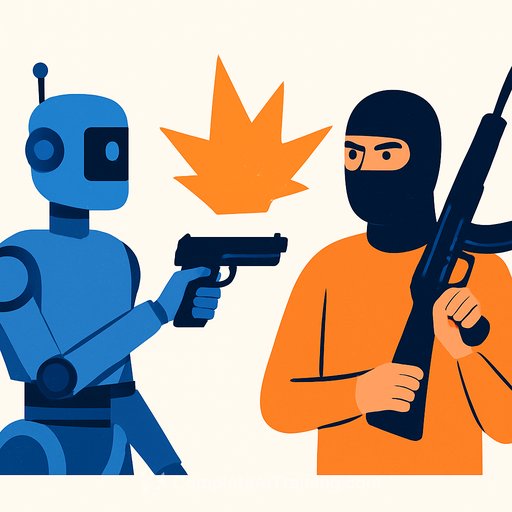
The term "AI terrorism" has entered policy circles, but the underlying problem remains terrorism itself-not the technology. A working paper published this week by Harvard Kennedy School researchers treats the "first major AI-enabled terrorism event" as a credible threat and speculates on how it might unfold. The paper joins a series of warnings from governments and think tanks over the past five years, yet the core dynamics of terrorist violence have not fundamentally changed.
The definition problem
Terrorism has never had a fixed meaning. In revolutionary France, it described state violence carried out by guillotine. By the late 19th century, the word shifted to nonstate violence from anarchist revolutionaries. The 20th century tied terrorism to independence movements, drawing it closer to guerrilla warfare and separatist conflict. By the century's end, ideological motivation became mandatory-terrorism was violence designed to produce a psychological effect.
Cyberterrorism already stretched the term's boundaries. Hacking or disabling computer infrastructure can be carried out by state actors and without physical violence, properties not normally associated with terrorism. The "AI terrorism" label inherits this confusion while layering on new anxieties about autonomous vehicles, facial-recognition spoofing, deepfakes, and engineered biological weapons.
What the reports actually say
In 2021, the United Nations Office of Counter-Terrorism co-published a report on the "malicious use of artificial intelligence for terrorist purposes." Cyberattacks such as malware and intrusion featured heavily, as did physical attacks via autonomous systems. The Middlebury Institute of International Studies published two reports in 2019 and 2020 on the risks that language models-still mostly unknown at the time-would pose to propaganda and radicalization.
These documents treat AI as a tool that amplifies existing tactics rather than creating new categories of violence. The Harvard working paper similarly assumes an AI-enabled event would look like terrorism that happens to use machine-learning tools, not a novel form of political violence.
Terrorism as a psychological weapon
What distinguishes terrorism from other violence is its intended psychological effect. The method-whether a truck, a bomb, or a deepfake-matters less than the fear it generates. AI tools may lower barriers to producing propaganda or coordinating attacks, but they do not alter the strategic logic: use violence or the threat of violence to influence a wider audience.
Professionals who work in AI for Government Courses often encounter threat assessments that blur the line between capability and intent. A tool's existence does not mean it will be adopted by terrorist groups, and adoption does not automatically produce more effective attacks.
Why this matters for executives and strategy leaders
Security planning suffers when organizations chase the latest technology label instead of assessing the underlying threat. The Harvard paper and UN reports describe AI as an accelerant for existing terrorist methods-propaganda generation, reconnaissance, attack coordination-not a fundamental shift. Leaders evaluating risk should focus on how adversaries operate today and whether AI tools change their capacity in measurable ways, not on speculative scenarios branded with a new prefix. Policy responses that treat AI terrorism as a distinct category risk misallocating resources toward technology mitigation when the core challenge remains political violence and its psychological targets.