
AI news ·
Alibaba aids China military-linked lab with Nvidia chip access
A Singapore firm backed by Alibaba bought over $4 billion in Nvidia chips, placing advanced American semiconductors one step from a Chinese military-linked AI lab. The transactions show how intermediary companies in third countries can route restricted technology past U.S. export controls.
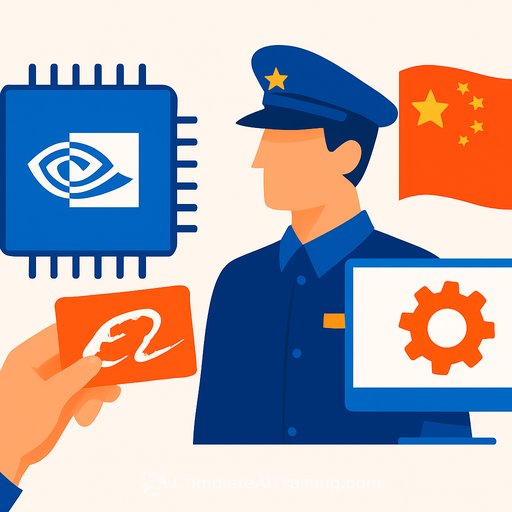
A Singapore-based company called Megaspeed purchased more than $4 billion in Nvidia chips over the past few years, backed by Chinese internet giant Alibaba. That financial relationship placed advanced American semiconductors one step away from an artificial intelligence lab with ties to China's military, exposing a supply chain that U.S. export controls were designed to prevent.
The deals trace back to 2023, when Alice Huang and her husband, Kang Wei, pitched investors in Shanghai on a plan to build an AI business in Southeast Asia. The couple said Ms. Huang's relationship with Jensen Huang, then Nvidia's chief executive, would guarantee a supply of powerful computer chips. They also hinted at a deep-pocketed customer that would anchor the business, according to two people who attended the meetings. The company that emerged, Singapore-based Megaspeed, later counted Alibaba as both its customer and financial backer, three people familiar with the relationship said.
The military-linked lab
Alibaba co-founded an AI laboratory with strong connections to China's military. Researchers there have worked on automating cyberattacks and simulating war games. U.S. intelligence officials have long warned that access to advanced chips could help China develop more sophisticated weapons, carry out cyber operations, and integrate AI into battlefield systems.
For weeks, Nvidia has been shaken by revelations that Mr. Huang had an extramarital relationship with Alice Huang, who U.S. officials say is an asset for Chinese intelligence and was passing information to Beijing. Beyond the personal scandal lies a geopolitical contest over the advanced Nvidia chips that power the global AI boom. The relationships among Megaspeed, Alibaba, and Nvidia show how supply chains often circumvent American efforts to keep those chips out of China's reach.
How the supply chain worked
Megaspeed served as the intermediary. The firm bought chips directly from Nvidia, then provided access to Alibaba. Alibaba's co-founding role in the military-linked AI lab means the technology sat just one degree of separation from researchers working on national defense applications. That proximity is exactly what officials in Washington have tried to prevent through export restrictions and licensing requirements.
The setup relied on a familiar pattern: a company registered outside China, in this case Singapore, acted as the buyer while Chinese capital and customers stood behind it. The $4 billion in purchases over multiple years signals a sustained operation, not a one-off transaction.
Why this matters for government professionals
For policy makers and intelligence officials, the Megaspeed-Alibaba case illustrates a structural weakness in chip export controls. Even when Washington restricts direct sales to Chinese entities, intermediary firms in third countries can route advanced semiconductors to end users with military connections. The gap between the restricted entity and the chip buyer was a single corporate relationship. Professionals working on AI Public Policy Courses are increasingly focused on closing these third-party loopholes, as traditional export bans prove insufficient against layered corporate structures. The scale here - billions of dollars, multiple years, a major Chinese tech firm - suggests enforcement mechanisms need to track not just the buyer, but who funds and consumes the computing power downstream.