
AI news ·
Alibaba unveils China's most powerful AI chip ahead of Xi-Trump meeting
Alibaba launched its Zhenwu V900 chip, claiming it triples the performance of its predecessor. The company also plans to scale cloud computing capacity to over 20 gigawatts by 2032.
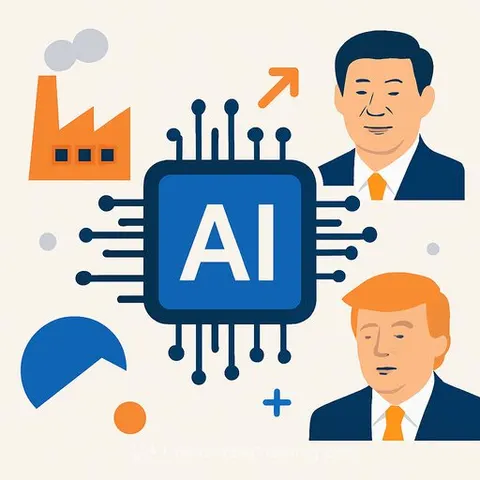
Alibaba launched its new Zhenwu V900 chip on Tuesday, describing it as China's most powerful AI processor and claiming it triples the performance of its predecessor. The announcement came during the company's annual conference in Hangzhou, days before Chinese President Xi Jinping and U.S. President Donald Trump are scheduled to meet in Washington, where AI competition is expected to dominate discussions.
CEO Eddie Wu said the chip will power AI model training and inference across Alibaba's data centers, serving both the company and its cloud customers. "The Zhenwu V900 is the most powerful AI chip in China today," Wu told attendees, positioning the hardware as a direct response to U.S. export restrictions that have blocked Chinese firms from accessing advanced chips from Nvidia and others.
Next-generation model targets trillion-parameter scale
Alibaba also outlined plans to train a new AI model with five to ten trillion parameters, a measure of learning capacity that would bring it closer to the most advanced U.S. systems. Its current flagship, Qwen3.8-Max, operates with 2.4 trillion parameters. By comparison, Chinese rival Moonshot released Kimi K3 in July with 2.8 trillion parameters, which the company calls the world's largest open model.
The push toward larger models reflects intensifying competition between Chinese and American AI labs. U.S. leaders including Anthropic CEO Dario Amodei have warned that China's AI progress threatens American dominance and have called for a broader slowdown in development. Chinese firms, meanwhile, continue to advance despite restricted access to leading-edge chips and manufacturing equipment.
Data center expansion signals infrastructure bet
The company said it plans to scale its cloud computing capacity to over 20 gigawatts by 2032, citing demand that is growing at what Wu described as an exponential rate. For context, SpaceX currently operates roughly 1.4 gigawatts of AI computing capacity and targets more than 10 gigawatts by 2027. Alibaba's projection signals a substantial long-term commitment to infrastructure, even as Wu acknowledged that global supply chain shortages are constraining immediate growth.
"We are mobilizing every resource to meet customers' demand for AI," Wu said, adding that shortages across the AI data center supply chain "are currently limiting the speed at which we can scale our compute infrastructure."
Chinese chips gain ground amid trade tensions
Alibaba's announcement follows Huawei's unveiling of new chip technologies last week, as Chinese-designed processors steadily gain traction in a market long dominated by Nvidia. Analysts note that while frontier AI training in China still relies heavily on Nvidia chips, domestic alternatives are narrowing the gap. Open Chinese models, often cheaper than closed systems from U.S. labs, have also found growing adoption globally, including in the United States.
Wu drew a parallel between AI growth and the industrial revolution, predicting that machine intelligence will eventually produce over 1,000 times more "thinking" than all of humanity combined - up from less than 3% today. He cautioned that "machine intelligence today is not a substitute for human intelligence," but framed the trajectory as a fundamental shift in computing capacity.
Why this matters for finance, research, and infrastructure professionals
For investors and analysts tracking the AI supply chain, Alibaba's chip roadmap and data center targets provide concrete benchmarks against U.S. competitors. The 20-gigawatt projection for 2032 signals sustained capital expenditure that will ripple through real estate, energy, and construction sectors tied to data center development. Research teams monitoring open-weight models should note the five-to-ten-trillion-parameter target, which could reshape the economics of AI deployment if Alibaba maintains its pattern of releasing models publicly. For technology leaders evaluating build-versus-buy decisions, the performance claims around the Zhenwu V900 - and whether they hold up under independent testing - will influence procurement strategies as Chinese silicon becomes a more viable alternative to restricted U.S. hardware. Professionals developing AI strategy can explore structured learning paths through AI Technology Leadership Courses or build foundational knowledge with Generative AI Courses to assess how shifting chip availability affects model training costs and infrastructure planning.