
AI news ·
Ambient AI scribes reduce physician pajama time but fail to eliminate after-hours work
Ambient AI documentation tools are gaining traction among physicians, but clinical informatics leaders warn they must embed directly into EHR workflows to avoid becoming just another screen to manage. Dr. R.
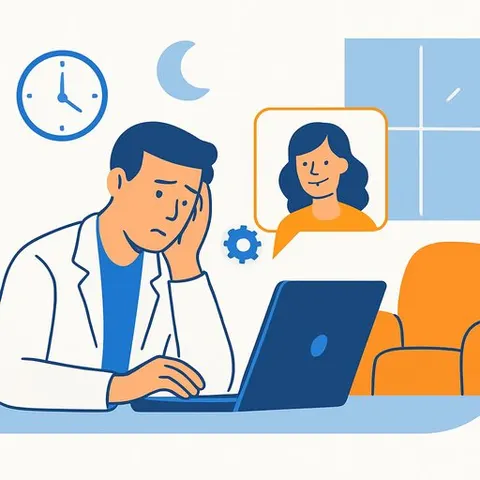
Ambient AI documentation tools are gaining traction among physicians by shifting attention back to patients and cutting after-hours charting. But the real test, according to clinical informatics leaders, is whether these tools disappear into existing EHR workflows rather than becoming another screen to manage.
The invisibility factor
"The clearest value I have seen is when AI removes work physicians never needed to be doing manually in the first place," said Dr. R. Ryan Sadeghian, chief AI officer at MITConn Advisors and physician committee co-chair for the HIMSS Physician Community. "Clinical documentation is a good example. Ambient AI can allow the physician to focus on the conversation rather than simultaneously listening, typing and navigating the EHR."
Sadeghian said his team has explored AI across documentation improvement, coding, prior authorization, revenue cycle and medical education. The common thread: narrowly targeted tools that reduce repetitive cognitive and administrative work. Where AI stumbles is when it becomes a separate destination. "If the physician has to leave the EHR, log into another application, copy information between systems, validate excessive output or change an established workflow to accommodate the AI, much of the value disappears," he said. He calls this the "invisibility factor." The best clinical technology, he said, increasingly disappears into the workflow so physicians experience less work - not another piece of technology they have to manage.
Ambient scribes win support, but vigilance remains
AI scribes have earned early physician backing. These tools produce a usable first draft and reduce "pajama time" - the after-hours documentation that follows clinicians home. Dr. Stephen J. Morgan, practicing physician and CIO at Pediatric Associates of Greater Salem, said most clinicians in his organization are happy with the AI scribe output. But he cautioned that the output cannot be accepted without review.
"One of our clinicians stated that they prefer the ambient scribe, as it better represents what they actually said, rather than the interpretation of another human," Morgan said. "I thought that was an interesting perspective. So, this has certainly reduced the amount of 'pajama time,' but clearly has not eliminated it."
The shift in attention is one of the most meaningful opportunities, Sadeghian said. When technology captures the clinical conversation and produces a first draft, the physician can maintain eye contact, listen more carefully and be more present during the encounter.
Measuring the full documentation cycle
Note-generation speed alone may be an incomplete success metric. Experts said total documentation time, editing burden, chart closure rates and after-hours EHR activity must be tracked to determine whether work has been eliminated or merely relocated.
"This is an important distinction because generating a note faster does not necessarily mean we have reduced physician workload," Sadeghian said. "We have to measure the entire documentation cycle." He pointed to the risk of work relocation: saving five minutes on note creation but spending four minutes correcting it later. That is why he tracks total documentation time, time in notes, after-hours EHR activity, chart closure and the amount of editing required.
Embedding AI into clinical workflows touches on skills covered in AI for Healthcare training, where the focus is on practical integration rather than standalone tools. For professionals managing health records, the AI Learning Path for Medical Records Clerks addresses similar documentation and EHR workflow challenges.
Why this matters for healthcare professionals
The gap between a tool that generates notes quickly and one that actually returns time to clinicians is where adoption succeeds or fails. Healthcare leaders evaluating ambient AI should measure the full documentation cycle - not just note-generation speed - and insist on tools that embed directly into existing EHR workflows. If a tool requires a separate login, manual data transfer or workflow changes that add friction, the promised time savings will erode. The objective, as Sadeghian put it, "is meaningful time returned to clinicians and patients."