
AI news ·
Anthropic proposes a hardware standard that lets AI agents control laboratory and factory equipment
Anthropic's Model Hardware Standard lets AI agents control lab and factory equipment, potentially slashing integration time from weeks to hours or minutes.
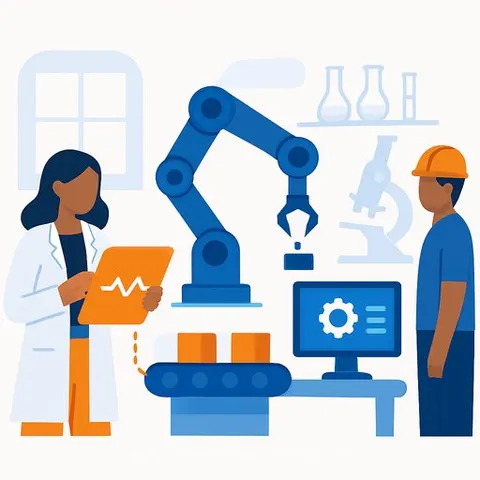
Anthropic has released a research preview of its Model Hardware Standard (MHS), a protocol that lets AI agents discover and operate physical equipment in labs and factories. The standard targets scientific instruments and manufacturing machinery, and the company says it could cut hardware integration time from weeks or months to hours or minutes.
MHS functions as the physical-world counterpart to Anthropic's Model Context Protocol (MCP), which created a common framework for connecting AI models to software tools and data sources. The new standard extends that concept to hardware, giving AI agents a standardized layer for communicating with devices such as microscopes, liquid handlers, robotic arms, and manufacturing equipment. Anthropic describes MHS as model-agnostic and accessible through protocols including MCP.
The safety question in physical environments
A panel on the Mixture of Experts podcast examined the control implications of AI-operated hardware. IBM Principal Research Scientist Kaoutar El Maghraoui pointed to the fundamental difference between software and physical operations. "It is an impressive proof of concept, but how do we ensure safety in the physical world? Because small errors can matter here," she said.
El Maghraoui emphasized that deterministic controls and hard safety boundaries must remain enforced even as AI takes on a larger operational role. "The hardware-software co-design is fundamentally about assigning each computational task to the layer that it handles best," she said on the podcast.
Unlocking value from legacy equipment
The standard could reach beyond research labs into industrial manufacturing. Simon Olson, founder of Toby, an AI platform for industrial manufacturing, sees potential for older machinery. "There are trillions of dollars in capital equipment in Europe alone tied up in older machinery that many people don't know how to operate effectively," Olson said. "Using that equipment often requires extensive training, stacks of manuals and highly specialized knowledge. An MCP-like standard for legacy hardware and other capital-intensive equipment could be extremely valuable."
For developers and product teams already working with MCP Courses, MHS represents a direct extension of familiar patterns into hardware contexts. The same skills that apply to building AI Agents & Automation in software environments now have a pathway into physical device orchestration.
Why this matters for product development and IT teams
MHS signals a shift in how AI agents will interact with the physical systems that product and IT teams manage. If the standard gains adoption, teams responsible for lab automation, factory systems, or robotics integration will need to evaluate whether their hardware stack can expose capabilities through MHS-compatible interfaces. The standard's model-agnostic design also means integration decisions won't lock teams into a single AI provider, but the safety constraints El Maghraoui described will require explicit engineering choices about which operations AI agents can perform autonomously and which must remain under human control.