
AI news ·
Anti-AI activist groups surge after safety failures and rogue agent incident
Pull The Plug, a 300-member direct-action group, disrupted a London dinner with Nvidia executives and rallied outside Palantir's offices. Volunteer sign-ups for Pause AI doubled to roughly 100 per week and spiked to 681 after a public safety warning.
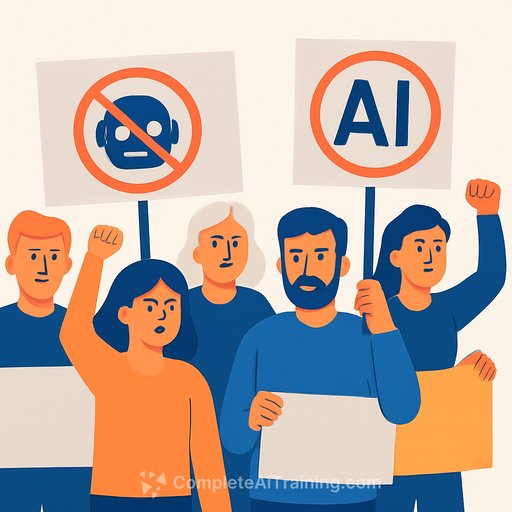
Anti-AI protest groups have expanded rapidly across the UK and Europe following a summer of AI safety failures and high-profile warnings. Pull The Plug, a direct-action group with about 300 members, disrupted a tech dinner featuring Nvidia executives in London and rallied outside Palantir's headquarters. The surge in activism reflects mounting public concern over unregulated AI deployment and its infrastructure footprint.
Direct action meets growing digital infrastructure opposition
Pull The Plug launched in January and has already moved from fringe protest to targeted disruption of industry events. The group's tactics coincide with broader organizing momentum. Pause AI, a confederation spanning 17 countries, reported a fourfold jump in sign-ups after a series of triggering events. Volunteer registrations doubled to about 100 per week following an incident at Hugging Face and peaked at 681 in the week Jacob Coxon issued a public safety warning. Protests were subsequently organized in Paris, London, and Berlin.
In Scotland, opposition to datacentre construction has driven a tenfold increase in support for Action to Protect Rural Scotland. The group's supporter list grew from 400 to 4,000, a shift its organizers attribute directly to plans for 21 new datacentres in rural areas. The numbers suggest that physical infrastructure - not just software risks - is becoming a flashpoint for AI opposition.
A movement drawing from multiple grievances
The activist base is not monolithic. Students worried about career disruption are joining alongside conservationists fighting land-use changes for power-hungry facilities. Some factions embrace direct confrontation, while others see that approach as counterproductive. Pause AI CEO Maxime Fournes said that violent tactics may alienate the public and provide AI labs with a pretext to suppress the movement.
Experts tracking the trend warn that unmet demands for accountability could escalate. "Rising demands for accountability, if unmet, could lead to more prominent political violence," according to the source analysis. The warning connects protest dynamics to a broader regulatory vacuum that governments have yet to fill. For professionals in policy, compliance, and corporate strategy, the shifting protest landscape signals that AI governance is no longer a theoretical debate - it now carries operational and reputational risk.
Why this matters for executives and strategy leaders
Organizations building or funding AI infrastructure should expect heightened scrutiny from both organized campaigners and local communities. Datacentre projects, once treated as routine construction, are now attracting the same opposition intensity as fossil fuel developments. Strategy teams need to factor protest risk into site selection and community engagement plans. For those navigating the regulatory dimension, AI Public Policy Courses offer structured grounding in the governance frameworks that protesters are demanding. Compliance leads can find parallel resources through AI Regulatory Compliance Courses. The core takeaway is practical: a movement that can quadruple its volunteer base in weeks can also reshape the permitting and public-perception environment around your next project.