
AI news ·
Apple cuts 200 jobs across Siri, Vision Pro and software teams
Apple is cutting more than 200 roles across Siri, software engineering, and Vision Pro, with about 100 positions eliminated from each area. The layoffs fund an AI-driven Siri rebuild and a pivot toward smart glasses as Vision Pro struggles with its $3,699 price tag.
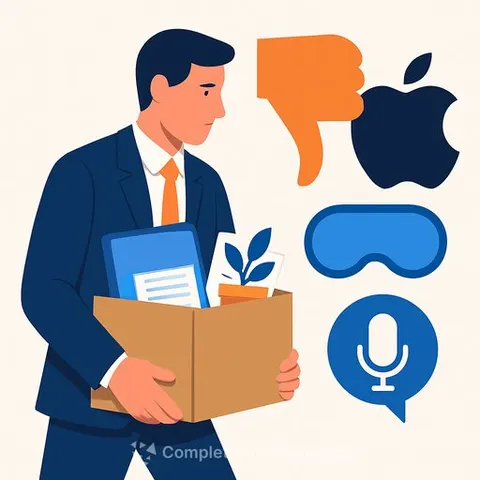
Apple is cutting more than 200 roles across its Siri, software engineering, and Vision Pro teams as it shifts resources toward artificial intelligence and next-generation hardware. The reductions are split roughly evenly, with about 100 positions eliminated from the Vision Pro group and another 100 trimmed from the Siri voice assistant team and the Intelligent Systems Experience unit.
The Intelligent Systems Experience group develops AI-driven software capabilities across Apple's product ecosystem, making it central to the company's technical transition. Apple said in a statement that the realignments are aimed at evolving its business operations and that certain existing roles are being impacted as a result. The company plans to create new positions, offer transition support, and give affected employees opportunities to apply for other roles within the organization.
Siri's architecture overhaul
The restructuring within Siri and Intelligent Systems Experience ties directly to Apple's work on an updated, AI-enhanced version of its virtual assistant, which relies on a completely revised technical architecture. That overhaul requires specialized skill sets that differ from those currently held by parts of the software team, prompting realignments intended to accelerate the assistant's development.
For product teams tracking how Apple approaches AI strategy, the shift is a case study in reallocating talent around a technical pivot - the kind of organizational change that often precedes major platform releases.
Vision Pro retreat
On the hardware side, the cuts signal a tactical retreat for the $3,699 Vision Pro spatial computer, which has struggled to gain widespread consumer adoption due to its premium price point and physical weight. Apple is largely dismantling its internal Vision Pro gaming team and scaling back a dedicated immersive video production unit, driven in part by the steep cost of producing 3D content - single episodes run into millions of dollars and require multiple production crews.
Apple plans to continue releasing a limited selection of first-party immersive videos but will lean more heavily on third-party creators for Vision Pro content. Despite the workforce reductions, Apple confirmed that the Vision Pro hardware line and its visionOS operating system remain active projects in its longer-term product roadmap.
Near-term hardware priorities have shifted toward developing smart glasses that don't require the complex 3D gaming or immersive media infrastructure that defined early Vision Pro ambitions. An updated Vision Pro model remains under consideration for release as early as late 2028, according to Bloomberg.
AAPL stock eased 0.6% on Friday but closed the week 1.2% higher and has gained 13.5% year-to-date.
Why this matters for product development
The layoffs show how a company can prune mature product lines to fund a strategic bet - in this case, an AI-driven Siri rebuild and a pivot toward smart glasses. For product teams, the lesson is that architecture decisions have staffing consequences: when Apple redesigned Siri's underlying system, the existing team no longer had the right skills, and the company had to realign around the new technical direction. Teams planning AI upgrades should expect similar friction and build transition plans before the gap between current capabilities and future requirements becomes a headcount problem.
For those tracking AI product strategy, Apple's move reinforces that AI for Product Development is becoming a core competency rather than an optional enhancement. The company's willingness to cut 200 positions to accelerate its assistant rebuild suggests that AI-driven product changes carry real organizational costs - and that leaders need to plan for skill transitions, not just feature roadmaps.
Product managers navigating similar shifts can find structured guidance through an AI Learning Path for Product Managers, which covers how to evaluate technical trade-offs and align team capabilities with strategic direction.