
AI news ·
Army chaplain builds AI agent to ease administrative burden
An Army chaplain built a custom AI agent called CHAP to manage chapel admin tasks after a new Army course changed his view on AI in weeks. The tool targets high personnel turnover by turning tacit knowledge into transferable resources.
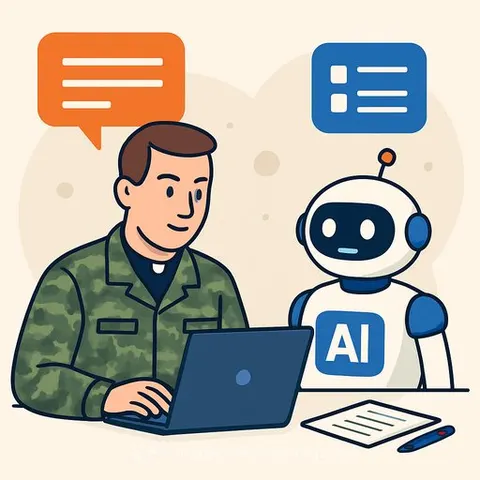
Maj. Sean Callahan, a chaplain attending the U.S. Army Command and General Staff College, built a custom AI agent called CHAP to handle administrative tasks for chapel communities. The tool emerged from the college's new AI Basics elective, which teaches officers across all warfighting functions to apply artificial intelligence to their specific roles.
Callahan arrived at the course with skepticism, having used AI only for product reviews and basic knowledge. The elective's mix of theory and hands-on work changed his view within weeks, leading him to create CHAP - a Chaplain Administration Platform designed to manage resources, maintenance, and facilities so religious support specialists can focus on soldiers' spiritual readiness.
Prompt engineering as a core skill
The course's focus on prompt engineering proved central to Callahan's work. He learned that the quality of information fed into large language models determines the quality of the output, and that AI can help refine its own instructions.
"One of the things that was very helpful to me was learning how to use AI to craft the prompts to build things with AI, sending it back and forth to different LLMs to learn where my gaps were, what I should consider, what guardrails I should put into place," Callahan said. "An AI was way better at doing that than I am."
That process of using one model to critique and improve prompts for another became a key part of his workflow. For professionals building similar tools, this technique - sometimes called prompt chaining - is directly applicable to any Prompt Engineering work, regardless of domain.
Peer learning across specialties
The course's small-group structure brought together officers from different branches, and Callahan said that diversity drove better solutions than any single specialty could produce alone.
"When you bring a student body like this here at CGSC together for a class in AI, and you have this diversity of warfighting functions, what that brings to the table is a diversity of knowledge and experience and perspective," he said. "We can all sit down and look at the same problem set. But what a maneuver officer might see and how they approach the problem be different than I approach it."
Callahan also described AI itself as an unexpected second peer in the room - another angle for exploring problems and testing ideas. The course pushed each student to build an AI agent that solves a real problem in their next assignment; Callahan aimed his at the Chaplain Corps as a whole.
Preserving institutional knowledge
CHAP addresses a persistent problem: high turnover among chaplains and religious support specialists. When personnel rotate, they take tacit knowledge with them. Callahan designed the platform to convert that knowledge into explicit, transferable resources like standard operating procedures and training videos.
"I asked, 'how could I create some kind of tool or kind of process that could be transferred in between posts so that it's something that's readily accessible and known and there's very little deviation?'" he explained. "How can we turn that tacit knowledge into explicit knowledge?"
This approach to knowledge capture is a common pattern in AI for IT & Development work, where tools are increasingly used to document processes and reduce the cost of onboarding.
Why this matters for IT and development professionals
Callahan's experience shows that a domain expert without a formal programming background can build a working AI agent in weeks, not months. The key enablers were structured prompt engineering, iterative refinement using multiple LLMs, and a clear definition of the problem to solve.
For IT and development teams, the practical takeaway is to start with a narrow, well-understood workflow - not a broad vision. CHAP began as a way to handle routine facilities and resource questions. That constraint made the project manageable and the output useful. The same approach applies to internal tools: pick a repetitive task, document how experts handle it, and build an agent that encodes those decisions.