
AI news ·
AI tools reshape family law work while creating new challenges for lawyers and courts
AI tools help family law attorneys organize financial records and cut administrative hours, but they also create inflated client expectations and faulty self-filed court documents. Roughly half of U.S. law firms have five or fewer attorneys, many of whom cannot afford premium AI tools.
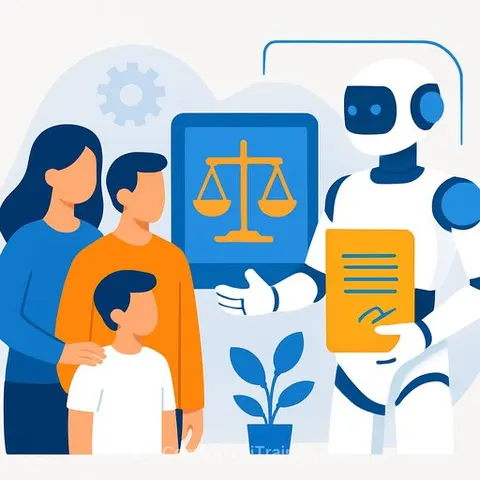
AI tools are changing how family law attorneys handle financial records, legal research, and routine casework, but the technology is also creating new problems: clients who arrive with inflated expectations from ChatGPT research, and a surge of self-prepared court filings that often fail to meet legal standards.
Practitioners across the field say the benefits are real. Digital tools can organize thousands of pages of financial documents, flag suspicious spending patterns, and cut hours of administrative work. But lawyers and judges also warn that AI-generated research can contain fabricated citations, and that the technology is no substitute for professional judgment in cases involving divorce, child custody, and support.
Financial analysis and case preparation
One of the clearest wins for AI in family law is financial discovery. Tools that absorb and organize bank statements, tax returns, investment accounts, and property records can speed up the process of determining what each party owns and earns, which is central to setting spousal and child support.
Bettina D. Hindin, a principal at Offit Kurman in New York City, said AI can also detect unusual spending or investment patterns that might otherwise go unnoticed. Those anomalies, if verified by accountants or forensic experts, can reveal attempts to hide assets or income.
"But there is a huge caveat," Hindin said. "It is not a replacement for the work and the judgment of the lawyer. It makes mistakes. It makes a lot of mistakes. As a basic tool to get you in the right arena and help you build a case, it is useful. But check your work."
Damian J. Turco, managing partner of Turco Legal in Newburyport, Massachusetts, and a former president of the Massachusetts Bar Association, said AI has had an "overwhelmingly positive" effect on the profession.
"Used thoughtfully, it has become an incredibly effective tool for streamlining routine work, reducing administrative bottlenecks, and organizing and analyzing large volumes of information," Turco said. "It allows attorneys to spend more of their time doing what only lawyers can do: Exercising judgment, counseling clients, negotiating resolutions, and advocating in court."
Research risks and client expectations
Samuel Estreicher, professor of law at New York University School of Law, said AI is useful for "aggregative" tasks like absorbing large volumes of information and organizing it for review. But he called the technology "problematic" for legal research because of hallucinations and other inaccuracies.
Judge Jeffrey S. Sunshine, the coordinating judge for matrimonial matters in the New York state court system, said most lawyers understand that large language models are "only as good as the information you put into them." He added that even accurate AI research is no substitute for traditional sources like LexisNexis, Westlaw, or state-specific statute commentaries.
"I don't think that AI is evil," said Sunshine, who also serves as a state Supreme Court justice in Brooklyn. "[But] it shouldn't be your primary source of research. … I don't think you can rely on it as the be all and end all."
Clients who use ChatGPT, CoPilot, or similar tools to research their own cases before meeting with a lawyer often arrive with unrealistic expectations, Hindin said. The general knowledge those tools provide can be helpful, but it rarely accounts for the specific facts of an individual case or the law in a particular jurisdiction.
"You have to calm them down a bit and bring them to the reality of their situation," she said. "Each case is unique."
Pressure on small firms and pro se filings
Cost is another factor. Roughly half of American law firms employ five attorneys or fewer, and most family law practices fall into that category. The more sophisticated legal AI tools used by larger firms may be out of reach for them.
Hans Guntren, founder of the legal management company Deliberately.ai, argued in an article for the American Bar Association that limited resources make AI adoption more urgent for family law practitioners, not less. A single case can involve thousands of pages of financial records, years of text messages, photographs, medical and psychological records, property documents, and insurance filings, he said, all of which AI can organize faster than a human team.
"Family law is often dismissed as too emotional, too complex, or too fragmented to benefit from technology," Guntren wrote. "In reality, those are precisely the reasons artificial intelligence is most urgently needed here."
AI is also showing up in the rising number of filings from self-represented litigants. Barbara M. Seymour, a professional responsibility and legal ethics specialist at Clawson & Staubes in Columbia, South Carolina, said general AI tools can make pro se filings look polished and sound reasonable, but the documents often fail to meet legal requirements and are adding pressure to crowded court dockets.
For legal professionals weighing AI adoption, the practical takeaway is to treat the tools as a complement to - not a replacement for - core legal skills. Use them to handle document review, organize financial records, and speed up routine drafting, but verify every output against primary sources and apply independent judgment before filing anything.
That division of labor is where the field is settling. Attorneys who use AI to manage volume while staying responsible for analysis and strategy are getting the most value from it. Those who outsource their judgment to the tools, or who let clients' AI-generated expectations go unchecked, are creating new risks in an already sensitive practice area.
Hindin said the line is simple: litigants in divorce, custody, and support cases are facing some of the most consequential legal matters of their lives, and they deserve a lawyer's expertise. A coffee mug on her desk makes the point, she said: "Your Google search does not replace my law degree."