
AI news ·
Artificial intelligence changes jobs instead of eliminating them as companies redesign work
AI's primary near-term impact is reinventing daily work, not eliminating jobs. Firms that redesign workflows for human-AI collaboration are gaining competitive advantage.
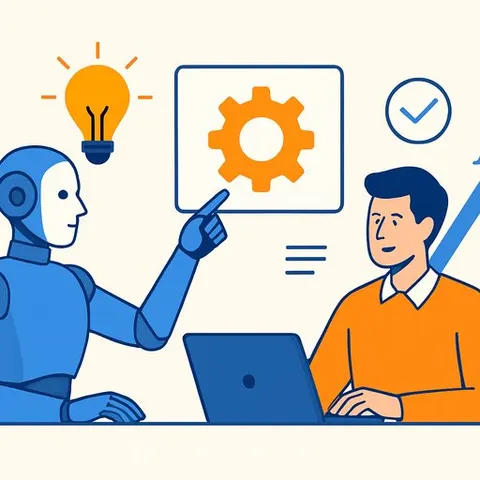
For months, the public conversation around AI has centered on a single question: how many jobs will disappear. That framing misses the more immediate reality that businesses are confronting-AI is reshaping roles faster than it is eliminating them, and the companies that redesign work around human-machine collaboration are pulling ahead.
As AI moves deeper into operations, customer service, marketing, and software development, executives are discovering that the technology's primary near-term impact is not wholesale job destruction. It is the reinvention of what people do each day.
The wrong question
The question "which jobs will machines take?" is emotionally loaded but strategically narrow. Past upheavals-the industrial revolution, the internet-did not erase work; they shifted its composition. AI is following that pattern, yet at a faster tempo.
The broader debate often ignores a more critical shift: how tasks, teams, and skills are being rearranged. The organizations gaining ground are those that treat AI as a reason to redesign entire workflows, not just a tool to cut costs.
Augmentation, not automation
One persistent misconception is that AI's main job is to automate. In practice, some of its highest-return uses are about augmentation-giving people real-time insights, speeding up research, and handling routine admin. That shifts the economics of skilled labor: a professional armed with AI tools can produce far more than before.
Marketing teams accelerate content development and audience analysis. Financial groups use pattern recognition to sharpen risk assessment. Software developers write code faster with AI-assisted tools. Customer service agents solve complex cases while routine inquiries are handled automatically. In every case, human judgment remains at the center.
The competitive fault line
The next divide in corporate AI is not between those who have the technology and those who don't. Access is becoming cheap and widespread. The split is between companies that redesign how work gets done and those that just bolt AI onto existing processes.
Firms pouring money into platforms without changing operating models rarely see durable gains. Competitive advantage comes when organizations re-examine workflows, retrain people, and treat AI as a transformation initiative. This is where the growing practice of AI for Executives & Strategy connects technical capabilities with leadership decisions.
Skills as the new strategic asset
As routine tasks get automated, deep human skills-critical thinking, adaptability, communication, and judgment-become more valuable. Firms that invest in continuous learning and AI literacy build a workforce that can work alongside intelligent systems rather than be sidelined by them.
Many organizations are creating structured learning paths for leadership, digital fluency, and cross-functional collaboration. The objective is not simply tool training; it is building a workforce that adapts to constant technical change.
Leadership's new mandate
The most effective executives have stopped asking whether to adopt AI. They are asking better questions:
- Which tasks should be automated, and which require human strengths?
- How should teams be restructured to combine technology and talent?
- What new skills will be needed, and how quickly can they be built?
- How can AI improve employee experience and customer outcomes at the same time?
These questions move the conversation from anxiety to strategy.
Why this matters for Executives and Strategy
The AI debate has been misframed. Leaders who treat AI as a workforce transformation initiative, not a labor reduction lever, will unlock innovation and productivity gains that competitors struggle to replicate. The next year's winners will be those who redesign roles, invest in skills, and make human-machine collaboration the cornerstone of their operating model.