
AI news ·
Audi tests wheeled humanoid robots for parts sequencing at Ingolstadt plant
Audi is testing wheeled humanoid robots to sequence unsorted parts at its Ingolstadt plant, tackling a logistics operation that handles roughly one million picks a day.
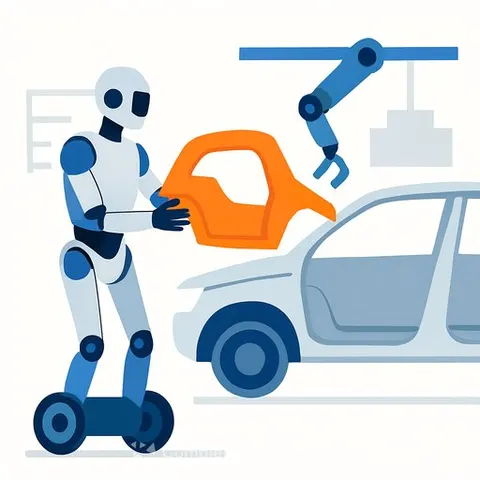
Audi is testing wheeled humanoid robots for parts sequencing at its Ingolstadt plant, bringing together Agile Robots, Dassault Systèmes and NVIDIA in a proof of concept announced October 21 at NVIDIA GTC Berlin. The evaluation targets one of automotive manufacturing's persistent automation problems: picking unsorted components of varying shapes and packaging, then placing them in precise assembly order.
The partners are running a small fleet in Audi's Production Lab. Audi has not committed to expanding the trial to routine production. The company's wider parts logistics operation handles roughly one million picks a day, though that figure describes total workload, not what the robots are currently processing.
A mobile design built for existing workstations
The robot comes from Munich-based Agile Robots and uses a wheeled base with a human-proportioned upper body, two arms and grippers. It operates at human working height. The design choice is deliberate: compatibility with current workstations matters more than building a new production line around the machine.
Sequencing parts for final assembly is a manipulation challenge as much as a scheduling one. Components arrive unsorted in containers. They differ in shape, orientation and packaging. Large or flexible items can require coordinated handling rather than a single grasp. The robots use image recognition to identify parts and determine how to grasp them without damage, with the two-arm configuration intended for handling larger and flexible components together.
Training on real and synthetic data
The system trains on a combination of real photographs and synthetic images generated in simulation. This exposes the model to variation before it handles physical parts. The core test is whether that combination can perform a specific logistics task reliably, not simply whether a humanoid can pick up a component.
Gerd Walker, Audi's board member for production and logistics, described picking within sequencing as a longstanding automation challenge. The evaluation, he said, will determine the project's next steps.
Validating the job before physical deployment
Dassault Systèmes is building a virtual twin of the logistics environment using DELMIA on its 3DEXPERIENCE platform and NVIDIA Omniverse libraries. NVIDIA's Isaac GR00T foundation model forms part of the robot training approach. Engineers use the simulation to assess feasibility, cycle times, ergonomics and safety before the robots execute the sequence physically.
Philippe Laufer of Dassault Systèmes framed the advance in engineering and mission validation as the project's central contribution. The simulation addresses the whole assignment, not grasping in isolation.
Why this matters for operations and product development
Parts sequencing is a bottleneck that sits between logistics and assembly. Automating it means solving for variability in packaging, part geometry and orientation - problems that fixed automation has struggled with. For operations leaders, the trial signals a shift toward robots that slot into brownfield facilities without requiring line redesigns. For product development and simulation teams, the virtual twin approach shows how feasibility and cycle time analysis can happen before capital equipment reaches the factory floor. AI Manufacturing Management Courses address this kind of production-line integration challenge directly.