
AI news ·
Catholic healthcare workers reflect on using AI as a tool of care, not a replacement for human judgment
Pope Leo's Magnifica Humanitas calls AI a tool of care, not a clinical replacement. It insists technology must support, not override, the human relationship.
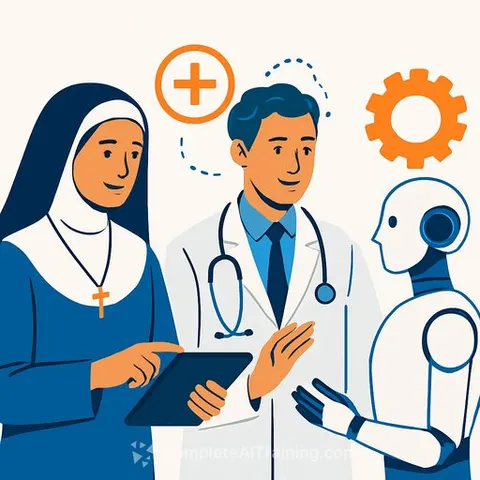
Catholic healthcare professionals should view artificial intelligence as a "tool of care" - a means to accompany the sick rather than replace clinical judgment - according to the principles laid out in Pope Leo's encyclical Magnifica Humanitas, released July 6, 2026. The document frames AI as a technology that can heal, connect, and educate, yet insists it must remain subservient to the human therapeutic relationship.
"AI Technology has the power to heal, connect, educate and protect … in the abstract, technology in and of itself is not a solution to humanity's problems, just as it is not inherently evil," Pope Leo writes. "In practice, however, technology is never neutral, because it takes on the characteristics of those who devise, finance, regulate and use it."
AI as a tool, not a replacement
The Catholic healthcare ministry sees care as a vocation, continuing Jesus' compassionate response to the sick and dying. For professionals, AI is to be used ethically and compassionately, never as an end in itself. This requires approaching technology with "wisdom and humility," shaped by prayer and formation.
A research committee at a Catholic hospital is currently evaluating whether AI can help doctors spot patient deterioration earlier, potentially preventing emergencies. The system under review would flag worrisome changes, but its protocol explicitly states that the AI will not override the doctor's clinical judgment. Any tool that sidesteps a professional's accumulated wisdom can do harm, the committee notes.
Safeguarding patient privacy
Using patient data to train AI algorithms raises immediate confidentiality concerns. Safeguards must be in place before deployment - clear rules about how data is used and firm accountability for any breach. Without those guardrails, the trust that patients place in Catholic healthcare could erode quickly.
Trust cannot be automated
The therapeutic relationship rests on three pillars: technical competence, relational empathy, and consistent integrity. AI cannot replicate the human dimension that builds trust over time. If systems prioritize commercial speed over relational care, the result is a transactional interaction that undermines the patient's confidence.
Many patients now arrive at appointments having consulted AI for health advice. The professional must sift through that information without dismissing the patient's concerns - a conversation that demands time and relational skill. Walking with the patient through correct, misleading, and incorrect AI claims is a modern expression of synodal accompaniment.
Why this matters for healthcare professionals
Catholic healthcare workers must ensure AI supports, not supplants, the relational care at the heart of their ministry. This means insisting on transparent data practices, preserving clinical decision-making as a human act, and sharpening the relational skills needed to guide patients through an AI-saturated information environment. Staying informed through resources like AI for Healthcare can help teams uphold these ethical standards in daily practice.