
AI news ·
CEOs expect AI to handle 48% of operational decisions without human input by 2030, IBM survey finds
CEOs expect AI to handle 48% of operational decisions without human input by 2030, per an IBM study of 2,000 executives. Just 25% of employees use AI regularly today, leaving a tight window for workforce training.
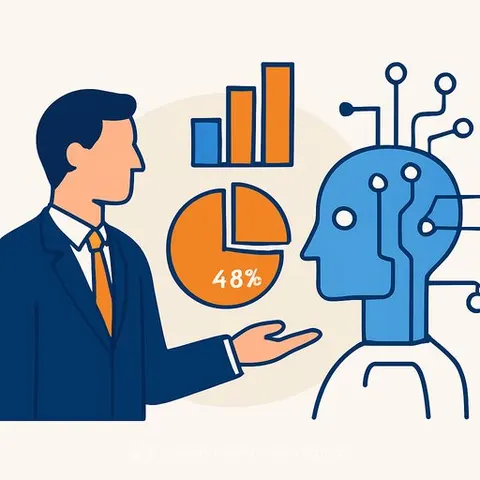
CEOs Expect AI to Make 48% of Operational Decisions by 2030
A May 2026 IBM Institute for Business Value study of 2,000 CEOs finds that executives expect artificial intelligence to make nearly half of all operational decisions without human involvement by 2030.
The findings signal a sharp acceleration in executive confidence about AI autonomy. Seventy-six percent of organisations now have a Chief AI Officer, up from 26% a year earlier. Sixty-four percent of CEOs say they are comfortable making major strategic decisions using AI-generated input.
What the data shows
The study identifies three other notable findings. Eighty-three percent of respondents view AI sovereignty-the ability to develop and deploy AI systems domestically-as a strategic priority. Only 25% of employees currently use AI regularly. Organisations expect substantial retraining and upskilling between 2026 and 2028.
The rapid appointment of Chief AI Officers reflects a broader shift in C-suite structure. As companies scale AI decision-making, they are moving accountability toward executive leadership, typically alongside investments in governance, model monitoring, and data-platform consolidation.
What operational decisions look like
The 48% figure reflects industry patterns in automation. Rule-based, repeatable workflows are the earliest targets: finance reconciliation, customer triage, scheduling, and inventory management. These environments rely on established data schemas, deterministic business rules, and closed-loop monitoring to keep automated decisions auditable and reversible.
Scaling this level of automation will require governance structures to scale as well. Teams typically invest in model registries, outcome-level guardrails, and human-in-the-loop escalation channels to manage false positives, data drift, and compliance requirements.
The workforce gap
The disconnect between automation expectations and current employee adoption presents a management challenge. If 48% of operational decisions move to AI by 2030, but only 25% of the workforce uses AI today, organisations face a two-year window for substantial learning-program investment and change management.
For executives, this suggests three practical priorities. First, clarify which operational decisions are candidates for automation and which require human judgment. Second, build governance controls-monitoring SLAs, audit trails, and model rollback procedures-before granting full autonomy. Third, measure employee productivity and adoption after automation, since the IBM study identifies employee adoption as a top determinant of AI success.
For your planning
Practitioners should track three indicators as automation expands. One: the types of operational decisions being automated and whether they are primarily low-risk, rules-based tasks. Two: the maturity of deployed governance controls. Three: quantitative measures of employee adoption and productivity post-automation.
Projects that deliver sustained value typically combine explicit decision taxonomies, well-instrumented data pipelines, and operational testing that simulates edge cases before full autonomy is granted.
For executives planning AI adoption, consider exploring AI learning paths designed for CEOs and understanding AI agents and automation systems that drive operational decision-making.