
AI news ·
China adopts vein recognition to counter AI forgeries
Vein recognition adoption is growing at a 29.6% annual rate to counter AI deepfakes. This surge drives China's biometrics market toward 34 billion RMB by 2026.
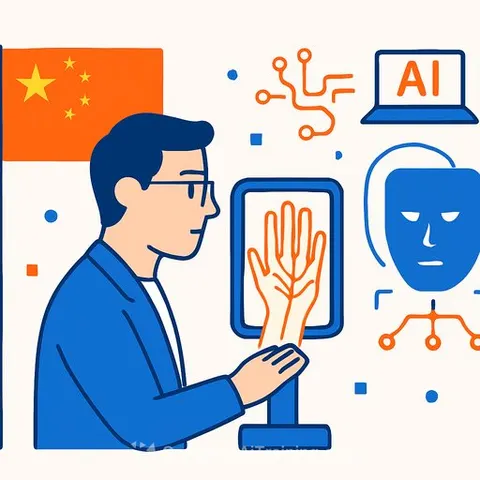
Vein recognition technology is emerging as a direct counter to AI-generated forgeries, with China's biometrics and trusted identity market projected to surpass 34 billion RMB in 2026. Privacy-focused biometrics-vein and palmprint recognition-are growing at 29.6 percent annually, far outpacing traditional facial recognition, as deepfake tools make external biometric features increasingly easy to spoof.
At a recent symposium on AI trusted identity authentication, Zheng Zhiming, an academician of the Chinese Academy of Sciences, addressed the shift. "As AI increasingly transitions from digital realms into physical spaces, three fundamental capabilities - trusted data, trusted identity and trusted computing - will support its healthy development," he said. "In this new era of physical intelligence, trusted identity is no longer just a 'premium add-on.' Instead, it serves as an essential trust infrastructure bridging data environments and physical environments. Without trusted identity, trusted data cannot exist, and trusted computing cannot be successfully implemented."
Huang Yi, chairman of the Digital Security Technology and Service Branch of the China Safety Industry Association, provided market figures. "The domestic biometrics and trusted identity market is projected to surpass 34 billion RMB in 2026, maintaining a stable compound annual growth rate of 18 percent. A massive structural shift is underway within this market: Privacy-focused biometrics (such as vein and palmprint recognition) are surging ahead with a 29.6 percent growth rate."
Why facial recognition is losing ground
Zhao Guodong, chief technology officer of biometric technology firm Saint Deem, said external biometric features face new threats. "External biometric features, such as facial profiles and voiceprints, are now facing systemic threats from advanced AI forgery and deepfake technologies. In contrast, vein recognition utilizes subcutaneous vein patterns inside the human body for liveness verification. This approach delivers distinct security advantages, including being impossible to replicate, exceptionally difficult to spoof, inherent liveness detection, and superior privacy protection."
The technical engine behind vein recognition
Vein recognition relies on two core capabilities that must work together: high-precision imaging technology and intelligent algorithms. As AI algorithms continue to improve, vein recognition is evolving from a standalone authentication method into a foundational piece of multimodal trusted identity platforms-a transition that holds direct relevance for professionals working in AI for IT & Development. Future identity authentication will no longer act simply as a login gateway. Instead, it will serve as essential identity infrastructure for AI agents, intelligent robots, smart vehicles, and other intelligent terminals.
Real-world rollout: transit payments and key-binding
Saint Deem is pioneering a trusted cryptographic key-binding technology powered by vein recognition. By integrating unique human vein patterns with cryptographic keys, the company has created a new security approach for digital asset ownership verification and intelligent terminal authorization. The technology is already live in multiple cities. Public transport groups in Wenzhou, Zhejiang province, and Chengde, Hebei province, have started promoting palm vein payment systems that let passengers pay for rides by waving a palm-an example of trusted identity infrastructure merging with public services, tracked closely by those in AI for Government.
Why this matters for IT, development, and government professionals
For IT and development teams, vein recognition's integration with cryptographic keys and multimodal platforms means authentication will soon be a core infrastructure layer, not a standalone feature. Understanding how to build and secure these systems will become critical as AI agents and smart terminals multiply. For government professionals, the technology offers a path to digital identity systems that avoid the weaknesses of facial recognition, providing a practical model for secure citizen services without privacy trade-offs. In both cases, the shift is already underway-not in a lab, but in real payment systems and identity networks.