
AI news ·
DeepMem architecture compresses sequences for efficient reasoning while preserving exact byte identity
DeepMem reduces reasoning FLOPs by 7,600× compared to full-resolution byte models while outperforming a matched Transformer on language modeling and multilingual benchmarks.
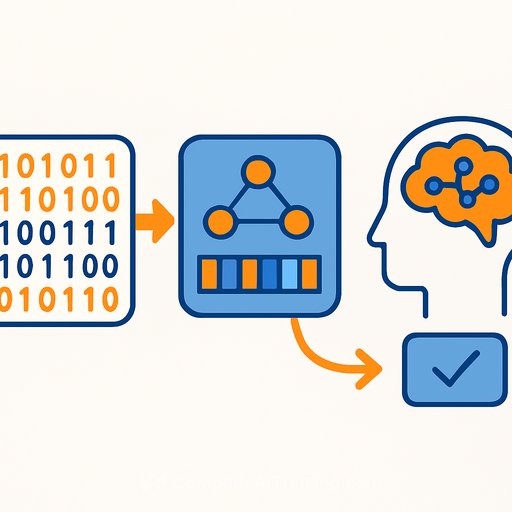
Researchers have introduced a new byte-level language model architecture called DeepMem that separates semantic compression from exact byte preservation, achieving stronger performance than a matched Transformer while dramatically reducing the computational cost of reasoning. The model uses invertible subband transforms and fast weight memory to compress sequences, preserving exact byte identity through lossless carriers and attention-based super-resolution decoding. Byte-level models avoid tokenizer dependence and provide universal coverage across languages and data types, but processing every byte at full resolution has been prohibitively expensive - a bottleneck DeepMem directly addresses.
How the architecture works
DeepMem constructs a hierarchy of shorter sequences using a learned invertible subband transform. A lossless carrier and explicit detail sidebands preserve byte identity throughout compression. Fast weight memory blocks operate along the encoder, with iterative shared state computation at the compressed bottleneck. An attention-based super-resolution decoder then restores byte-resolution representations.
The design allows the model to reason at a compressed level while retaining the ability to reconstruct exact bytes when needed. Bottleneck refinement requires roughly 7,600 times fewer counted FLOPs than equivalent full-resolution reasoning, according to the paper. Despite this efficiency gain, the model maintains competitive evaluation throughput.
Performance benchmarks
DeepMem achieved stronger language modeling performance than a matched byte-level Transformer on the FineWeb-Edu and PG19 datasets. It obtained the best macro average performance across the evaluated FLORES languages, a multilingual benchmark spanning numerous language pairs. The model also improved PIQA accuracy, a measure of physical commonsense reasoning.
Results remained competitive on code modeling tasks, multiple-choice reasoning benchmarks, and byte-level corruption robustness tests. The paper reports these gains without sacrificing the universal coverage that makes byte-level models attractive for production systems that must handle arbitrary text, code, and multilingual content without tokenizer artifacts.
Why byte-level matters
Most large language models rely on tokenizers that split text into subword units. Tokenizers introduce dependencies on specific vocabularies, struggle with misspellings and rare characters, and can behave unpredictably across languages. Byte-level models eliminate these problems by operating directly on raw bytes, but the computational cost of processing long byte sequences has limited their practical adoption.
DeepMem's compression approach suggests a path toward byte-level models that remain efficient enough for real-world deployment. The paper demonstrates that separating semantic processing from exact byte reconstruction allows the model to reason compactly while preserving the fidelity needed for byte-level tasks. Professionals working with multilingual systems or code generation may find this architecture particularly relevant, as it addresses fundamental tokenization challenges that affect model reliability across diverse inputs. For those building production AI systems, understanding architectures that reduce reasoning costs by orders of magnitude - as DeepMem does with its 7,600× FLOP reduction - can inform decisions about model selection and infrastructure planning. The techniques also connect to broader work in generative AI and LLM efficiency research.
Why this matters for developers and researchers
DeepMem's efficiency gains matter most for teams building systems that process multilingual text, code, or noisy user-generated content - exactly the scenarios where tokenizer-based models introduce subtle failures. The 7,600× reduction in bottleneck FLOPs means reasoning can happen at a fraction of the cost without losing byte-level precision. For software engineers evaluating model architectures, the paper provides a concrete benchmark: a byte-level model that outperforms a matched Transformer while using dramatically fewer compute resources for its core reasoning step. Researchers exploring efficient architectures can examine the invertible subband transform and fast weight memory design as building blocks for future work. The competitive code modeling results also suggest that byte-level approaches need not sacrifice performance on structured data.