
AI news ·
Educators report AI makes it harder to assess student understanding
53% of national educators struggle to assess student learning due to AI, a survey found. Meanwhile, 74% cited cheating as a top concern.
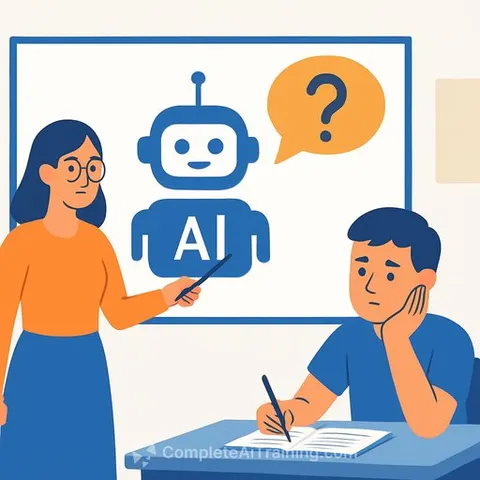
A new survey of K-12 educators suggests that while cheating with AI is a top concern, a deeper issue is emerging: how to assess student learning when a chatbot can produce polished academic work in seconds. The study, which included 303 school professionals in Wisconsin and 132 others across the country, found that 53% of national respondents cited difficulty in assessing student learning when AI is used as a worry. In Wisconsin, that figure was 47%.
Cheating and plagiarism are common worries
Academic dishonesty remains the most frequently cited concern. In the national sample, 74% of respondents identified it as an issue, compared with 65% in Wisconsin. Those numbers align with broader trends: an estimated 84% of high school students used generative AI for schoolwork in 2025, according to College Board.
But the survey also pointed to a more fundamental problem: finished work is becoming harder to interpret. A student might copy a friend's work or get too much help from a parent, but AI blurs those lines further. "Difficulty in assessing student learning when AI is used" was selected by nearly half of Wisconsin respondents and a majority nationally.
Assessing learning becomes harder
Generative AI makes a longstanding classroom challenge more visible. When a student submits a paragraph explaining the theme of a short story, the teacher once could see evidence of reading, thinking, and writing. Now, that same prompt can return a polished, accurate response that reveals nothing about the student's own understanding.
Some teachers are turning to AI-detection tools, but the research on their accuracy is sobering. One study of 14 detectors found false-positive rates as high as 50% and false-negative rates reaching 100%, depending on the tool. About 20% of AI-generated texts were misclassified as human-written, rising to 52% when the AI text was manually edited. Nonnative English writing was falsely flagged as AI-generated at an average rate of 61.3%.
The survey also revealed that 29% of Wisconsin respondents and 40% nationally reported increased student reliance on AI, while 19% and 33% respectively saw reduced critical thinking or problem-solving.
Rethinking assignments to see student thinking
Many teachers are already adjusting their practices. They ask students to show their process, include oral explanations, write more in class, or complete paper-and-pencil tasks when independent thinking needs to be visible. The goal is to design assignments where the learning outcome is clear and the evidence of that outcome is not easily faked by a chatbot.
Some schools are adopting the Artificial Intelligence Assessment Scale, a framework that helps teachers specify the permitted level of AI use for each assignment. A task that requires no AI because the teacher needs to assess independent writing is treated differently from one where students can use AI for brainstorming but must submit original notes and a final reflection.
Many educators seeking practical strategies for this shift are exploring resources on AI for Education to design assessments that go beyond AI-generated text. Clear policies remain rare: only 33% of Wisconsin respondents and 29% nationally said their district had a formal AI policy.
Why this matters for educators
The survey makes clear that educators are not simply rejecting AI. Many use it themselves for planning, communication, differentiation, and administrative tasks. Their concerns are more specific: they want to know what a student actually understands, and they need assessments that make that visible.
The practical challenge is to preserve meaningful evidence of learning when AI can produce polished academic work. That means auditing existing assignments to see if they truly measure the intended skill, and then designing tasks where the teacher can still answer the core question: "What does this student actually understand?" For teachers seeking structured guidance, an AI Learning Path for Teachers offers frameworks for integrating AI while maintaining that evidence of learning.
This article is republished from The Conversation under a Creative Commons license. Read the original article.