
AI news ·
EU and Canada forge 'alliance for the future' at Montreal summit
The EU and Canada launched a partnership on AI, critical raw materials, and energy security in a direct push to reduce reliance on the U.S. and China. EU imports of critical raw materials from Canada rose 62% between 2024 and 2025, and two-way trade in goods and services has grown 80% since 2016.
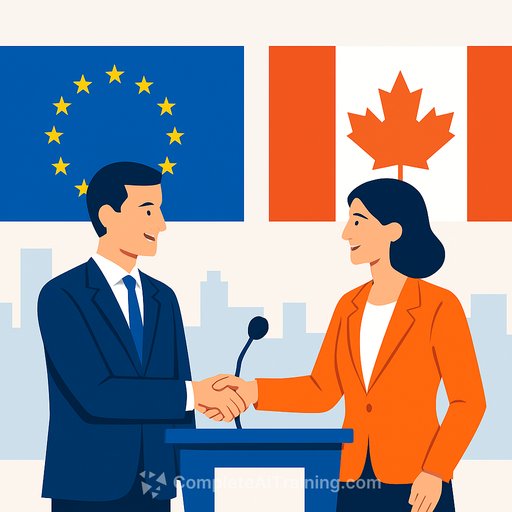
The European Union and Canada agreed Friday to build what European Council President António Costa called "the closest, deepest and most unique" partnership between the two blocs, launching joint projects in artificial intelligence, critical raw materials, and energy security. The pact marks a direct response to strained relations with the United States and aims to reduce dependence on both Washington and Beijing.
Speaking at the two-day Montreal summit, Costa said the "alliance for the future" would cover security and defense, growth and jobs, sustainable development, and interpersonal contacts. The initiative follows mounting geopolitical tensions and comes as U.S. President Donald Trump has threatened consequences should the rapprochement harm American interests.
Energy independence and critical minerals
The EU and Canada plan to work more closely on energy security, including a feasibility study on liquefied natural gas exports to Europe. A nuclear cooperation agreement between Canada and the European Atomic Energy Community will be modernized. The partners also want to ease European investment in Canadian raw material deposits, particularly rare earths used in electric vehicle motors, semiconductors, batteries, clean technology, and defense applications. EU imports of critical raw materials from Canada rose 62% between 2024 and 2025.
AI cooperation and digital trade
Both sides committed to closer coordination on artificial intelligence regulation and security. Canada will be integrated into the EU's high-performance computing infrastructure, and the partners will work to ease mutual access to digital markets, including cloud and AI services. A new digital trade agreement aims to reduce barriers for cross-border business. Two-way trade in goods and services grew 80% between 2016 and 2025, supported by the Comprehensive Economic and Trade Agreement, which has been provisionally applied since 2017.
For executives and policy professionals tracking AI governance developments, AI Public Policy Courses provide structured learning on the regulatory frameworks now being shaped by agreements like this one.
The "associate membership" dispute
European Commission President Ursula von der Leyen pushed the term "associate membership" to describe the new relationship, arguing it would be "an association without accession" that includes closer policy coordination and exchanges between parliaments and courts. She said she had discussed the proposal with Canadian Prime Minister Mark Carney and pointed to broad support among EU member states and the European Parliament.
German Chancellor Friedrich Merz rejected the term, saying it should have been discussed with member states before being used, partly because it already appears in Ukraine's EU accession process. The phrase was removed from the final summit declaration, though von der Leyen used it again at the closing news conference. "The idea of associate membership would be uncharted territory," she said, "but both sides had the ambition, trust and creativity to shape it together."
Security commitments and Ukraine support
The agreement includes expanded cooperation on defense, cyberdefense, and critical infrastructure protection. Both sides reaffirmed support for Ukraine. Canada already participates in an EU loan program for joint defense procurement and will contribute to the EU support loan for Ukraine. By the next summit in 2027, a formal concept for closer ties will be developed, without full membership.
Why this matters for executives and strategy leaders
The EU-Canada pact signals a structural shift in transatlantic supply chains and regulatory alignment. Companies dependent on rare earths, semiconductors, or AI infrastructure should assess how reduced reliance on China and the U.S. might reshape procurement options and compliance requirements over the next two years. The digital trade agreement and computing infrastructure integration will likely create new market access conditions for cloud and AI service providers operating in both jurisdictions. Professionals in government-adjacent roles can track these developments through AI for Government Courses that address the intersection of policy and emerging technology standards.