
AI news ·
Executives convert AI time savings into relationship capital
AI's main strategic value is freeing executive time for human relationships. A new framework tracks this Human Connection Dividend across three measurable components.
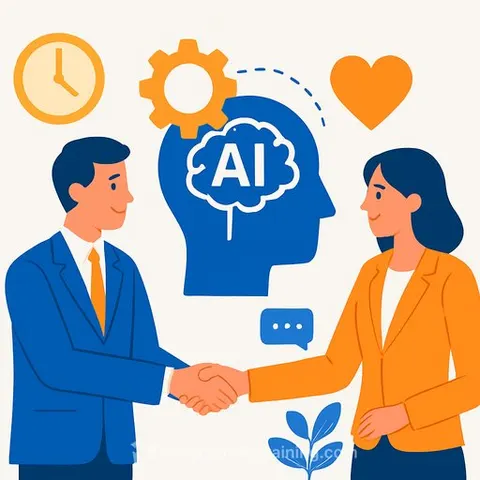
The most strategic impact of AI in the enterprise is not raw efficiency, but the time it unlocks for leaders to invest in human relationships. As AI automates administrative tasks, the executives who convert that reclaimed time into trust, coaching, and cultural cohesion will define the next decade of competitive advantage, according to an analysis published by CEOWORLD Magazine on July 28, 2026.
The publication calls this surplus the Human Connection Dividend (HCD)-the attention, presence, and relational capacity created when machines handle repetitive work. Most organizations still treat the dividend as a productivity bonus, using freed hours to clear inboxes or accelerate sales cycles. The true shift, CEOWORLD Magazine says, is captured in a simple question: "AI shouldn't just help us do more. It should help us lead better."
Across industries, executives report saving hours each week through AI tools that handle information processing, routine communication, and administrative tasks. The change is from an efficiency narrative-streamlining workflows and reducing costs-to a capacity narrative: expanding the time available for the work that moves people and organizations forward.
The Human Connection Dividend framework
The HCD has three measurable components:
- Time Reclaimed: hours freed by AI from administrative, repetitive, or low-value tasks
- Time Reinvested: the proportion of those hours consciously dedicated to relationships and culture
- Trust Created: the observable impact on engagement, psychological safety, and team performance
Executives can track HCD by measuring how much AI-reclaimed time goes into one-on-ones, coaching conversations, developmental feedback, and meaningful dialogue-rather than more email, reporting, or firefighting. CEOWORLD Magazine notes that AI adoption without a positive HCD is a missed strategic opportunity. As the emerging discipline of AI for Executives & Strategy shows, the focus is shifting from automation alone to the human capacity AI can unlock.
Relational Strategy as competitive infrastructure
CEOWORLD Magazine introduces Relational Strategy as a concept that puts relationships-between leaders and teams, companies and customers, firms and regulators-at the center of competitive advantage in an AI-shaped world. The core question is: how deliberately is your leadership using AI-created time to deepen human connection, not just accelerate output?
This reorientation treats human connection as hard infrastructure, on par with data platforms and cloud architecture. For chief executives, the AI Learning Path for CEOs offers a structured approach to converting AI-driven time savings into strategic relationship capital. Without that shift, the reclaimed hours risk being absorbed by the same digital noise that AI was meant to reduce.
Measuring readiness: The Human Connection Readiness Index
To help executives assess their position, CEOWORLD Magazine proposes the Human Connection Readiness Index (HCRI), a lens for evaluating how prepared an organization is to convert AI investments into relational capital. The HCRI examines:
- Leadership time allocation between tasks and relationships
- Frequency and depth of meaningful conversations
- Strength of cultural rituals and shared stories
- Levels of psychological safety and trust in teams
Organizations with high HCRI scores are more likely to use AI-driven capacity to build engagement, innovation, and retention. Those with low scores risk amplifying emotional disconnect, burnout, and shallow collaboration, even as their technical systems improve.
Risks: Soft skills recession and over-reliance
One quiet risk of AI adoption is a "soft skills recession." As machines take on more conversational and information roles, human capabilities such as empathy, influence, and conflict resolution can atrophy if not deliberately exercised. At the very moment these skills become more valuable, organizations risk investing least in them.
Over-reliance on AI for complex judgment calls can weaken critical thinking and ethical clarity. CEOWORLD Magazine warns that constant digital noise, shallow communication, and the pressure to "keep up with AI" can leave teams fatigued and disengaged. The lesson is clear: AI will not fix culture. Humans will.
Why this matters for Executives and Strategy
The time reclaimed by AI is not a marginal gain-it is strategic capital. Leaders who treat it as such will ask one question of every AI initiative: "What human connection will this technology enable?" They will track the Human Connection Dividend, measure readiness through the HCRI, and redirect AI-driven hours into coaching, listening, and presence. As CEOWORLD Magazine notes, "the future will not be won by the smartest systems, but by the most human leaders." The organizations that win will be those that treat human connection not as a soft add-on, but as the core infrastructure that turns AI from a technical upgrade into a source of competitive resilience and enterprise value.