
AI news ·
Fast Work, Slow Work: How Leaders Can Harness AI to Unlock Human Creativity and Strategic Impact
AI transforms work by automating routine tasks and enhancing human creativity. Leaders must balance fast automation with slow, strategic thinking to unlock true potential.
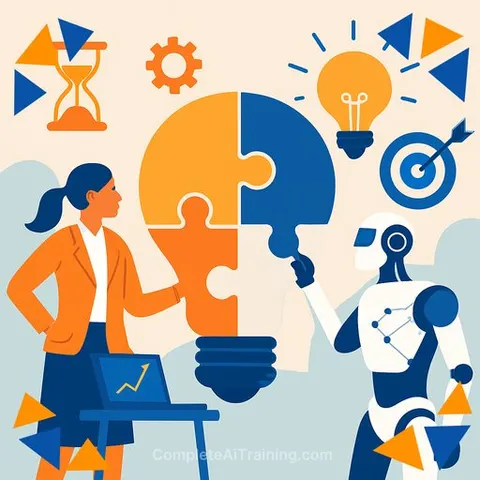
Fast Work vs. Slow Work: How Leaders Can Leverage AI to Maximize Human Potential
We’re in a new phase of work. Artificial intelligence has shifted from a productivity aid to a tool that enhances reflection and creativity. Leaders now face a critical question: How do we guide teams through changes that affect both the quick, routine tasks and the deep, strategic thinking?
Past innovations—from the steam engine to the internet—focused on speed and efficiency. AI changes the game by boosting both rapid “fast work” and thoughtful “slow work,” reshaping how we define productivity.
Industry leaders are already signaling this shift. Meta’s CEO, Mark Zuckerberg, predicts AI will handle tasks once reserved for mid-level engineers by 2025. Salesforce’s CEO, Marc Benioff, plans no new hires in software engineering because AI has made his existing team far more efficient. AI is evolving at a pace and depth unseen before, with models improving weekly and delivering impressive results. If your strategies don’t keep up, your organization risks falling behind.
Finding Opportunity Amid the Acceleration
As AI surpasses humans in traditional knowledge work, the key question is: Where does human value remain? AI handles routine, fast tasks exceptionally well and frees mental capacity for deeper work. This shift allows organizations to create new value, not just capture existing efficiency.
Human strengths—reflection, empathy, and imagination—remain unmatched. Leaders stand at a crossroads where people and possibilities meet. Meeting this moment requires empathy, humility, and curiosity. Let AI take over routine work and let humans focus on creativity and strategy. This approach doesn’t just boost efficiency; it opens doors to new ideas, sharper questions, and more meaningful work.
Augmented Productivity: Where Humans Add Value
Take drafting an IPO prospectus. It once took six bankers two weeks; now AI does 95% of it in minutes, saving significant costs. But the last 5%—the strategic, nuanced part—still needs human judgment. This highlights the divide between fast work (automatable tasks) and slow work (strategic, complex endeavors).
Goldman Sachs CEO David Solomon calls this a productivity transformation. It’s about giving smart people tools that let them do more, faster, and differently. The goal is to amplify humans, not replace them.
An effective approach, called augmented human productivity (AHP), breaks work into four types:
- Automatable work: routine or data-heavy tasks.
- Augmentable work: tasks where AI improves quality but humans oversee.
- AI-accelerated work: tasks enhanced by AI.
- Intrinsically human work: complex judgment, empathy, and creativity.
As AI advances, these categories will shift. Roles once thought purely human may include automated parts, while new augmentable tasks will appear. Leaders must constantly ask, “Can we automate this?” and more importantly, “Should we automate this?” Freeing people from mechanical work lets them focus on thoughtful, impactful contributions.
Evolve Constantly; Avoid a Fixed AI Playbook
Saying “AI does 95%, humans do 5%” is easy; deciding exactly what to automate and who remains accountable is complex. Each company will draw these lines differently based on culture, compliance, and strategy.
For example, consultancies may limit automation in client interactions, while cost-driven businesses automate widely. Some tasks might be easy to automate but too risky without human checks. Speed without trust and empathy risks damaging customer relationships.
Leaders must dissect roles and workflows carefully, aligning automation with ethical and strategic priorities. Success depends on ongoing decisions, not a one-time plan.
AI now offers expertise comparable to top specialists—from medical diagnostics to software engineering. But true impact comes when AI and humans collaborate. A recent study in JAMA Network found that AI alone outperformed physicians using AI tools, partly because humans sometimes ignored helpful AI suggestions.
This shows that simply layering AI on old workflows won’t work. Organizations must redesign roles and mindsets to foster effective human-AI partnerships. The biggest obstacle is not AI’s ability but a lack of openness and humility to rethink work.
Leaders should shift focus from cost-cutting to asking, “What can we achieve with near-expert AI at our side?” This requires experimentation, tolerance for failure, and breaking free from old habits. Investing in upskilling is key—teaching people how to craft prompts, interpret AI output, and exercise ethical judgment.
When aligned, AI amplifies uniquely human strengths: empathy, ethical reasoning, and vision. Offloading routine tasks frees minds for creative and intuitive challenges—this is the heart of augmented intelligence.
Culture shapes AI’s success. Fear breeds resistance, while embracing AI as a partner sparks innovation and growth. Leaders who combine data-driven rigor with entrepreneurial courage will unlock human potential in new ways.
Differentiation Demands Bold Creativity
AI capabilities advance so fast that yesterday’s stretch goals soon become baseline. The challenge shifts from “Can AI do this?” to “What should we create?” Imagination—not processing power—becomes the bottleneck.
Your edge depends on AI agility: the ability to adapt and innovate as new breakthroughs emerge.
Most start with quick wins like automating reports or cutting costs. These are necessary but not enough. True differentiation requires bold creativity—new products, experiences, and business models enabled only by advanced AI.
Stop tracking only efficiency gains. Measure how many bold ideas move from concept to reality through AI’s capabilities. You can’t just add AI to old thinking and systems. A culture that values iterative improvements and imaginative leaps—balanced with ethical guardrails—will thrive.
The AI Agility Framework centers on three elements driving human-centered value:
- Prompt design: People need fluency in crafting prompts and refining AI outputs into market-ready solutions, shifting focus from efficiency to creativity at scale.
- Human + AI partnerships: Combining empathy and judgment with AI’s analysis yields ethical innovation that builds trust and lasting advantage.
- Cultivating human skills: Critical thinking, adaptability, and collaboration keep teams ready as AI evolves, ensuring a future-ready organization.
The greatest risk isn’t AI falling short; it’s human imagination failing to keep up. Organizations that align human skills with AI capabilities will move beyond automation to transformative breakthroughs. Leaders must champion curiosity and responsible exploration to guide their companies into a future where intelligence is abundant, but imagination leads.
A Future Built on Human Potential
Thriving organizations put people first—using AI to remove tedious tasks while nurturing curiosity, empathy, and strategic thinking. Combining fast work automation with slow work augmentation creates not only efficiency but resilience and creativity.
As a leader, your mission is to ensure machine efficiency never overshadows what makes us human. Leading this change turns AI from a tool into a lasting advantage for your people and organization. The future belongs to those who imagine new, inspiring ways to use AI.
A People-First Road Map: 5 Steps for Maximum AI Impact
Ready to develop human potential in an AI-rich world? Start here.
- Map Your Workflows. Identify what should be automated and what requires human insight. Free your team from mundane tasks and highlight where their judgment matters most.
- Redesign Roles for Augmented Intelligence. Break roles into automatable, augmentable, and intrinsically human tasks. This clarifies where AI leads, where partnerships thrive, and where human oversight is essential. Use this to guide ongoing upskilling.
- Cultivate Imagination. With AI handling the routine, continuous reinvention becomes your advantage. Encourage creative exploration and balance cautious optimization with bold experiments.
- Prioritize Responsible AI. Accelerate AI adoption while ensuring fairness and transparency. Implement bias checkpoints, clear data governance, and ensure AI supports human judgment.
- Invest in AI Agility at Every Level. Extend human-AI collaboration beyond tech teams. Provide continuous learning so all employees can effectively work with AI. Combine lightweight governance with strong ethics—move fast without breaking trust.
For executives looking to build AI fluency and leadership skills, exploring targeted AI courses can provide practical frameworks and tools to lead this transformation effectively. Consider visiting Complete AI Training for resources tailored to strategic leaders.