
AI news ·
FCC clears SpaceX to launch up to 1 million Starmind satellites for orbital AI data centers by 2040
The FCC authorized SpaceX to deploy up to 1 million satellites for orbital AI data centers. The Starmind constellation has a 2040 deadline and could shift the economics of large-scale model training.
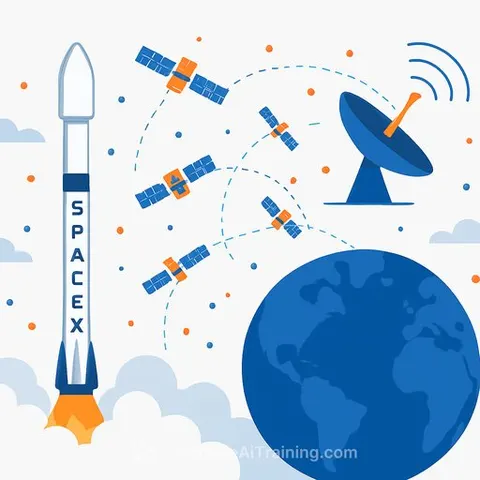
The Federal Communications Commission has authorized SpaceX to deploy up to 1 million satellites for orbital data centers, according to Reuters. The Starmind constellation of orbital compute modules aims to meet part of the surging demand for AI computing power on Earth - a move that could reshape how the industry thinks about infrastructure costs and energy constraints.
The FCC also approved radio links that let SpaceX monitor and control the satellites if their optical connections fail. The authorization sets a 2040 deadline for the full deployment.
What the Starmind constellation actually is
Starmind satellites are not traditional communications spacecraft. Each module functions as an orbital compute node designed to process AI workloads in space. SpaceX has framed the project as a direct response to the bottleneck in terrestrial data center capacity. Power grid limitations, land costs, and cooling requirements have made it harder to build large-scale AI compute facilities on the ground.
Moving computation to orbit sidesteps some of those physical constraints. Solar power is abundant in space, and the vacuum environment simplifies thermal management for the high-density hardware that modern AI training and inference require.
Scale and regulatory context
One million satellites represents a dramatic increase over anything currently in orbit. For comparison, SpaceX's Starlink broadband constellation is authorized for roughly 12,000 satellites, with the company seeking approval for up to 42,000. The Starmind authorization dwarfs both figures.
The FCC's approval includes spectrum allocations for the optical and radio links that connect the satellites to each other and to ground stations. The backup radio links were a specific condition of the authorization, ensuring SpaceX can maintain control of the satellites even if the primary laser-based connections degrade.
Why this matters for executives and strategy leaders
If SpaceX executes on even a fraction of this plan, the economics of AI compute could shift. Organizations that rely on large-scale model training or real-time inference may see new options for accessing capacity outside traditional cloud providers. The 2040 timeline gives the industry a decade and a half to prepare, but the strategic implications will surface much sooner - particularly around energy strategy, latency requirements, and vendor lock-in with terrestrial data center operators.
IT and operations leaders should watch how this affects the cost curves for compute-intensive workloads. Real estate and construction executives with exposure to data center development need to factor orbital competition into long-term demand models, even if the full impact remains years away. For government and regulatory professionals, the Starmind authorization signals that spectrum and orbital slot allocation for non-communications satellites is accelerating.