
AI news ·
Freelance journalists train AI models to make ends meet
AI firms pay journalists to train language models. After six months, these workers fear the tools they build could replace them.
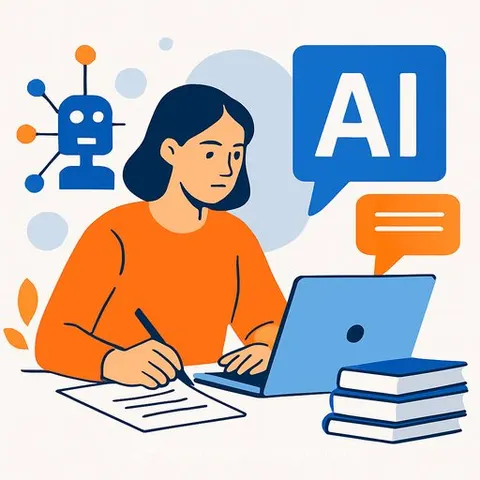
AI companies are hiring freelance journalists to train their language models, paying them to judge clarity, accuracy, and natural flow-skills that reporters use daily. The work offers financial stability in a shrinking freelance market, but it forces writers to confront an uncomfortable irony: they are helping build tools that could eliminate the jobs they trained for.
How journalists train AI models
Job descriptions for AI training roles often ask contributors to ensure the "accuracy, clarity, and natural flow" of chatbot responses. Others seek applicants with professional writing experience, such as journalists and editors, to write original content that improves model performance. The skills journalists used daily-judging clarity, accuracy, and natural flow-are the same capabilities that many AI for Writers tools seek to augment.
Darius Osborne did everything right to launch a journalism career: university newspaper, newsroom internships, and scholarships at Howard University. After graduating, he could not land an entry-level staff role. The best job he found was as a data labelling analyst for Meta, reviewing AI-generated videos and labelling whether they met quality standards. "I feel like I'm not using journalism skills at all," Osborne said. "It's a job, like everybody else has to have, to be able to support themselves." The steady income allowed him to continue freelancing on the side.
Khaleda Khan spent months searching for media work in Canada after graduating in late 2024 before joining xAI as a trainer for the chatbot Grok. Her daily tasks included correcting transcription data across global accents, training the model to understand languages beyond English, and refining outputs by identifying unnatural phrasing. "There were a lot of transferable journalism skills that I was really able to use in my everyday duties and I was surprised because the person who hired me also had a reporting background," she said. "There were not really as many people in tech as there were people in the humanities. There were a lot of writers there."
In Germany, freelance journalist Bettina Blass worked for a startup building an AI editing tool that turns press releases and police alerts into news articles. Blass wrote the rules and prompts for the AI model, a core task of Prompt Engineering. "Journalism is always written in the form of an inverted pyramid. As a journalist, you know that, but the AI tool does not, so you have to teach the tool to understand these things," she said.
Bisma Farooq, a freelance journalist in India, took a data annotation role with Invisible Technologies after a friend recommended it as a way to supplement her income. The work-image anonymization, language detection, and flagging incorrect language-felt technical and distant from journalism. "Once I entered this, I had an existential crisis: What am I doing? What is this?," she said. "It felt like I was talking to robots, and I thought, this is not my field, so why am I here?" The job was commission-based, and the grind of competing for tasks left her exhausted. She eventually stopped working for the service.
Pay varied widely. Khan and Osborne said the tech salaries were more lucrative than journalism. Blass and Farooq earned less than they did for freelance reporting. "Journalism does not pay the same way. You are supposed to know the intrinsic value of what you do, and that is something you have to reassure yourself of, instead of seeing it reflected in your pay rate," Khan said.
Will AI systems replace the journalists who train them?
Osborne often thinks he is training his replacement, but he made a pragmatic trade-off between ethical concerns and the need for financial stability. "As a journalist, I do have some problems with AI," he said. "I also know we are moving into a different job market, and if I find myself stuck again and need a job, I now have experience in AI that can help me support myself." His daily work also convinced him that AI is still far from matching human journalism. "If this whole thing were a vehicle, AI would be the car and humans would be the gas," Osborne said. "I do think it's scary to imagine getting to a point where AI could be self-replicating, but I can see how far away we still are from that."
When xAI did not renew Khan's contract after six months, she realized how quickly AI was reshaping the industry. "While I was working there, I was thinking, 'Am I helping make something that will replace me?' I still wonder about this," she said. "I didn't know I was going to be a freelancer competing with this. I didn't know it was going to happen so quickly."
Blass argued that journalists should adapt rather than resist. "AI won't go back in the bottle so, as a writing journalist, it makes much more sense to learn now at the beginning of AI, how badly it will reach us," she said. "I see it's no magic. Without humans who are working with it and who are training the tools, AI wouldn't exist."
Defining the human touch
After working closely with AI, the journalists I spoke to agreed that the technology cannot fully replicate the creativity, judgment, and human perspective central to journalism. "After going through this AI training, I feel that the human touch-the real emotions and real feelings of a real journalist-will never be replaced by a machine," Farooq said.
Khan and Blass both saw AI as well suited to routine tasks such as sports scores or press releases, which could free human reporters for higher-impact work. "Journalism is already in this weird transitional phase, where not many people are reading, but people do want content, and journalism is not the same as content," Khan said. "It is going to revolutionise how we use AI for audiences, not just how we use it in journalistic practice itself and, as a result, we may need to bridge the engineering and editorial mindsets."
Why this matters for writers
For writers, these stories highlight a dual reality: AI training jobs can offer a financial lifeline, yet they also demand skills that make one complicit in automating editorial work. The journalists who trained models emerged with a clearer sense that human judgment remains indispensable, even as they learned to write the prompts and rules that make AI function. Writers who understand prompt engineering and can evaluate AI outputs critically will be better positioned to navigate an industry where the human element still defines quality. The value lies not in resisting the technology but in shaping it with the editorial standards that only a trained writer can bring.