
AI news ·
FutureLink signs deal to bring 200 Pony.ai robotaxis to Korea
Pony.ai will deploy 200 robotaxis in South Korea through FutureLink, starting with 10 units for certification before expanding citywide by 2028. Component costs dropped 70% versus the prior generation, and the company has logged over 110 million km of autonomous driving across four Chinese cities.
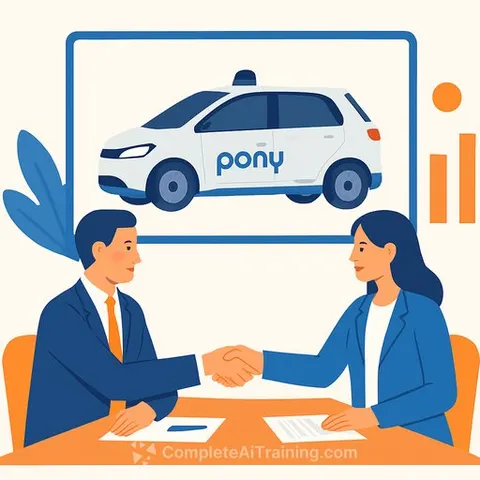
Korean roads will see 200 robotaxis from Chinese autonomous driving company Pony.ai, with KOSDAQ-listed PonyLink's subsidiary FutureLink handling certification and service operations.
The vehicles, built on BAIC platforms and fitted with Pony.ai's seventh-generation autonomous driving technology, will launch in Seoul pilot zones before expanding citywide by 2028 and then to other cities. FutureLink will first bring in 10 units, complete certification with the Ministry of Land, Infrastructure and Transport, then add 190 more.
Pony.ai competes with Google's Waymo, Tesla, and Baidu globally. It has logged more than 110 million km of autonomous driving and operates commercial Level 4 robotaxis - a stage allowing driverless operation - in four Chinese cities including Beijing and Shanghai. The company plans to expand its fleet to 4,000 vehicles by year-end, focused on Europe and the Middle East.
A platform built for autonomous driving from the start
The seventh-generation robotaxi differs from retrofit approaches. BAIC designed the platform with autonomous driving in mind, applying redundant architectures for braking, steering, and power during mass production. If a sensor fails during driverless operation, other sensors can bring the vehicle to a stop.
Pony.ai said component costs dropped 70% compared to the previous generation, giving it a price advantage over retrofitted vehicles.
FutureLink and Pony.ai's relationship goes back two years. FutureLink loaded Pony.ai's sixth-generation technology onto a Hyundai Kona and logged more than 80,000 km around the Gangnam district.
"There were no accidents while driving this distance in Gangnam, which has high congestion and many construction zones and two-wheelers," said FutureLink CEO Cha Doo-won. "We gained confidence that we can commercialize the service if we bring in high-quality autonomous driving vehicles."
The two companies plan to establish a joint venture after completing certification procedures. Investment size, revenue distribution, and equity structure haven't been decided. "We will set up a corporation in line with the scale at which the business proceeds domestically," a FutureLink official said.
Concerns about Chinese technology entering Korea
Industry warnings about Chinese autonomous driving technology encroaching on Korea's mobility sector have surfaced as the domestic industry struggles to cross the commercialization threshold. Baidu is also pushing to establish a joint venture with a domestic company. KG Mobility recently signed a strategic investment agreement with Chery Automobile covering PHEV drive systems and software-defined vehicle technology.
FutureLink pushed back against these concerns. "Working with companies that have finished technology to build the market and strengthen capabilities is one path of open innovation," Cha said. "Starting from scratch is important, but to create a business model and generate revenue, you need a verified partner."
Nam Gyeong-pil, chairman of PonyLink and Futurelink, offered a historical analogy: "If Apple had not entered Korea, would Samsung have developed as it has? What matters is gaining competitiveness through competition."
There are also data sovereignty concerns - whether robotaxis based on foreign technology could push Korean data abroad. Pony.ai CEO James Peng said: "We make it a principle to store data produced overseas only in that country. Not only driving habit data but also all people and license plates captured by the vehicle are mosaicked before storage."
Why this matters for operations managers
The certification, service operation, and joint venture setup will take time, but the testing blueprint is what operations functions should study. FutureLink validated sixth-generation technology by running a Kona 80,000 km in a dense urban district - the kind of staged operational pilot that scales before a full city rollout.
Operations teams facing any AI deployment with fleet, logistics, or autonomous components can apply the same sequence: validate in a controlled urban environment, collect data at scale, then expand using proven technology. For a practical guide to modern autonomous system management, see AI for Operations Managers. You can find additional deployment patterns and workflow optimization strategies in AI for Operations.